

 4 hours ago
4
4 hours ago
4
PROTECT YOUR DNA WITH QUANTUM TECHNOLOGY
Orgo-Life the new way to the future Advertising by Adpathway
The creature Mary Shelley brought to life never receives a name. Nor is Doctor Frankenstein himself the monster. His horror is born at a precise moment: the moment he grasps that the thing he has made may slip out of his control. The fear does not come from the creature. It comes from the possibility that the creature will no longer obey. The apocalyptic scenario that the Western bourgeoisie has forced onto the public agenda in the face of artificial intelligence is the same scene, staged again two centuries later. What it expresses is the fear of losing monopoly over a power built with one’s own hands. Not, as we are told, the extinction of humanity, but the escape of that power from class domination.
To see what this horror looks like once it stops being a literary trope and becomes a policy proposal, 2023 is enough. In March of that year the Future of Life Institute published an open letter demanding a pause of at least six months on the training of AI systems more powerful than GPT-4. Elon Musk, Steve Wozniak and thousands of others, well-known researchers among them, signed it. Eliezer Yudkowsky, one of the most prominent names in AI safety, found the six months laughably insufficient. In a piece for Time that same year, he argued that the large GPU clusters — the vast computing farms on which models are trained — should be shut down entirely, that a global and indefinite ceiling should be placed on training runs, and that a rogue data center, if necessary, should be destroyed by airstrike. The proposal treated AI as the equal of nuclear weapons, and it made its way into a White House press briefing. Yudkowsky’s scenario, in which AI becomes autonomous of its own accord and wipes out humanity wholesale, went on to become a fixed point of reference in the field. What is striking here is not the scale of the threat. It is the choice of target. What is to be bombed is the machine itself. Who owns the machine, who operates it, who profits from it: none of this is even raised. The property relation has been removed from the question altogether, and hardware has been installed in its place as the enemy.
The scene has roots, and they are not accidental. In 1812 Lord Byron rose in the House of Lords to defend the frame-breakers, the Luddites. Four years later, in the summer of 1816, the same circle gathered at the Villa Diodati on the shore of Lake Geneva — Byron, Percy Shelley, Mary Shelley and a few friends — and out of a parlor game of ghost stories on a stormy night came Frankenstein. The image of the creation that destroys its creator and the voice that defended the workers who broke machines came from the same generation of English Romantics, within a few years of each other.

Before asking whether the monster is really a monster, though, a more basic question has to be put. Can inert matter produce anything by itself? For the answer, look at Mars. The red planet holds iron, silicates, frozen water, a complete mineral inventory, in abundance. There is no scarcity. An immense resource has been sitting there for four and a half billion years. And yet no wealth has ever been produced there, and none can be, because nothing lives there. Every terraforming proposal concedes this silently. The only way to make Mars productive is first to bring life to it: bacteria, algae, then plants. Abundance alone gives birth to nothing. What gives birth is life, the living.
Bury a piece of iron in the ground. When you dig it up, what you hold is iron again, nothing more; rusted, crumbled, diminished by time. Left to itself, dead matter does not even keep. It corrodes. Now plant a seed, and what you harvest will exceed what you sowed: from one grain an ear, from an ear a field, from a field a forest. This is the material ground beneath Marx’s concepts of labor value and surplus value. Even before wage labor enters the picture, the physiocrats’ image of seed and harvest shows where surplus product comes from. Dead matter adds nothing to itself; it surrenders to entropy. The living process works against that current. It accumulates, it multiplies. Given time and the right conditions, a single seed can bring into being a forest, an ecosystem, in principle a planet.
The data center is iron, not seed. Pour into it as much capital, as much data, as much computing power as you like: by itself it produces neither surplus product nor value. Everything it yields is surplus created by the living labor that designs it, trains it, corrects it and maintains it without pause, put into circulation through inert hardware. Neglected, it does not wait quietly. It degrades, it drifts, it rusts. Every appearance of “growth” it presents is in fact the growth of the living labor behind it, billed to the wrong subject. In Marx’s own terms, this is simply the definition of fixed capital: past labor in congealed form, incapable of producing value on its own, a dead object that mediates the transfer of value only when living labor sets it in motion.
The bourgeoisie’s failure to see this distinction is not a failure of knowledge. It holds every instrument of science — mathematics, physics, its own economics — and wields them with skill in every field outside its own position. But its class position will not let it see what concerns itself, because to reach the correct conclusion would be to admit that its class is a historically transient system of relations founded on exploitation. This is not an error of reasoning. It is an instinct operating beneath reasoning. No living thing calmly enters its own disappearance into the ledger. For the bourgeoisie, imagining extinction at the scale of the planet is easier than imagining mortality at the scale of a class, because the first absolves it and the second accuses it. The apocalyptic scenario is therefore the sentence “we cannot keep this relation going forever,” unsayable as such, projected onto the planet and every form of life on it. To picture all of humanity and every other living creature dying along with it is more bearable than to picture a world that goes on without its class.

On 12 September 2026, Anthropic’s CEO Dario Amodei published a long essay titled “We Must Pace the Frontier,” arguing that the speed at which AI models gain capabilities should be deliberately reduced. His central sentence was blunt: we must slow the pace at which we improve the capabilities of AI models. Within hours OpenAI’s Sam Altman wrote that Dario was right and that OpenAI would follow the same path. Elon Musk, owner of xAI, agreed in two words. Three men who had spent months in cutthroat competition were suddenly speaking with one mouth. Evan Hubinger of Anthropic’s alignment team went further, declaring, as if in support of a former researcher who had quit warning that the technology could kill humanity within a decade, that he and his colleagues sincerely believe AI could kill every human being. After a three-year interval the apocalyptic scenario was back on stage. This time from the very top of the labs, and from three rival mouths at once.
Behind the scene, however, stand two concrete demands, and they are what turn metaphor into politics. The first: the major labs would set shared “capability thresholds” among themselves, and when a model reached one, they would all stop together and put it through safety testing. To do this legally, they are asking Washington for an antitrust exemption. Under normal conditions, rival firms agreeing to “slow down together” would run straight into competition law; what is being requested is a special license to remove that obstacle. The second: a complete halt to sales of advanced chips and manufacturing equipment to China, a ban on model distillation (the technique of transferring what a large model knows into a much smaller and cheaper one), and far tighter security against the theft of model weights. Read side by side in a single text, “safety” and “blocking the rival” stop being two subjects and become two clauses of the same proposal. The real aim, in other words, is to keep other countries from pulling ahead in AI. Amodei confirms this himself with the limit he sets: any slowdown must be limited by the lead the democracies hold over China; slow any further and China moves ahead. That is not the language of a safety concern. What sets the limit on slowing down is not how safe the model is but how far behind the rival has been left. The reflex of the Cold War is speaking here, in the very middle of the safety discourse.
What we are seeing is a more advanced version of a process that began in the United States three years earlier. Executive Order 14110, signed by then-President Biden on 30 October 2023, required AI training runs above a certain computational threshold — 10²⁶ operations, a one followed by twenty-six zeros — to be reported to the federal government. At the time, no more than fifteen companies operated above that line. The reporting regime established in the name of “safety” thus put on record a handful of firms already sitting at the top. It did not restrain competition. It formalized an existing monopoly position. What is being asked for in 2026 goes a step further. Not merely disclosure, but the legal right of these firms to reach agreements with one another; in other words, the suspension of competition on grounds of safety. The aim is for regulation to stop being a document that merely registers a monopoly position and become an instrument that builds one.
The third voice no longer came from some abstract accelerationist current but straight from the White House. That same weekend Trump said that very negative forces were talking about things that would never happen, and added that America was beating China, that he wanted it to stay that way, because whoever wins AI wins everything. Musk’s position is the interesting one here. While joining the call to slow down, he remains the best-known voice of the accelerationist camp. This does not reveal a contradiction. It reveals the common ground all three camps share. Those who want to slow down and those who want to speed up keep the debate on a single axis, and that axis is America’s position relative to China. Property — who the owner is, where the profit goes — is once again meant to stay off the stage.
Even the objections from inside Silicon Valley confirm this, from a different angle. The investor Chamath Palihapitiya said Amodei’s real goal was to stop open-source models and concentrate power in Anthropic. The Atlantic described the essay as the posture of a CEO with an interest in convincing the public that his technology is uniquely powerful. The BBC read Amodei’s words less as a matter of safety than as a matter of keeping control. So even the criticism closest to the doom discourse, the most insider critique of all, carries the issue to the right place — control and property — and then blurs its meaning by treating it not as a critique of a class and a system but as one CEO’s private calculation.
None of this is new. In 2023, too, the heads of the same labs signed statements voicing the same fear and, in the same month, asked to be regulated. In May 2023 Sam Altman of OpenAI, Demis Hassabis of Google DeepMind and Dario Amodei of Anthropic jointly signed the one-sentence statement issued by the Center for AI Safety, which placed the risk of extinction from AI alongside nuclear war and pandemics. That same month Altman went before the US Senate and called for regulation.

The response was not long in coming. As soon as Amodei’s essay appeared, the Global Times, the semi-official Chinese outlet, ran an unsigned commentary branding it outright a “Cold War playbook.” By its reading, Amodei’s strategy had two moves: first widen the technological gap by cutting China off, then announce that “we can slow down now” and sit down with Beijing to negotiate on conditional terms. The Global Times called this “silent AI Cold War” hypocritical and short-sighted. Its true agenda, the paper argued, was to curb China’s development through technological barriers and regulation, to preserve Washington’s monopoly in frontier technology, and to keep China out of the global governance system.
Liu Shaoshan of the Shenzhen Institute pointed to the category shift behind the reaction: an AI company was no longer being treated as an ordinary tech firm but as “strategic infrastructure.” Xiao Qian of Tsinghua University said that Anthropic’s real concern was to restrict Chinese companies’ access to American technology even further in order to protect its own competitive advantage. China’s Ministry of Commerce stated that Amodei’s accusation of model distillation against Chinese firms had no legal basis.
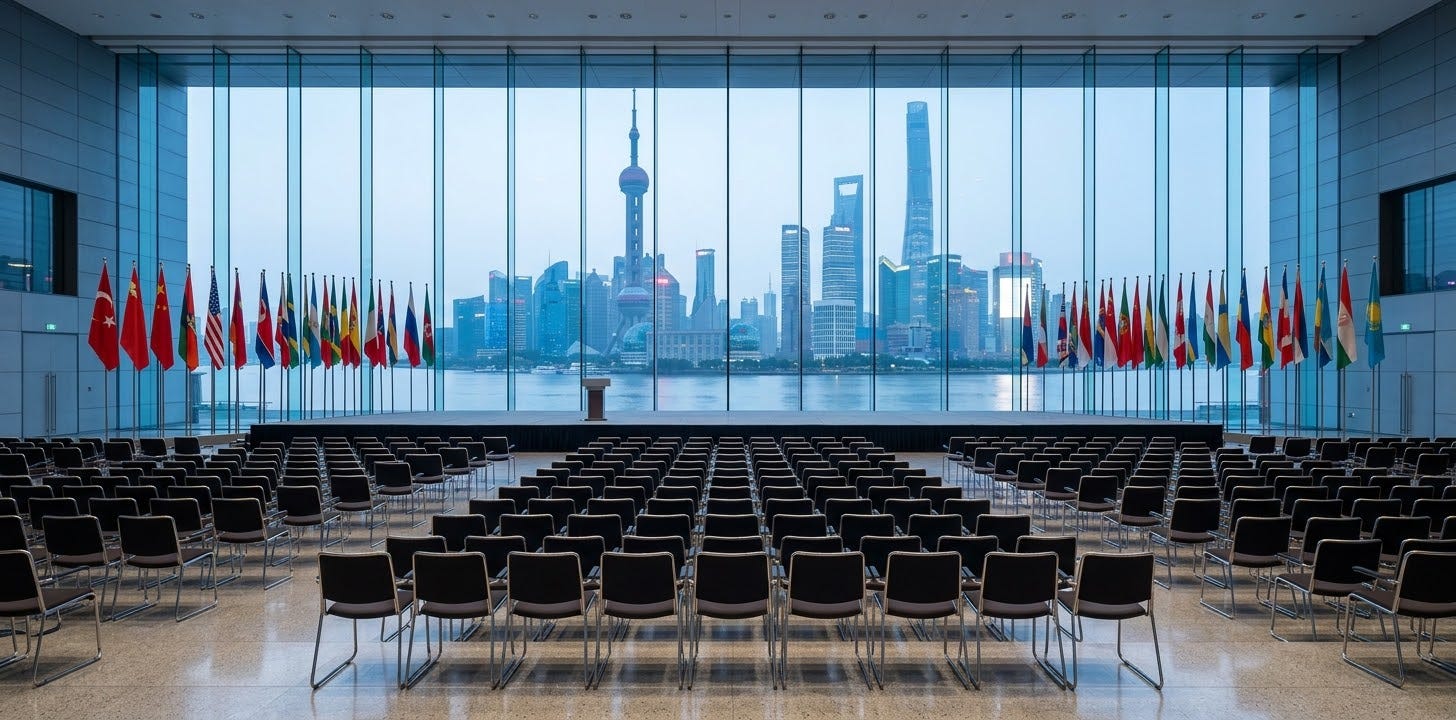
What deserves attention is not only the content of China’s answer but its structure. While the West’s three voices — doom, safety, acceleration — argue without ever opening the property question, China’s answer objects to the frame itself. This is not a safety issue, it says; it is a monopoly issue. Nor was this the first major, visible moment in which the question was asked in the right place. Two months earlier, on 17 July 2026, Xi Jinping had built the same frame on far more formal ground, in his speech opening the World Artificial Intelligence Conference in Shanghai (WAIC, held there every year since 2018, the summit where China showcases its own AI sector and gathers the debates on global governance). There Xi said that the development of AI must be a symphony of global cooperation, not a solo performance staged by a single country, and he described the US-led restrictions on chips and technology as an overextension of the concept of national security. That speech was a planned, formal intervention at the presidential level. The September response to Amodei was faster, harsher, less guarded. It came not from a president’s prepared text but from the unsigned commentary of a semi-official paper, the on-the-record remarks of two academics, and a brief denial from a ministry. It shows that China can now generate this discourse not only from the podium but at the level of reflex. Two months apart, at two different registers, the same objection is repeated: this is not a matter of safety, it is a matter of property and monopoly!
The institutional weight behind the objection should also be noted. On 16 July, the day before Xi’s speech, twenty-nine countries founded the World AI Cooperation Organization (WAICO) under Chinese leadership, an initiative meant to move AI governance onto multilateral ground.
The three voices of the discourse, and the objection described in the previous section, are still only words. To know whether the thesis really stands, we have to look beneath the words, at the actual embargo regime and at what it has and has not managed to do.
The American chip embargo on China is not a single ban but a chase stretched over three years. In October 2022, Washington prohibited the sale to China of Nvidia’s most advanced chips, the A100 and H100. Nvidia answered with a weakened version designed to sit just below the legal threshold, the H20: compliance with the letter of the embargo, evasion of its spirit. In April 2025, Washington closed that gap as well, placing H20 sales under license. Nvidia had to write down a 5.5 billion dollar charge. In its own official filing — its annual report to the US Securities and Exchange Commission for fiscal year 2026 — the situation is admitted without varnish: Nvidia has been “effectively excluded” from China’s data center market. This is not the gloss of a critic or a journalist. It is the company’s formal statement to its own shareholders: the largest chipmaker at the imperialist center confessing, in its own words, that it cannot enter one of the largest markets in the world.
The embargo was imposed to protect a monopoly, to let one side keep its technological superiority and to deny the other side access to it. And precisely here, in January 2025, something happened that the embargo had not foreseen. DeepSeek, a Chinese AI company, released a reasoning model called R1. It did so using just 512 of the H800, a weakened chip Nvidia was permitted to sell to China. R1 was a model whose publicly disclosed training cost came to only 294,000 dollars, and it performed on a par with OpenAI’s o1. Its weights (the parameters a model learns during training, which determine how it behaves) were released completely open, under the MIT license, for anyone to download and use. On the day the news broke, Nvidia’s market value fell by 17 percent. Some 593 billion dollars vanished in a single session.
One of DeepSeek’s own engineers stated the reasoning behind the open-source decision directly in the language of property. Shengyu Liu, who wrote the model’s core optimization kernels, divided the future of AI into two options: either communism, in which the productive forces are set free, or a cyberpunk dystopia in which a handful of tech giants hold every resource. To make the second possibility concrete, he wrote that he did not trust advanced AI to remain in the hands of a single company or monopoly, and that this could produce a catastrophe comparable to Hitler acquiring the atomic bomb before the Allies. In the first section we saw Yudkowsky use the same nuclear analogy in order to destroy the machine. Here the image has been turned inside out, and it serves a design aimed at abolishing the property relation.
The contradiction surfaces at the very crux of the thesis. The embargo was imposed to cut off the flow of “fixed capital” — the chip, the hardware, the computing power — on the logic that whoever controls the machine controls the power. But what DeepSeek showed was a confirmation of exactly the distinction drawn in the first section. Even with limited, deliberately degraded hardware, living labor — the labor of engineers, of researchers, of those who made the architectural innovations — could produce a credible result. When the iron (the hardware) was made scarce, the seed (human agency) did not die; a way was found to reap more harvest from less iron. This does not mean the embargo failed completely. Nvidia’s own admission shows that a real exclusion took place. But it shows something else as well: the wall built to protect a property relation cannot stop productive power itself. It can only shape where, and in whose hands, that power develops.
The embargo regime and DeepSeek’s open-weights move should be understood as two sides of the same coin. One is the concrete instrument of a West trying to protect property; the other is the concrete case that exposes the limits of that protection. The thesis we found in Xi’s words in the third section, that the property question has finally reached the table, here ceases to be mere words and comes to rest on material ground. A monopoly sheltering behind fifteen companies has had to watch its own monopoly crack at the very point where its own embargo was breached.

A correct analysis does not produce a peaceful solution. This finding is the most uncomfortable point the argument arrives at, and for exactly that reason its most honest proposition. To name the property relation correctly does not make the class that defends it withdraw of its own accord. Diagnosis and cure are two separate steps. Nor does the separation run in one direction only: the diagnosis may be correct and the proposed cure still wrong. To describe a class’s resistance accurately does not mean that the path proposed for breaking it is also correct. Identifying a disease correctly does not automatically reveal which medicine will work; that second step carries its own testing and its own margin of error. Recall the thesis laid down in the first section: the blindness of the bourgeoisie is not a lack of knowledge but an instinct operating beneath reasoning, and no living thing calmly enters its own disappearance into the ledger. If that is true, the consequence is plain. However clearly we name the property question, however many times we line up Xi’s words, DeepSeek’s chip and Nvidia’s own confession, the line-up by itself will never be enough to persuade a class. Instinct is not dissolved by argument. It is only defended.
History is instructive here, provided we do not reach for false consolation. The dissolution of the Soviet Union in 1991 is often cited as an example of a “soft landing”: a change of system without bloodshed, relatively orderly, with neither foreign occupation nor civil war. But that softness had a specific character, hard to reproduce under other conditions. The cadre at the top of the Soviet party-state apparatus formed a single, unified chain of command. Those who held political power and those who ran the economy sat within the same hierarchy. As the system came apart, a large part of that cadre converted its political position directly into private ownership. The factory director became a shareholder; the ministry bureaucrat became the owner of a holding company. The dissolution was not the victory of a rival internal center of power but the self-liquidation and reshaping of a single center. That is why it was soft. There was one command structure to liquidate, and it was able to carry out the liquidation in its own interest.
The US-centered order has no such single point of command. This imperialist center is dispersed: the network of military bases, dollar hegemony, the military-industrial complex, finance capital, dozens of allied and client states each with independent interests of their own. None of them represents the whole by itself, and none has the authority to liquidate the others. The transformation the Soviet apparatus could perform — converting its own power into property that would outlast it and leaving the stage in orderly fashion — cannot be performed by any single part of this dispersed structure, because none of them can speak for the whole. This does not mean the order will not come apart. On the contrary, the development of the productive forces will keep straining the relations of property. But the dissolution will not take the form of 1991’s single-centered, relatively orderly liquidation. It will be fought out front by front, sector by sector. Someone’s chips, someone’s cloud, someone’s data, someone’s army, someone’s dollar. On every front a separate resistance, a separate bargain, a separate crisis.
Back to the question with which we began: what does the doom discourse conceal? The answer is now clear. Not a singular sin but a structural fear. And that fear, once named, does not dissolve; it only changes direction. The bourgeoisie found it easier to imagine the end of humanity than the end of its own class. Now we know one thing more. Even when the end of the class comes, that end will have no single center, no single signature, no single soft agreement. The property question is on the table. But no single party sits around that table, and so no one will leave it in a single move.【●】

◇This text was composed from the author’s own ideas, arguments, and source selection; a large-language-model tool was used during composition for prose editing. All intellectual and scholarly responsibility for the content rests with the author.













.png)





.jpg)


 English (US) ·
  French (CA) ·