

 4 months ago
48
4 months ago
48
PROTECT YOUR DNA WITH QUANTUM TECHNOLOGY
Orgo-Life the new way to the future Advertising by AdpathwayThe start of the holy season of Lent this year coincides with the beginning of the Islamic penitential observance of Ramadan on February 18, when Muslims, too, enter a season of prayer and fasting. Already, some of our shepherds are hailing it as a sign of God’s divine providence. Take for example Bishop Jose Colin Bagaforo, president of the Commission for Interreligious Dialogue of the Catholic Bishops’ Conference of the Philippines (CBCP), who sees this coincidence as an opportunity for solidarity and reflection within a diverse national religious landscape.
“This shared beginning is a grace. It invites us to slow down, return to God, and walk together in faith,” he said. According to the prelate, the shared date is a unique opportunity for a period of grace for interreligious dialogue; it represents a symbolic backdrop for ongoing peace building efforts in Mindanao, as in all of the Philippines, highlighting the shared values of dedication to life and devotion to the merciful God.
All things being equal, it is impossible to associate the Islamic season of Ramadan with our holy season of Lent.
The prayers and sacrifices we make during Lent are in preparation for the celebration of our Lord Jesus Christ’s Resurrection from the dead on Easter Sunday. The self-denials we practice tend to be an inner pilgrimage to be reborn with Christ Himself, the conqueror of sin and death. We put away the “old person” within us so that we may be able to partake in the Lord’s rising from the dead—eternal life.
For Muslims, Ramadan is not a time for personal conversion. Instead, it is a marker of a social and religiously-based legalistic affiliation to the umma (community) through a most brutal and excessive fast, which includes even abstaining from drinking water from sunrise to sunset. This is why a Muslim must be publicly recognized for his prayer and fasting, hence the legalistic acceptance by the community. If he falls short in his observances, he is to be chastised by the community or even sanctioned.
In our Christian tradition, our fasting and acts of penance are to be without public display. The Lord Himself taught that fasting should be discreet and without ostentation: “When you fast, do not look somber as the hypocrites do, for they disfigure their faces to show others they are fasting. Truly I tell you, they have received their reward in full” (Matthew 6:16).
The goal as Christ’s faithful is to know the fulness of who God is—the Father who is love who revealed Himself in Jesus Christ—and seek to be one with Him, that is, to become holy like He is: “You shall be holy, for I am holy” (1 Peter 1:16).
Islam, instead, presents a vision of a god that is distant, impersonal, and absolutely transcendent, with no possibility of having a filial relationship with humanity.
The transcendence of Allah is rationalized via our state of imperfection. Since we are naturally humble, a trait the Islamic god cannot possess, we cannot claim transcendence, superiority, or exaltedness; nor can we dispute with our Creator over the exclusive characteristics of his divinity and lordship. In essence, Allah created us not because he loves his creation or wants to be a part of it, as taught by Christianity, but only because we must acknowledge that Allah exists and that he must be worshiped: “I did not create jinn [devils] and mankind, save to worship me” (Sura 51:56).
It is true that among the 99 names of Allah (God) is the Loving One (al-Wadud), but that does not mean that “God is love” as revealed to us in Sacred Scripture (1 John 4:16). In fact, the phrase in Arabic for “Allah is love” (Allahu muhibba) is altogether absent from his attributes. “Love,” as with any other attribute of Allah, is a description of an action or command he has taken and not an expression of his nature since, unlike the Christian understanding of God, we cannot in any manner know the nature of Allah. We can only know his will.
The merciful God of Islam is a god who has mercy not toward sinners but toward those he wants—and not on those who displease him: “Allah might bring mercy on whom He will[ed]” (Sura 48:25).
It is not my place to judge any Muslim who in his sincerity seeks to improve himself before God during Ramadan. This, however, does not mean that we need to walk hand in hand with Muslims during the holy season of Lent—and not just during Lent.
Holy Mother Church calls us to be witnesses of the Gospel at all times. Our relationship with Muslims should not be a lukewarm rapport where we equate their observance of Ramadan to Lent. It must be, instead, one where we show respect—but with doctrinal clarity; for as Pope St. Pius X said: “The Church alone, being the Bride of Christ and having all things in common with her Divine Spouse, is the depository of the truth.”
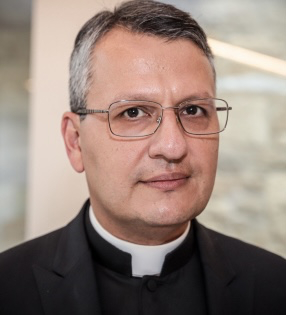
Fr. Mario Alexis Portella, J.D., J.C.D. is a priest of the Cathedral of Santa Maria del Fiore in Florence, Italy, as well as a Visiting Fellow at the Danube Institute in Budapest, Hungary, and a Visiting Professor at ITI Catholic University in Trumau, Austria. He holds a doctorate in canon law and civil law from the Pontifical Lateran University in Rome.
















.png)






.jpg)



 English (US) ·
  French (CA) ·