

.png) 3 weeks ago
61
3 weeks ago
61
PROTECT YOUR DNA WITH QUANTUM TECHNOLOGY
Orgo-Life the new way to the future Advertising by AdpathwayWhether it’s the f-word or reportedly calling someone a bitch, President Donald Trump’s administration leans hard into profanity.
Trump regularly uses the f-word in his Truth Social rants and has even said it in a televised interview, and his administration follows suit. JD Vance recently referred to certain jobs as “bullshit” and Steven Cheung, the White House communications director, called Jimmy Kimmel a “shit human” in a recent post on X.
Experts told HuffPost that the use of profanity from the country’s highest office isn’t normal, but does seem to play a role in what the Trump administration hopes to achieve and how it’s portraying itself. Here’s what to know:
The “hot mic moments” of the past are very different from today’s intentional public profanity.
It’s likely every president has had their “hot mic moments,” said Elvin Lim, the founding dean of the College of Integrative Studies and professor of political science at Singapore Management University.
For example, Barack Obama audibly called Kanye West a “jackass,” Joe Biden referred to the passing of the Affordable Care Act as “a big fucking deal,” and Lyndon Johnson was known to curse often, said Sam Martin, the chair of the Frank Church Institute and professor of political communication at Boise State University.
But these were all closed-door moments, which is very different than how Trump uses profanity now, she noted.
“What the Trump administration is doing is it has made cursing part of the ways presidents communicate with the very public that it seeks to serve,” Martin said.
“Swearing in private is a normal thing that we all do now and then. But Trump stands out for doing so publicly and unapologetically,” Lim observed. “His profanities are perhaps a natural extension of who he is — he is the most self-consciously anti-establishment, personalistic president in perhaps the last century — but they also serve political purposes in helping him drive the political rage that his base feels as a personal political weapon.”
Political discourse has become more heated, which likely explains the profane remarks.
“It is true that the incidence of profanity has probably gone up in recent years, in tandem with the ‘heat’ of political discourse over the last few decades,” Lim said.
Outrage and anger are now “signals of authenticity and democratic responsiveness by politicians, in a media and platform context that both permits and encourages such displays of vitriol,” Lim continued. “There’s a clear parallel to 19th-century partisan rhetoric, where trading jibes and personal attacks were everyday occurrences in the partisan press and pamphlets — savagery toward opponents is nothing new.”
But actual profanity was more rare at this time. “Society’s attitudes toward profanity have relaxed considerably since then, and what counts as profane has changed,” Lim said.
It isn’t “just that profanity is more available, it’s that the front-stage and back-stage registers have merged, so the savagery and the crudeness now show up in the same place.” Instead of just hearing it in private or at the local pub, it’s now in more professional spaces.
Trump’s crudeness is a way for him to distinguish himself from the “conventional political elites,” experts say.
This type of behavior is a strategic tool that populists like Trump tend to use, according to Martin.
“They use crudeness and foul language ... to distinguish themselves from the ‘conventional political elites’ and to claim the authenticity that is unavailable to politicians who still follow those rules,” she said.
“When it comes to Trump, he’s also creating a weird intimacy and solidarity. He’s telegraphing to his supporters, ‘Listen, I’m going to speak the way you speak. I’m going to be angry at the same people you’re angry at.’
It’s more than just the realization that the president is cursing or speaking in a coarse way, Martin noted.
“It’s also becomes a marker of being different,” she said. It’s his way of saying, “I’m like you, and you can tell I’m like you because I speak in this way — they’re the ones who don’t like it.”
This galvanizes anyone who feels judged by the “elites,” whether that is so-called coastal elites, academics, Democratic politicians or another group of people.
The “elites” made the rules that presidents should be polished and proper, yet Trump bucks that tradition. “He’s speaking in a way that ‘they’ [the elites] look down on,” Martin said.
Swearing creates a connection with Trump’s base.
According to Martin, “swearing itself creates intimacy, and when it does that, it reinforces group identity.”
It’s like when you learn the “f-word” in middle school and say it for the first time with your friends, she added. “When adolescents and their friends discover things that they can say that the older generations don’t want them to say, or can’t understand, it creates a kind of independence and group identity among them. That’s how language works.”
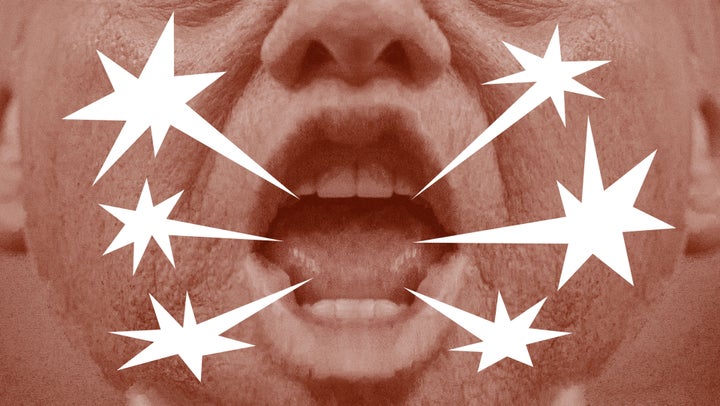
Illustration: HuffPost; Photos: Getty
“When it comes to Trump, he’s also creating a weird intimacy and solidarity. He’s telegraphing to his supporters, ‘Listen, I’m going to speak the way you speak. I’m going to be angry at the same people you’re angry at, and we’re not going to ask for their approval because we are ourselves, and people are free to join us, but we are not going to join them,’” Martin added.
Profanity doesn’t communicate complexity, which is dangerous in a presidential setting.
“Profanity compresses an argument or an idea into an emotion,” Martin said.
It also communicates urgency and allegiance. “You can communicate intensity, but it also allows speakers to sidestep having to engage with or even acknowledge complexity,” she said.
For instance, when Trump posts on Truth Social about the Iran war but uses four-letter words in his post, “that profanity elides the complexity of the situation in Iran and what is happening,” Martin explained. It turns the situation black and white, like “we are the good guys” and “they are the bad guys.”
“But there’s a risk, because if every statement gets delivered that way, then the language loses its ability to tell anyone when there really is a crisis,” Martin said, which can make the public “numb to what’s happening.”
On its face, the use of profane language by Trump and his administration isn’t the problem. The problem is “the way that they make contempt and personal degradation seem like just ordinary tools that presidents can use to make their points,” Martin said.






.png)



.jpg)

 English (US) ·
  French (CA) ·