

 3 weeks ago
27
3 weeks ago
27
PROTECT YOUR DNA WITH QUANTUM TECHNOLOGY
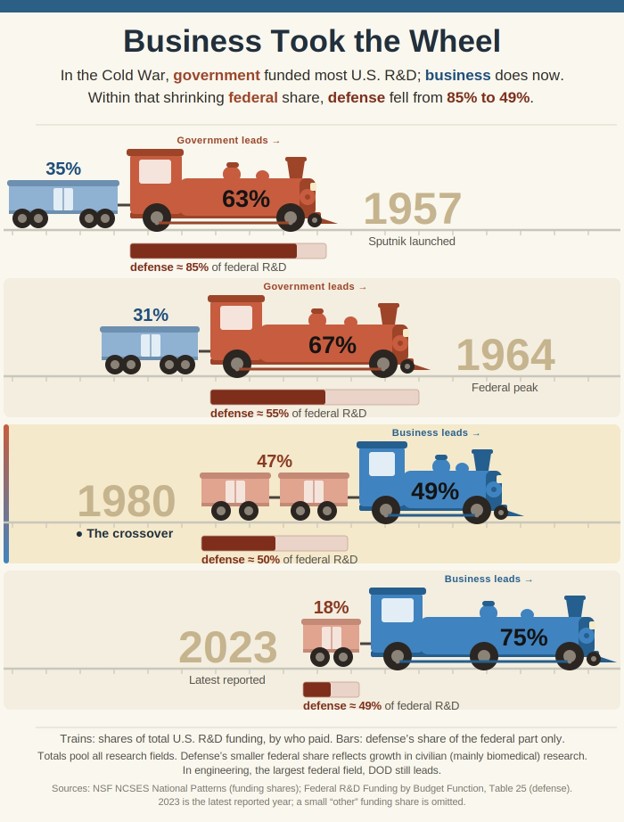
Orgo-Life the new way to the future Advertising by AdpathwayWhen the Soviet Union launched Sputnik in 1957, the U.S. government was the unrivaled patron of American science. It funded nearly two-thirds of the nation’s research and development — much of it for defense — defining the early Cold War. In a phenomenon that’s been widely explored in our Arsenal of Innovation series, for several decades federal dollars pushed the technological frontier, and the private sector followed.
Today, that arrangement has been inverted. Industry now funds roughly three-quarters of U.S. research and development, while Washington’s share is less than a fifth. Because the cutting edge increasingly emerges from commercial labs, the Pentagon must now court and adapt innovation, rather than drive it.
Our infographic tracks this reversal across four snapshots — 1957, 1964, 1980, and 2023, the year with the most current data from the National Science Foundation’s National Center for Science and Engineering Statistics.
The infographic’s second layer also explores defense funding as a share of shrinking federal research and development. Defense research and development comprised about 85 percent of total funding in the Sputnik era, compared to roughly 49 percent today. However, this dynamic reflects less a Pentagon retreat than a surge in civilian (mainly National Institutes of Health biomedical research) funding. If the lens is narrowed to engineering, the Defense Department remains the dominant funder.
Although we didn’t discuss who performs research and development (we focused instead on who funds it), that’s an interesting topic too. Measured by performance, industry’s share is larger still (about 77 percent in 2023), because companies also carry out federally funded work under contract.














.png)






.jpg)



 English (US) ·
  French (CA) ·