

 1 day ago
1
1 day ago
1
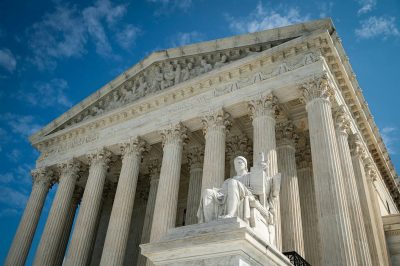
For years, we have been warning that the U.S. Supreme Court would not save us from the American police state.
That warning has not grown less urgent. It has simply become more complicated.
The danger today is not merely that courts will favor order and procedure over freedom. It is that by the time justice makes an appearance, it will arrive so narrowly, so procedurally and so late that the government will already have prevailed.
Consider the fight over President Trump’s massive $400 million White House ballroom.
Lower courts found serious reason to doubt Trump’s claim to unilateral authority to tear down the historic East Wing and proceed with the project without congressional approval, and they ordered above-ground construction halted.
.

Ballroom and helipad construction at the White House on July 10, 2026 (CC BY 4.0)
.
Those orders were stayed while the administration appealed.
Construction continued.
Then the administration argued that the project had progressed so far that stopping it had become impractical.
On August 31, the U.S. Supreme Court, by a 5–4 vote, allowed the construction to continue—not because it determined that Trump had acted legally, but because the majority concluded that the preservationists challenging the project likely lacked legal standing to sue.
Therein lies the problem with justice in the age of the American police state: by the time the courts finally decide whether government officials have overstepped their constitutional authority, the deed may already be done, the right already violated and the damage already inflicted. And whatever constitutional principle eventually emerges from the litigation arrives too late to undo the damage.
At what point will “We the People” be told that we, too, lack standing to object to the destruction of our republic?
The Founders built safeguards into the constitutional system to guard against any one branch of government becoming all-powerful: If the president overreaches, Congress is supposed to stop him. If Congress fails to do its duty, the courts are supposed to intervene. If a lower court gets it wrong, the Supreme Court will set things right.
That is how the system is supposed to work.
But constitutional rights are only as meaningful as the remedies available when government violates them, and increasingly those remedies come with strings attached: You must have standing. Your case must not be moot. You must prove that you were personally and directly harmed. You must sue the right government official in the right court at the right time. You must survive questions of jurisdiction, immunity, procedure and remedy before anyone ever reaches the underlying question of whether the government had the constitutional authority to act in the first place.
This is not to say that standing, jurisdiction and other limits on judicial power are meaningless technicalities. But when technicalities are all that stand between us and tyranny, we’re in trouble.
Our constitutional system depends upon three separate, coequal branches of government restraining the others.
Yet when Congress refuses to assert its authority, the Executive Branch overreaches and the courts intervene only after increasingly difficult procedural hurdles have been cleared, the balance of power begins to collapse.
This is how freedom falls and tyranny rises.
The White House ballroom is not an isolated dispute. It is a particularly visible example of government by fait accompli.
This has become Trump’s go-to method for sidestepping the rule of law: delay, deflect, deny, and run out the clock until he can claim it’s too late to put things back the way they were.
Governments have relied on this tactic for years, but Trump has turned it into a governing philosophy. The result is a constitutional system increasingly incapable of preventing government misconduct before the harm occurs.
That distinction matters.
A court ruling issued years after the fact may establish an important principle. It may vindicate someone whose rights were violated. It may even prevent the government from repeating exactly the same conduct in exactly the same way.
But it cannot always undo the harms the government has already inflicted.
You cannot un-deport someone after the government has wrongly removed them from the country. You cannot un-search a home. You cannot un-collect a person’s DNA. You cannot make a surveillance database forget where someone traveled. You cannot restore privacy once the government has mapped a person’s movements.
You cannot restore months someone wrongly spent behind bars. You cannot restore a destroyed building. You cannot give back the life of someone killed by government agents.
You cannot un-launch a war.
In such cases, justice delayed is not merely justice denied. Justice delayed can become justice rendered irrelevant.
This is the problem when courts that were established to serve as Courts of Justice too often function like Courts of Order—more concerned with preserving government authority and institutional stability than with safeguarding the rights of the people.
This is true at all levels of the judiciary, but especially so in the highest court of the land, the U.S. Supreme Court. When presented with difficult constitutional questions, the Court too often ducks, remains silent or speaks to the narrowest possible concern.
Too often, the benefit of the doubt goes to the government and the powers of the police state, but the danger now extends far beyond police searches, excessive force and qualified immunity.
Even victories for constitutional limits arrive with an asterisk.
This is tyranny by technicality.
Yet the courts were never intended to be the first and only line of defense against an overreaching president.
Congress is supposed to act before the damage is done. Unfortunately, members of Congress behave as though their constitutional responsibility begins and ends with supporting or opposing whichever party controls the White House.
That is abdication of the worst kind.
This is why we must stop looking to Washington for saviors.
Neither the president, nor Congress, nor the Supreme Court will preserve liberty unless the American people insist upon it.
That means challenging government abuses before they become permanent. It means opposing unconstitutional power even when it is exercised by politicians we support. It means refusing to allow emergency powers to become ordinary powers. It means demanding that Congress act as a separate branch of government rather than a presidential cheering section. And it means insisting that courts provide meaningful constitutional remedies while there is still something left to remedy.
Above all, as we make clear in Battlefield America: The War on the American People and its fictional counterpart The Erik Blair Diaries, it means remembering that constitutional government depends upon a citizenry unwilling to surrender its freedoms for promises of security, efficiency, prosperity or political advantage.
Who has standing to save the republic? We do.
*
Click the share button below to email/forward this article. Follow us on Instagram and X and subscribe to our Telegram Channel. Feel free to repost Global Research articles with proper attribution.
This article was originally published on The Rutherford Institute.
Constitutional attorney and author John W. Whitehead is founder and president of The Rutherford Institute. His most recent books are the best-selling Battlefield America: The War on the American People, the award-winning A Government of Wolves: The Emerging American Police State, and a debut dystopian fiction novel, The Erik Blair Diaries. Whitehead can be contacted at [email protected].
Nisha Whitehead is the Executive Director of The Rutherford Institute. Information about The Rutherford Institute is available at www.rutherford.org.
They are regular contributors to Global Research.
Global Research is a reader-funded media. We do not accept any funding from corporations or governments. Help us stay afloat. Click the image below to make a one-time or recurring donation.
















.png)






.jpg)



 English (US) ·
  French (CA) ·