

 5 months ago
60
5 months ago
60

Greenland has re-emerged as a focal point of American strategic ambition with recent pronouncements from President Donald Trump, including his appointment of Louisiana Gov. Jeff Landry to serve as US special envoy to Greenland to pursue the matter, renewing the push to bring the world’s largest island under direct US control. This is part of a broader foreign policy doctrine taking shape in Washington on the consolidation of an exclusive US sphere of influence across the entire Western Hemisphere.
On December 22, 2025, during a press conference at his Mar-a-Lago estate, President Donald Trump made a declaration regarding US ambitions toward Greenland. While taking questions from journalists, he explained the issue as an urgent strategic imperative, stating,
“And we need it for national protection. We need Greenland for national protection. They have a very small population. And I don’t know, they say Denmark, but Denmark has spent no money. They have no military protection. They say that Denmark was there 300 years ago or something with a boat. Well, we were there with boats, too, I’m sure. So, we’ll have to work it all out. But […] we need it for national, we need Greenland for national security, not for minerals. We have so many sites for minerals and oil and everything. We have more oil than any other country in the world. We need Greenland for national security. And if you take a look at Greenland, you look up and down the coast, you have Russian and Chinese ships all over the place. We need it for national security. We have to have it […], Greenland’s a big deal.”
Trump’s pronouncement, delivered amidst discussions of battleships and global threats, he mentioned a deliberate move to justify the potential absorption of the autonomous Danish territory as a defensive necessity, squarely placing it within his administration’s broader doctrine of consolidating an exclusive American sphere of influence across the Western Hemisphere.
All the while, Denmark, an EU member since 1973 has found little to no aid from European leadership in this, such as the EU’s Kaja Kallas, who are reportedly unwilling to even publicly name the United States as the source of the threat in her X post about the situation, which is further evidence of their vassal-like status. Moreover, Denmark’s Prime Minister Mette Frederiksen, who frequently warns of the Russian threat, took over a week to find the valor to publicly condemn President Donald Trump’s renewed threats to annex Greenland, denouncing the idea of taking over another country as unacceptable. In response to this pressure from a key ally, she announced that Denmark is accelerating its military buildup and strengthening Arctic security. The prime minister emphasized that Denmark will stand firm against these ongoing threats. For more information readers might want to read my prior articles related to the subject:
“Could Trump’s Annexationist Talk Be Part Of A Great US Castling Strategy?”
“Not All Superpowers Desire Spheres Of Influence”
“Trump Recalibrates US Networked Empire Into A Tariff-Based Order”
“Panama’s BRI Exit Signals Trump Is Raising The Quanta Of Violence”
“Could A Remnant Empire In The Western Hemisphere Be The True Goal Of The US Siege In The Caribbean?”
The Closing of the Americas?
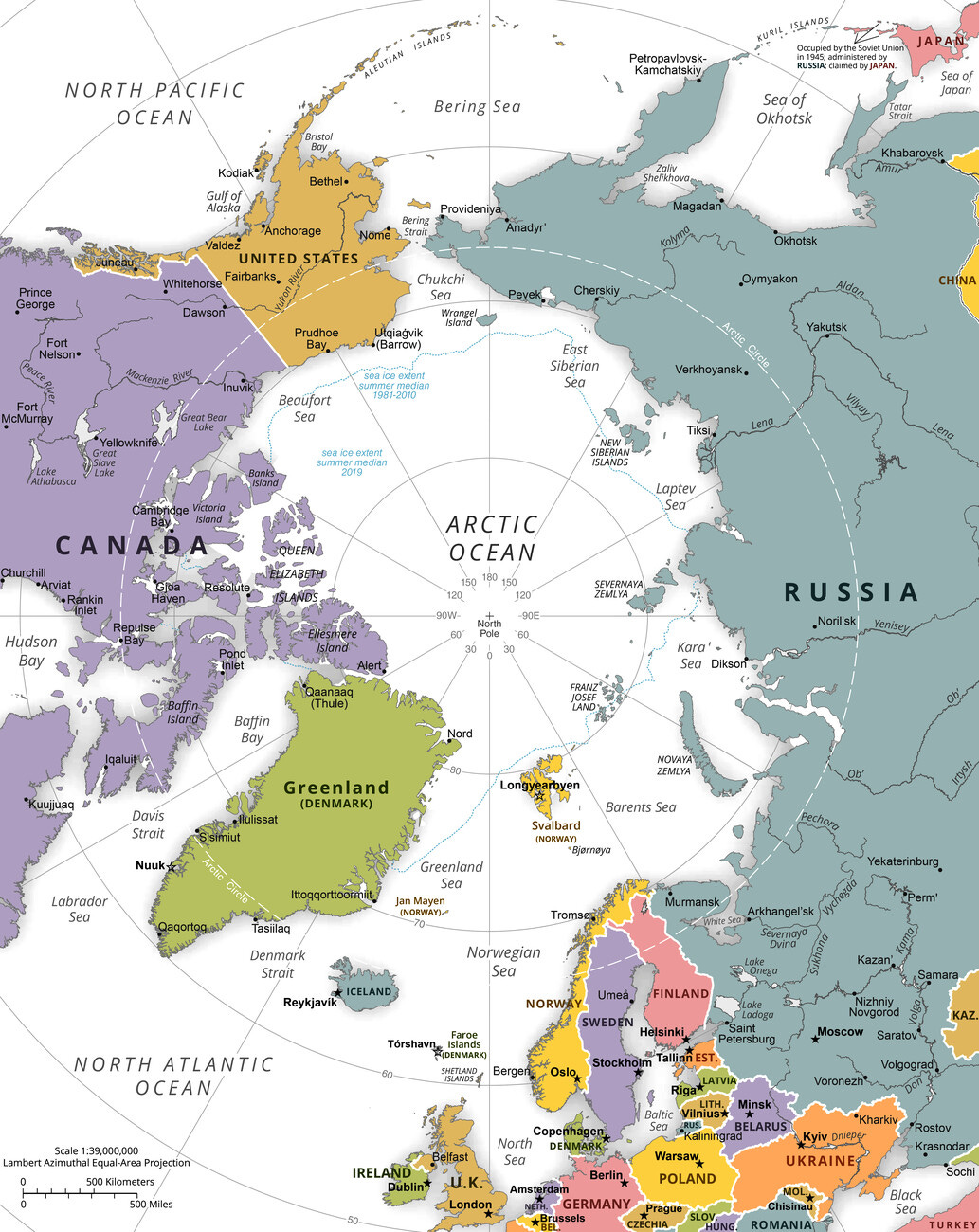
Greenland fits seamlessly into the US strategic calculus for controlling the pathways into the Americas. As it offers unparalleled command over the North Atlantic, the crucial maritime gateway to the US eastern seaboard. In an era of renewed great-power competition, the US seems to believe controlling Greenland and other chokepoints means the ability to monitor, and if necessary, deny access to Russian or Chinese commerce and trade movements from the Arctic into the Atlantic. The intellectual groundwork for this pivot was laid in the recent U.S. National security strategy, decisive shift towards a world ordered by US spheres of influence, specially in the western hemisphere. Under this framework, the primary objective of U.S. statecraft is to secure absolute dominance within the Americas, while managing relations and competition with Russia and China. Russia has solidified a formidable military and economic presence along its northern sea route, treating the region as a strategic bastion. China, self-styled as a “near-Arctic state,” is increasing its investments and scientific footprint, seeking influence through its partnership with Russia. Thus absorbing Greenland would instantly transform the US into a major Arctic power, with Thule Air Base possibly becoming a much larger strategic footprint.
.
.
The United States controlling Greenland would not allow it to legally “close” the Northern Sea Route’s entrance to the Americas because the critical chokepoint is the Bering Strait, which lies between Alaska and Russia and is governed by international law guaranteeing passage; however, dominating Greenland would give the U.S. immense strategic leverage over the broader Arctic region by solidifying control of the North Atlantic approaches (the GIUK Gap), enabling forward military and intelligence operations to monitor, challenge, and potentially disrupt Russian shipping and military activities along the NSR’s western flank from a position of strength, thereby contesting Russia’s Arctic dominance without directly blockading the route.
A Doctrine of Spheres
Long before the US executive branch published its National Security Strategy the administration was making a push for this systematic castling strategy within the hemisphere. The Trump administration’s systematic pressure across the Western Hemisphere represents a calculated “castling” strategy—a decisive move ensuring that from the Arctic to the Panama Canal, US influence is strong.
This strategy is partially related to the deployment in the Caribbean against Venezuela, an oil-rich nation which the US has sustained and intensified a campaign of maximum pressure. Simultaneously, in Panama, alarm bells rang over the country’s deepening ties with China, including Beijing’s administrative roles in critical ports and infrastructure linked to the Panama Canal. For the Trump administration Greenland represents a low-cost, high-reward geopolitical gambit that shows the strength of the US amid perceived losses in the economic and military spheres, by projecting power into a critical region and reinforcing a doctrine of hemispheric dominance.
*
Click the share button below to email/forward this article. Follow us on Instagram and X and subscribe to our Telegram Channel. Feel free to repost Global Research articles with proper attribution.
Miguel Santos García is a Puerto Rican writer and political analyst who mainly writes about the geopolitics of neocolonial conflicts and Hybrid Wars within the 4th Industrial Revolution, the ongoing New Cold War and the transition towards multipolarity. Visit his blog here. He is a regular contributor to Global Research.
Featured image source
Global Research is a reader-funded media. We do not accept any funding from corporations or governments. Help us stay afloat. Click the image below to make a one-time or recurring donation.












.png)





.jpg)



 English (US) ·
  French (CA) ·