

 2 months ago
37
2 months ago
37
PROTECT YOUR DNA WITH QUANTUM TECHNOLOGY
Orgo-Life the new way to the future Advertising by AdpathwayLast week, in his meeting with the Anglican Archbishop of Canterbury, Sarah Mullally, Pope Leo XIV said:
While much progress has been made on some historically divisive issues, new problems have arisen in recent decades, rendering the pathway to full communion more difficult to discern. I know that the Anglican Communion is also facing many of these same questions at this time. Nevertheless, we must not allow these continuing challenges to prevent us from using every possible opportunity to proclaim Christ to the world together.
Ever since the Church began engaging in ecumenical dialogue with “separated brethren” during the Second Vatican Council (1962-1965), we as a Church have refused to address the doctrinal disputes that actually divide us. Instead, greater emphasis is placed on matters that are beyond the competency of the Church, like global warming—now reworded climate change—or other ecological issues. Subsequently, it is as if “full communion” can be achieved in a distant future through a compromise among conflicting and even opposing views—the Catholic Church, which teaches that she possesses the fullness of divine revelation; the Anglicans (and other Protestants) who refute that.
For two millennia, the Catholic Church, which is the Mystical Body of Christ, has taught that she is the sole true religion founded by Jesus Christ after He fulfilled the Old Covenant; and only the Church possesses the fulness of the truth as revealed in Holy Writ. As noted by Pope Pius XII in his 1943 encyclical Mystici Corporis, this “was first taught by the Redeemer Himself” (1).
However, this long-standing teaching was modified during Vatican II with the Dogmatic Constitution Lumen Gentium, which equated Christ’s mystical body, which “subsists” within the Catholic Church, with the partial presence of “elements” in other Christian churches and ecclesial communities (8). This change laid the groundwork for the contemporary ecumenical movement, which, contrary to its name, is not genuinely ecumenical. Instead, it resembles what Pope Pius XI denounced in his Encyclical Mortalium Animos (1928): that of a federation of Christians where each individual maintains their own beliefs and personal judgment regarding matters of faith, even when these beliefs diverge from those of others.
This new truism was catapulted by the Italian-born German-naturalized Catholic priest Fr. Romano Guardini (1885-1968). In his The Church of the Lord: On the Nature and Mission of the Church, he presented the Church as a “mystical body”
[t]o the extent that we look upon the Church as organization…like an association…[not having] yet arrived at a proper understanding of it. Instead, it is a living reality and our relationship with it ought to be—life. (160)
With this followed, as Jesuit priest Fr. Henri de Lubac explained, the concept that the Church of Christ “subsists among members of a human society, for among them there is not only outward harmony, but true unity.”
Pius XII, as a result of the then misinterpretation of what mystical body meant, was compelled to clarify this a few years later in his encyclical Humani Generis:
Some say they are not bound by the doctrine, explained in Our Encyclical Letter of a few years ago, and based on the sources of revelation, which teaches that the Mystical Body of Christ and the Roman Catholic Church are one and the same thing. Some reduce to a meaningless formula the necessity of belonging to the true Church in order to gain eternal salvation. Others finally belittle the reasonable character of the credibility of Christian faith. (27)
Naturally, “subsists” can be equated to “exists as a substance,” i.e., that there is only one substance of the Catholic Church. The new ecclesiology, however, expounded on a “partial communion” between the Catholic Church and other churches in schism, such as the Copts and the Orthodox; ecclesiastical communities, like the Anglicans, Lutherans, and other mainstream Protestants; and sects, as with the Jehovah’s Witnesses or Christian fundamentalists.
Indeed, within the same paragraph of Lumen Gentium, it says: “…although many elements of sanctification and of truth are found outside of its [the Church’s] visible structure,” thereby leading anyone to believe that salvation can even be objectively found in (Talmudic) Judaism, Hinduism, Buddhism, and many other Eastern religions that are pantheistic by nature.
On June 29, 2007, Cardinal William Levada, then Prefect of the Congregation for the Doctrine of the Faith—now called the Dicastery for the Doctrine of the Faith—attempted to clarify the terminology on what “subsist” means. He stated that Christ “established here on earth” only one Church and instituted it as a “visible and spiritual community” that from its beginning and throughout the centuries has always existed and will always exist, and in which alone are found all the elements that Christ Himself instituted.
This one Church of Christ, which we confess in the Creed as one, holy, catholic, and apostolic…. This Church, constituted and organized in this world as a society, subsists in the Catholic Church, governed by the successor of Peter and the Bishops in communion with him.
From this, one can conclude that, at least in terminology, there is a clear distinction between the “Catholic Church” from the “Church of Christ;” the latter containing a much broader entity and not exclusively constituted as a visible society in the Catholic Church. The term subsists in renders the understanding that the Church of Christ, while not achieving its perfection and fullness in other ecclesial or non-Christian religious communities, is nonetheless present in them, as explicitly stated by Cardinal Joseph Ratzinger in Dominus Jesus (2000).
With the expression subsistit in, the Second Vatican Council sought to harmonize two doctrinal statements: on the one hand, that the Church of Christ, despite the divisions which exist among Christians, continues to exist fully only in the Catholic Church, and on the other hand, that “outside of her structure, many elements can be found of sanctification and truth,” that is, in those Churches and ecclesial communities which are not yet in full communion with the Catholic Church. (16)
Ratzinger goes on to explain that while the formula subsistit in cannot be equated to the fact that the one Church of Christ could subsist also in non-Catholic Churches and ecclesial communities, there are still, nevertheless, elementa Ecclesiæ, i.e., elements of that same Church.
It would have been much easier for all of us had both Levada and Ratzinger cited the 1964 Orientalem Ecclesiarum (on the Eastern Catholic Churches), which says:
The Holy Catholic Church, which is the Mystical Body of Christ, is made up of the faithful who are organically united in the Holy Spirit by the same faith, the same sacraments and the same government and who, combining together into various groups which are held together by a hierarchy, form separate [Eastern Catholic] Churches or Rites. (2)
It would have been beneficial to Sarah Mullally had Pope Leo said the same thing—that the Church of England is merely an ecclesiastical community that needs to be in full harmony with the Roman Pontiff. Or if he had mentioned that Cardinal John Henry Newman, after his conversion to Catholicism, never engaged in any “dialogue,” for he knew that full communion could only be found within the Mystical Body of Christ, which is the Catholic Church.
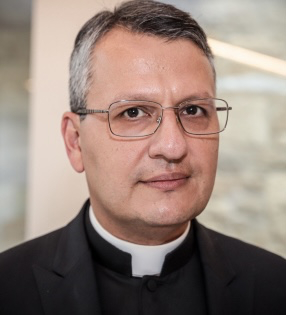
Fr. Mario Alexis Portella, J.D., J.C.D. is a priest of the Cathedral of Santa Maria del Fiore in Florence, Italy, as well as a Visiting Fellow at the Danube Institute in Budapest, Hungary, and a Visiting Professor at ITI Catholic University in Trumau, Austria. He holds a doctorate in canon law and civil law from the Pontifical Lateran University in Rome.














.png)






.jpg)



 English (US) ·
  French (CA) ·