

 1 month ago
19
1 month ago
19
PROTECT YOUR DNA WITH QUANTUM TECHNOLOGY
Orgo-Life the new way to the future Advertising by AdpathwayInside one of Munich’s landmark churches, something devilish is said to be stamped on the floor. In the middle of the room, a black footprint is clearly seen, named The Devil’s Footprint, as he was said to have left it there.
The Frauenkirche officially the Cathedral of Our Lady, also known as Munich Cathedral is a late Gothic church building in Munich’s Old Town and is one of the landmarks of the Bavarian capital , Munich. It is also said to be full of fantastical legends and ghosts.
Read More: Check out all ghostly legends from Germany
Munich’s iconic cathedral is famous not only for its twin towers but also for the mysterious “Devil’s Footprint” near the entrance. According to legend, the Devil himself left the mark after being tricked during the church’s construction.
 Legend of the Church: Several legends explain the reason for the new church’s construction. In the packed old church, a false fire alarm sounded one day. The most beautiful girl in Munich was trampled to death in the panicked rush of people fleeing the church. Duke Sigismund, in his youth, had been in love with a girl of lower social standing. She refused marriage, however, fearing she would be treated like Agnes Bernauer, who was cruelly murdered by her father-in-law, Duke Ernst, because of her low social class. Because the girl who died in the church reminded Duke Sigismund of his unhappy love and he felt her death should not have been in vain, he founded the Frauenkirche in her memory.
The Devil’s Footprint
In 1468 architect Jorg von Halspach went looking for money to build a new cathedral in Munich and ended up making a bargain with the Devil. The cathedral’s master builder had promised him a church without windows. Also, In exchange for his help, the devil was to receive the soul of the first person to enter the church.
 Jörg von Halspach: (*before 1441 probably in Halsbach near Altötting ; † 6 October 1488 in Munich), also called Halsbach, Ganghofer or ‘Jörg von Polling’, was a Munich master builder and architect of the Late Gothic period. His principal work is the Frauenkirche in Munich, which was built between 1468 and 1494. For its vaulting , he traveled to Ulm and Augsburg , where he studied St. Ulrich’s Church and the cathedral. Master Jörg is buried beneath the north tower.
On February 9, 1468, Duke Sigismund and Bishop Tulbeck laid the foundation stone for the new St. Mary’s Church, and the old church was demolished in 1472. Construction progressed relatively quickly.
But when the devil inspected the work and stood where the imprint was, he saw not a single ray of light. He laughed and stamped his foot in glee until he took another step – and suddenly discovered windows hidden behind the pillars. Enraged by the master builder’s deception, he unleashed a storm to destroy the building. The storm subsided, but the devil’s wrath remains – even today, a cold wind always blows around the cathedral.
The black footprint, or Der Teufelstritt, is still there in the middle of the entrance hall, although they cover it up during church masses. Visitors often pause at the footprint, but some claim the atmosphere changes dramatically around it, with sudden chills, feelings of unease, and an overwhelming sense of being watched. Whether folklore or something more sinister, the legend continues to draw curious believers.
 Source
Although the columns are not blocking the windows in real life, a huge altar used to conceal it from 1620 to 1858. The footprint itself is a reconstructed one, after the rooftop collapsed in the second world war, and was first ended in 1994. But when the original footprint was set, no one really knows.
The Haunted Cemetery
The story of the Devill’s Footprint is not the only story from this church though. Outside of it, it used to be an old cemetery, the “Frauenfreihof,” as the cemetery by the cathedral was still called at the beginning of the 19th century.
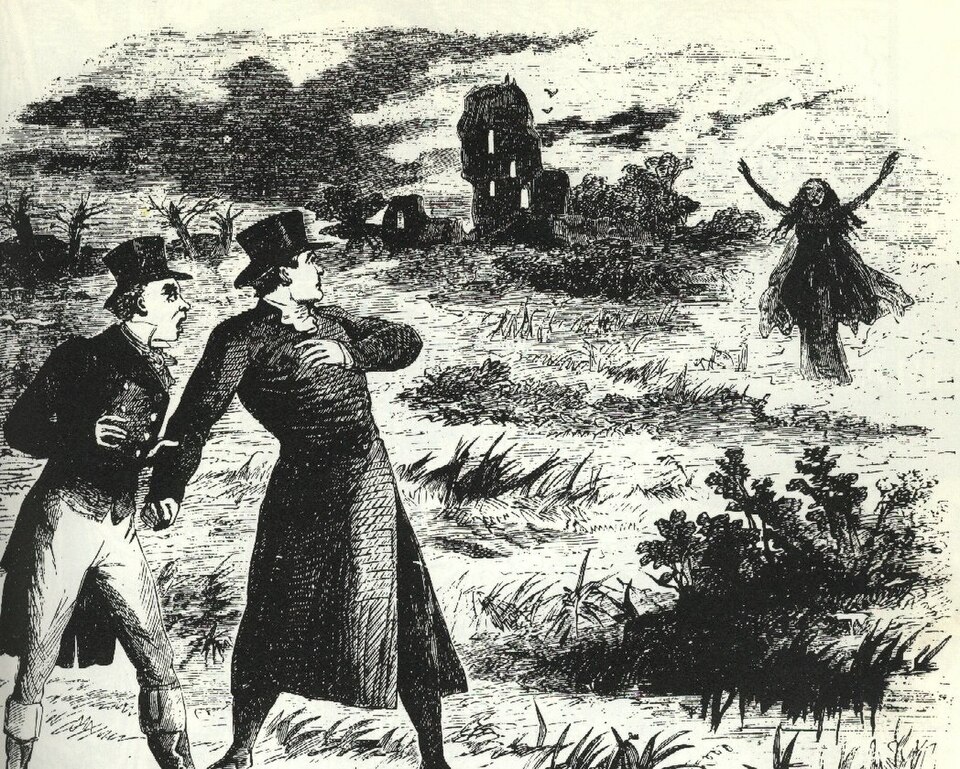
Back then, the cemetery was considered extremely haunted by an eerie figure in the nightcap who made Munich residents avoid the area after dark.
 The Cemetery: Numerous epitaphs are mounted along the lower outer walls on the north, east, and south sides. They commemorate the cemetery that once surrounded the church. For hygiene reasons, the cemetery was slated for relocation, but the townspeople successfully resisted this on several occasions. However, since 1773, burials were permitted only in family plots, and the area was paved in 1800.
But then there was this merchant with his shop on Weinstraße opposite the old police station. One night, after a visit to the tavern, he wandered through the cemetery, probably on a whim fueled by beer as he used to indulge in after closing his shop.
To impress his drinking friends, he would take the route through the haunted cemetery. And as fate would have it, a white figure wearing a pointed cap sat motionless on one of the gravestones. The merchant, with enough courage-boosting alcohol in his blood, gave the apparition a resounding slap. The stranger’s cap slipped off his head, revealing a grinning skull.
Read Also: Similar stories exists in several stories, like with The Icelandic Ghost Story of The White Cap
Now it was time for the shopkeeper to make a run for it. Arriving at his house, he thought himself safe. The ghost couldn’t get in through it because, according to old pious custom, it was marked with three crosses and the names of the Three Wise Men, bearing the effective demon-banishing incantation “C+M+B.” But the ghost is quite clever: it climbs through the window into the merchant’s bedchamber, who, quick-wittedly, throws a picture of the Madonna, the Holy Mother of God of Altötting at it.
When he awoke the next day, the picture was hanging on his wall. The apparition vanished and was said to never appear again, but the man is henceforth known by his nickname: Schlafhaubenkramer, or “Sleepcap Merchant”.
Newest Posts
The Devil’s Castle in the Aubinger Lohe and the Hidden Treasure28. August 2026
Said to be the location of a hidden treasure, the old nobles from the Devil’s Castle in the Bavarian hills are said to roam the forest, still searching for it.
The Devil’s Footprint in Frauenkirche in Munich27. August 2026Inside one of Munich’s landmark churches, something devilish is said to be stamped on the floor. In the middle of the room, a black footprint is clearly seen, named The Devil’s Footprint, as he was said to have left it there.
The Cursed Black Cat at Promenadeplatz in Munich26. August 2026Once the house of a greedy grain speculator, the haunted house at Promenadeplatz in Munich is said to be haunted by the man in the form of a cat, as penance after a curse drove him to ruin.
The Kuntilanak and the Pontianak: Vampiric Ghosts of the Banana Tree24. August 2026At the cusp of a vengeful ghost and a vampiric entity, the Kuntilanak of Indonesia, or the Pontianak as she is called in Malaysia, is after both vengeance and to devour her victims.
The City of Pontianak and the Vampiric Ghost its Named After17. August 2026How haunted is a city to be named after its ghosts? This is the case of the Indonesian city of Pontianak, said to have been haunted by the fearsome ghosts known as the Pontianak or the Kuntinalak ghosts, thirsting for blood and vengeance.
The Lady in White Haunting Ebersberg Forest13. August 2026Said to haunt the area around The Hubertus Chapel in the vast Ebersberg Forest in Bavaria, Germany, the Lady in White is seeking revenge for those refusing her a ride. But is she truly the only thing haunting this old and mystic forest?
The Plague Dance and the Dragon who Brought it to Munich12. August 2026Once, a plague ridden Lindworm was said to crawl out from the darkness, and attack the people of Munich. After defeating the dragon, and ridding themselves of the plague, a ceremonial dance has been danced through the city for over 500 years.
The Plague Visits Munich at Alter Peter Church11. August 2026Fantastical legends foretelling the Black Plague exist throughout Europe that would leave whole cities without any living. In Munich, Germany, a legend talks about a mysterious black hooded figure at the cemetery of St. Peter’s church being the omen of death.
Langsuyar: The Night Vampire of Malay Folklore10. August 2026From the despair of a mother dying in childbirth, a blood thirsty spirit rises in her place. With her alluring appearance and ability to transform into flying entities, she is one of the feared vampires from Malay folklore.
Ghostly Kittens at Radlsteg in Munich7. August 2026After being drowned in the river by Radlsteg in Munich, it is said that the ghosts of the discarded cats are still roaming and following passerby’s.
The Lady in Black at the Munich Residenz and the Wittelsbach Curse6. August 2026Before their deaths, members of the royal Wittelsbach family claimed to have seen the mystical Lady in Black appearing to them. Although the woman behind the black clothing is a mystery, her message has been clear: in the soon future, you will die.
The Walled Up Man’s Echoes at Sendlinger Tor5. August 2026From within the old city gate, Sendlinger Tor in Munich, it is said that the voice of the ghost is haunting its remains. If you listen carefully, it is said the laments of the man walled up inside of the gate lingers.


References:
Tour in München – Schön schaurig – Landkreis München – SZ.de
Sagen & Geschichten – Eintrag bearbeiten













.png)






.jpg)



 English (US) ·
  French (CA) ·