

 2 months ago
46
2 months ago
46

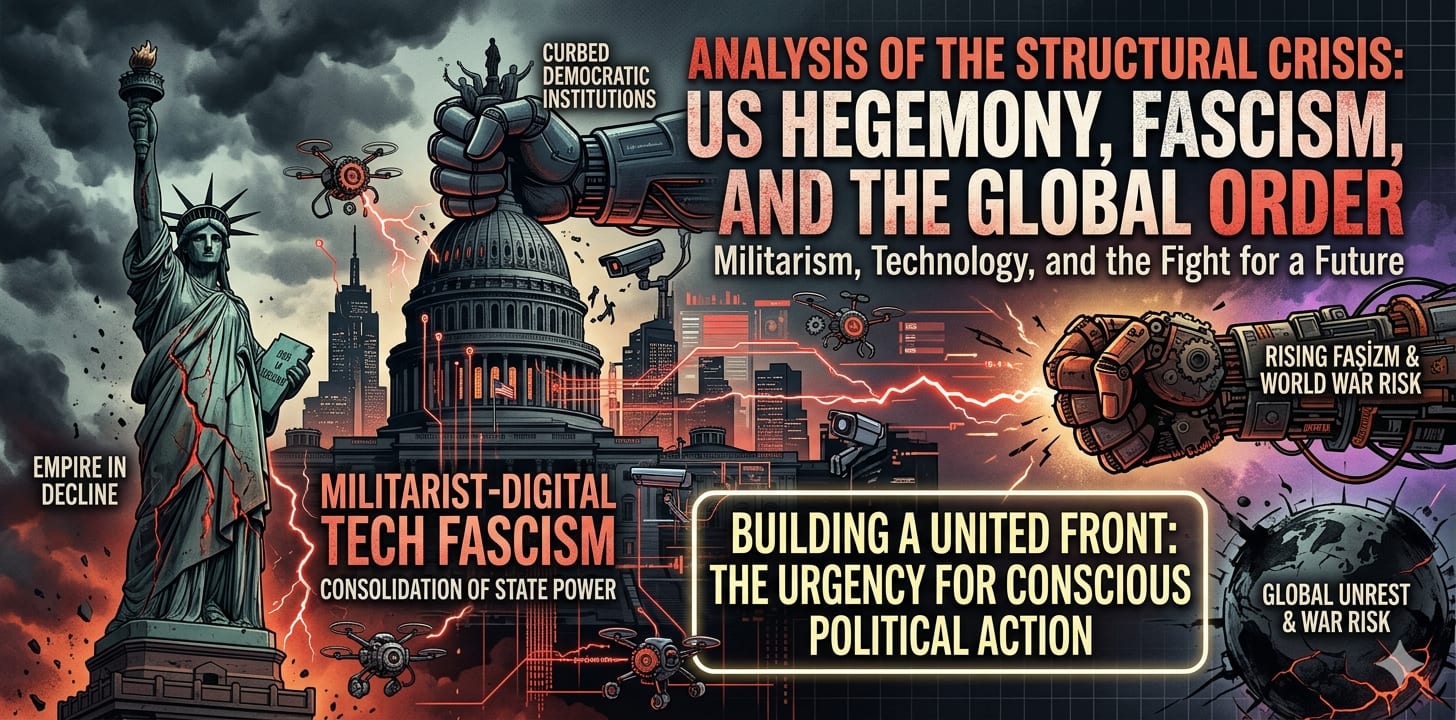
Fascism and world war are not parallel dangers but two faces of the same structural crisis. Understanding their connection is the precondition for any serious political response.
*
The world is changing at a pace and in a direction that demands clarity. Across the left and among progressive forces internationally, two questions dominate political discussion: Is the United States moving toward fascism? Is a world war coming?
These questions are asked with increasing urgency — and answered with increasing confusion.
Some dismiss the fascism danger as hyperbole, pointing to the continued functioning of American democratic institutions.
Others declare the threshold already crossed, evacuating the concept of its analytical precision.
On the war question, some place their hopes in an expected rupture between the United States and Europe, anticipating that inter-imperialist contradictions will resolve the danger from within. Others see world war as already underway in its opening phases — in Ukraine, Gaza, Iran and the Taiwan Strait.
Confusion on these questions is not merely academic. It has direct political consequences. A movement that misreads the stage of the fascist danger will either mobilise too late or exhaust itself in premature confrontations. A movement that misunderstands the war dynamic will build its strategy on foundations that the actual balance of forces will demolish.
This article is written to cut through that confusion.
We argue that the two questions cannot be separated. Fascism and world war are not parallel dangers developing on independent tracks. They are two dimensions of a single structural crisis: the crisis of American hegemony. Understanding this connection — its economic roots, its class dynamics, its military logic, and its political implications — is the precondition for any serious strategic response.
Our method is explicit. We use the analytical tools that the Marxist tradition has developed for precisely these questions: Marx’s analysis of capitalism as contradictory value production, Lenin’s concept of finance capital and imperialism, and Dimitrov’s definition of fascism. We do not apply these concepts dogmatically — as sacred texts whose conclusions are predetermined. We test them against today’s concrete reality, asking of each: is it still valid? Where does it hold? Where does it strain? Where do the variables need updating?
We resist the opposite temptation equally: the inflation of concepts, the endless production of new vocabulary that mistakes novelty of form for novelty of substance, and in doing so renders the analytical tools of Marxism blunt and unusable. A carpenter works with the tools of carpentry. When a tool no longer cuts, it is replaced — not multiplied into a hundred variations of itself.
The variables have changed. The structural logic has not.
Digital infrastructure has replaced heavy industry as the dominant accumulation base. Algorithmic suppression has joined paramilitary violence as an instrument of social control. Hypersonic missiles have extended the reach and speed of imperial force projection. But the class relationships that drive these developments — the imperative of accumulation, the tendency of the rate of profit to fall, the drive of the most aggressive fraction of capital toward state capture — remain structurally identical to what Marx, Lenin, and Dimitrov analysed.
The analysis that follows is not written as prophecy. It is written as a warning — and as an argument for the political tasks that the situation demands.
.
.
Part One: The Theoretical Framework — Testing the Tools
Every analysis of a concrete situation requires theoretical tools. The question is not whether to use them but which ones — and whether they still cut.
We propose three: Marx’s analysis of capitalism as contradictory value production, Lenin’s concept of finance capital, and Dimitrov’s definition of fascism. Not because they are sacred texts but because they have not yet been superseded. Each will be tested against today’s reality before being applied to it.
A Note on Method
These concepts are not applied here as sacred texts or closed systems. They are analytical tools — and like all tools, they must earn their place in each concrete situation. A concept valid in one context may strain or require modification in another. Where that happens, we say so. Where a genuinely new phenomenon resists existing categories, we acknowledge it rather than forcing it into a pre-existing mould.
What we resist is the opposite temptation: the inflation of concepts, the endless production of new vocabulary that mistakes novelty of form for novelty of substance. The carpenter works with the tools of carpentry. When a tool no longer cuts, it is replaced — not multiplied into a hundred variations of itself.
Marx: Contradictory Value Production
Is this still valid? Yes — and more visibly so than at any point since the 1930s. The tendency of the rate of profit to fall is not a theoretical curiosity. It is the structural motor behind the financialisation of the economy, the desperate search for new accumulation frontiers, and the growing resort to state power to compensate for the limits of the market. What appears as political chaos in Washington is, at its root, the surface expression of this deeper contradiction.
Where does the concept strain? Marx analysed value production in an era of industrial capitalism. Whether digital products — data, algorithms, software — constitute commodities in Marx’s sense, whether they contain socially necessary labour time, remains genuinely contested. Data and algorithms may function as powerful instruments of coordination and control over value circulation — but they do not, in themselves, produce value. This distinction matters. It is a reason to apply the framework carefully, not a reason to abandon it.
Lenin: Finance Capital
Lenin defined finance capital as the fusion of banking and industrial capital into monopoly. Is this still valid?
Yes — but with a significant development. Today’s dominant capital is not merely the fusion of bank and factory. It is the fusion of financial, industrial, and digital infrastructure capital into platforms that control not just production and credit but the very nervous system of the global economy. Amazon, Nvidia, BlackRock — these are not aberrations. They are finance capital in its most advanced form.
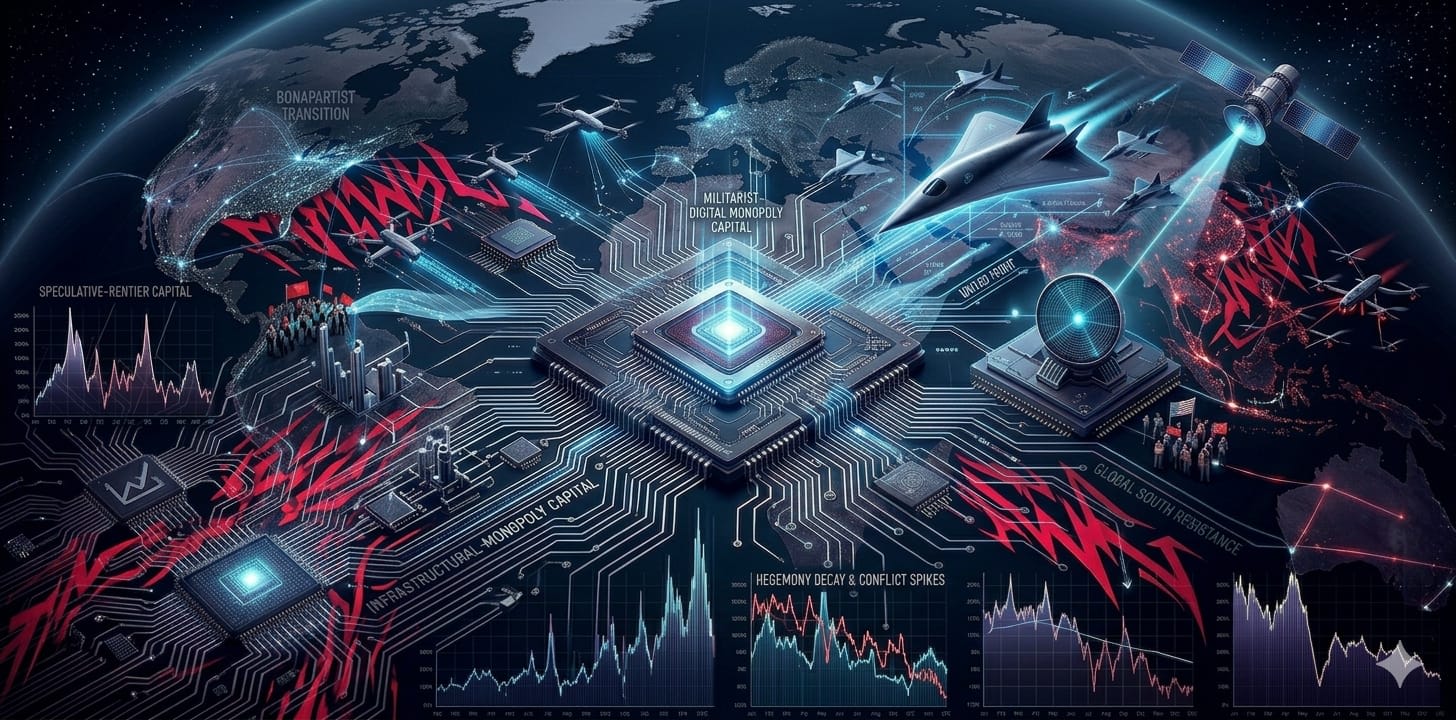
Where does the concept strain? The traditional definition risks obscuring an important internal differentiation within finance capital itself — between speculative-rentier capital that lives off financial manipulation, and infrastructural-monopoly capital that controls physical and digital production networks. Lenin’s concept covers both but does not distinguish between them. This distinction matters for understanding the current intra-bourgeois conflict.
Dimitrov: Fascism
Dimitrov’s definition: fascism is the open terrorist dictatorship of the most reactionary, most chauvinist, most imperialist elements of finance capital.
Is this still valid? Yes — precisely because it is a scientific abstraction, not a historical portrait. It identifies a structural relationship: when finance capital can no longer maintain class rule through democratic institutions, its most aggressive fraction moves toward open dictatorship.
Where does the concept strain? In two places. First, the form of ‘open terror’ has changed. Paramilitary violence in the streets has not disappeared but it is no longer the primary instrument. Algorithmic suppression, financial exclusion, digital surveillance — these are today’s terror mechanisms. The substance is the same; the form is new. Second, Dimitrov’s definition requires us to identify which fraction of finance capital is the most reactionary and aggressive in any given moment. This is an empirical question, not a theoretical one. It must be answered concretely.
Dimitrov: The Fracture of Bourgeois Consensus
Bourgeois democracy is not, at its core, a system designed for the benefit of all citizens. It is an arrangement among the different fractions of the bourgeoisie themselves — an agreement not to exercise dictatorship over one another. Competing fractions of capital coexist within shared institutional rules: courts, regulatory agencies, legislative procedures, international agreements. No single fraction captures the state entirely. This balance serves the general interests of capital as a whole, not the narrow interests of any one fragment.
The capitalist state, under normal conditions, is precisely this: the guardian of capital’s general interests, not the instrument of any particular fraction. It manages crises, mediates conflicts, and maintains the conditions for accumulation across the board.
Fascism marks the breakdown of this arrangement. One fraction — the most reactionary, the most aggressive, the most desperate — abandons the shared rules. It seizes the state not to serve capital in general but to serve itself in particular. It exercises dictatorship not only over the working class but over other bourgeois fractions as well. Rival capitals are expropriated, criminalised, subordinated.
This is why fascism is not merely a working-class problem. It represents a rupture within the bourgeoisie itself — a moment when the common institutional framework that protected all fractions collapses under the weight of one fraction’s drive for total dominance.
The United Front: A Strategy Born from the Analysis
The united front policy, first systematically formulated by Dimitrov at the Seventh Congress of the Comintern in 1935, was not a tactical improvisation. It followed directly and necessarily from the analysis.
If fascism is the dictatorship of one fraction of finance capital over all others — over the working class above all, but also over other bourgeois fractions, the petty bourgeoisie, the peasantry, and significant sections of the population — then the force capable of resisting it must be correspondingly broad. The united front is not a compromise of principles. It is the political expression of the structural reality that fascism creates multiple victims, not one.
Dimitrov’s answer was clear: all of them. The working class leads — because it bears the heaviest burden and has the least to lose — but it does not fight alone. This is not a theoretical footnote. It is the political horizon toward which the entire analysis points.
The American ruling class is not a monolith. It is internally differentiated — divided into fractions whose accumulation bases, strategic interests, and relationships to the state differ significantly. Understanding these differences is the precondition for understanding the current conflict.
A Note on Nomenclature
The names we give to the fractions of the American bourgeoisie are not arbitrary labels. Each name is derived directly from the fraction’s accumulation base — that is, from the concrete answer to the question: where does this capital grow, and how? This is the only scientifically defensible basis for naming. A fraction of capital is defined not by what it says about itself, not by its political rhetoric, not by the party it funds or the ideology it professes — but by the material conditions of its reproduction. Show us where a capital grows and we will show you what it is, what it needs, and what it will do to protect itself.
When we name a fraction, we are not expressing a preference or making a rhetorical choice. We are identifying a structural reality. The reader is invited to test each name against the evidence presented — and to reject it if the evidence does not support it.
Speculative-Rentier Capital
At the apex of the financial system sit the great asset management firms — BlackRock, Vanguard, State Street — alongside the major investment banks. These entities do not primarily produce value. They manage, circulate, and multiply it. Their accumulation base is not the factory or the platform but the financial instrument — the derivative, the bond, the equity stake.
Does Lenin’s concept apply here? Partially. These firms are deeply fused with industrial and technological capital through ownership — they are the largest institutional shareholders of virtually every major corporation. In this sense the fusion Lenin described is present. But today’s speculative-rentier capital has moved toward pure financial manipulation, increasingly detached from the production of value. It is finance capital in its most parasitic form.
Its political preference follows from its accumulation base: institutional stability, predictable legal frameworks, international agreements, multilateral organisations. Chaos is its enemy. It needs the rules of the game to remain intact — because the game is the rules.
Infrastructural-Monopoly Capital
This is the capital that controls not money flows but the physical and digital infrastructure of the global economy — semiconductors, cloud computing, logistics networks, energy systems, communication platforms. Here Lenin’s concept applies most fully. Nvidia produces chips but is simultaneously a financial giant. Amazon operates logistics and retail but its most profitable division is cloud infrastructure. These are platforms that other capitals cannot function without.
This fraction does not merely accumulate — it extracts. Traditional industries, agriculture, manufacturing, finance itself — all must rent their operational existence from these platforms. This is monopoly capital in its most advanced form. Its political preference is aggressive: it does not need stable rules — it needs to write the rules.
Traditional Industrial Capital
The classical bourgeoisie — manufacturers of machines, vehicles, chemicals, pharmaceuticals, aerospace outside the military sector — still exists. It employs millions, operates factories, produces tangible goods. But this fraction has largely lost its independence. It is subordinated financially to the rentier fraction through credit and equity, and operationally to the infrastructural fraction through digital dependency. It retains political weight — tariff demands, industrial policy lobbying — but it is no longer a hegemonic force in its own right. It is a junior partner, pulled in different directions by the two dominant fractions.
The Military-Industrial Complex and Its Transformation
Eisenhower named it in his farewell address in 1961. He warned against the organic fusion of a permanent military establishment with a large arms industry, and the acquisition by this combination of unwarranted influence over state policy. He saw that this fusion created a structural interest in permanent conflict — that the complex could not reproduce itself without threat, without arms expenditure, without war.
In the six decades since, the complex has not merely persisted. It has transformed — and the nature of that transformation is critical to understanding the current political situation.
The traditional component remains: Lockheed Martin, Raytheon, Northrop Grumman, Boeing. These companies live entirely off state contracts. Their accumulation base is not the market but the Pentagon budget. They are state-dependent monopolies whose survival requires not peace but permanent threat.
But a qualitatively new component has emerged, and the evidence of its fusion with the traditional complex is concrete and documented.
In 2013, Amazon Web Services signed a $600 million contract with the CIA for cloud computing infrastructure. In 2021, after protracted legal dispute, Microsoft won the $10 billion JEDI contract — the Joint Enterprise Defense Infrastructure — to provide cloud services to the entire US Department of Defense. Amazon subsequently secured its own $10 billion NSA cloud contract. The companies that dominate civilian digital infrastructure now run the classified systems of American intelligence and military power.
Palantir Technologies — founded with CIA seed funding through In-Q-Tel, the agency’s venture capital arm — provides data analytics and targeting systems to the CIA, NSA, FBI, and Pentagon. Its software has been deployed in battlefield targeting in multiple conflicts. Peter Thiel, Palantir’s founder, simultaneously sits at the intersection of Silicon Valley venture capital and direct state intelligence relationships.
Nvidia’s graphics processing units power both the large language models that drive civilian artificial intelligence and the autonomous targeting systems of the next generation of weapons platforms. The same chip that runs a chatbot guides a drone strike. This is not coincidence. It is the structural convergence of two previously distinct accumulation streams into a single technological base.
SpaceX’s Starlink network, developed as a commercial satellite internet service, became the critical communications infrastructure for Ukrainian military operations — demonstrating in real time that private digital infrastructure and military operational capability are now inseparable. Anduril Industries, founded by former figures from the Silicon Valley venture capital world and explicitly oriented toward autonomous weapons systems, represents the next generation: companies built from the outset at the intersection of digital technology and military application.
The personnel flows confirm the structural fusion. Eric Schmidt, former CEO of Google, chaired the Pentagon’s Defence Innovation Board. The revolving door between Silicon Valley and the defence establishment has become a structural feature, not an exception.
And at the ownership level, the integration is complete: BlackRock, Vanguard, and State Street — the same asset management giants that are the largest shareholders of Nvidia, Amazon, and Microsoft — are simultaneously the largest institutional shareholders of Lockheed Martin, Raytheon, and Northrop Grumman. The financial architecture that sits above both the civilian digital and the traditional military fractions is identical.
The result is what we term militarist-digital monopoly capital — not an alliance between two separate industries, but an organic fusion whose accumulation simultaneously requires Pentagon contracts and platform monopoly, military state power and digital infrastructure control. This is finance capital in Lenin’s sense, but at a qualitatively higher level of integration and state dependency than Lenin’s original formulation envisaged.
.
.
Militarist-Digital Monopoly Capital: The Dominant Drive
The organic fusion described above gives militarist-digital monopoly capital a structural characteristic that distinguishes it from all other fractions: it does not merely benefit from state power — it requires the state as an organic component of its own accumulation. Without Pentagon contracts, without intelligence budgets, without state-backed exclusion of foreign competitors, this fraction cannot reproduce itself.
This structural dependency drives a specific political offensive. The goal is not to influence the state from outside — through lobbying, campaign finance, revolving doors. The goal is to become the state. To replace the institutional apparatus with direct factional control. To eliminate the regulatory frameworks that constrain accumulation. To use executive power as a weapon against rival fractions.
This is what Dimitrov meant by the seizure of state power by the most aggressive fraction of finance capital. The form is new — no uniformed paramilitaries, no single charismatic dictator in the classical mold. But the structural logic is the same: the subordination of the state to the narrow interests of one fraction, at the expense of all others.
The Dollar Question

For speculative-rentier capital, dollar hegemony is the foundation of existence. The entire architecture of this fraction’s global power — bond markets, dollar-denominated debt, capital flow dominance, the ability to impose financial sanctions — rests on the dollar’s status as the world’s reserve currency. If that status erodes, the fraction’s power erodes with it.
For militarist-digital monopoly capital, the dollar is an instrument — powerful and useful, but not irreplaceable. This fraction’s accumulation base rests on physical and digital infrastructure: chips, weapons systems, cloud platforms, energy networks, satellite systems. These assets retain their structural importance regardless of what currency denominates global transactions.
This asymmetry produces a structural paradox at the heart of the current conflict: the fraction most dependent on dollar hegemony is having that hegemony undermined by the policies of the fraction that depends on it least. Tariff wars, the dismantling of multilateral institutions, the erosion of rule-based international order — all of these damage dollar credibility and accelerate the search for alternatives.
Militarist-digital monopoly capital is simultaneously pursuing a second strategy: not to capture the dollar system but to bypass it. The infrastructure of cryptocurrency and digital payment systems is overwhelmingly controlled by Silicon Valley capital. If dollar hegemony erodes, this fraction is structurally positioned to provide alternative financial infrastructure — one it controls directly, without the institutional constraints that the current system imposes.
This connects to a deeper point that Radhika Desai’s recovery of Marx’s original analysis of money illuminates. Marx did not treat money as merely a commodity like others. He analysed it as an autonomous and dangerous force in the circulation of capital — containing within itself the seed of crisis. The crisis of dollar hegemony is not an external shock to the system. It is the internal contradiction of a capitalism whose most aggressive fraction is sawing off the branch on which its rival sits — while having already constructed an alternative branch for itself.
The Federal Reserve
The Federal Reserve sits at the centre of this tension. For speculative-rentier capital, Fed independence is essential — it is the institutional guarantor of dollar credibility and global financial stability. For militarist-digital monopoly capital, the Fed is a constraint to be overcome.
The drive to subordinate the Fed follows the same logic as the drive to dismantle other regulatory institutions. If the state is to serve the narrow interests of the dominant fraction rather than the general interests of capital as a whole, then no institution — including the central bank — can remain genuinely independent.
The Structural Advantage of Militarist-Digital Monopoly Capital
The observation that militarist-digital monopoly capital appears stronger is not merely an impression. It is structurally grounded — and its most telling indicator is cross-party dominance.
The Democratic Party passed the CHIPS and Science Act, dramatically expanded military spending, prosecuted the technology war against China, and maintained Trump-era tariffs on strategic sectors. The Republican Party does the same, but more aggressively and with fewer institutional constraints. The fraction does not need one party. It has both. A fraction that must rely on a single political vehicle is vulnerable. A fraction embedded in the state apparatus regardless of which party governs is structurally secure.
Its opponent — speculative-rentier capital — has no equivalent cross-party presence. Its institutional base is eroding as the international order it depends on dissolves. And here lies the deepest structural asymmetry: militarist-digital monopoly capital feeds on disorder. Every rupture in the international order generates new military contracts, new technology wars, new state subsidies. The chaos that destroys its rival’s accumulation base expands its own.
Click here to read the full article on the author’s Substack.
*
Click the share button below to email/forward this article. Follow us on Instagram and X and subscribe to our Telegram Channel. Feel free to repost Global Research articles with proper attribution.
Global Research is a reader-funded media. We do not accept any funding from corporations or governments. Help us stay afloat. Click the image below to make a one-time or recurring donation.

















.png)






.jpg)



 English (US) ·
  French (CA) ·