

.png) 1 month ago
28
1 month ago
28
PROTECT YOUR DNA WITH QUANTUM TECHNOLOGY
Orgo-Life the new way to the future Advertising by Adpathway70,000 out of 72,000 migrants in Ceuta returned to Morocco, Spanish minister says
Spain’s interior minister Fernando Grande-Marlaska is also briefing the press right now.
He says all countries were “constructive” and acknowledged Spain’s immediate response.
He tells reporters that 70,000 of the estimated 72,000 that crossed in Cueta have now returned to Morocco.
Spain is “in the process of resolving” the status of the remaining individuals, and those who do not have the right to remain in the country will be returned to Morocco, he says.
But he goes out of his way to make it very clear that the EU’s Schengen area “was in no way compromised” by the crisis, with “no secondary movement, nor even the possibility of any.”
As we explained on Europe Live on Friday, Ceuta has a special status under the Schengen rules, meaning that all entries and exits to mainland Spain or the EU still require full border and document checks.
He says today’s meeting was “satisfactory” in recognising Spain’s work on irregular migration.
Key events 6h ago Closing summary 7h ago Greek firefighters make progress battling wildfires outside Athens 7h ago Hungary hopes for rain to alleviate drought pressures on the Danube as operations at key power plant hangs in balance 7h ago German economy's prospect could be hit by impact from low levels in the Rhine 8h ago Austria breaks all-time temperature record 8h ago 'Uncontrolled immigration is a threat to Europe and Denmark,' Danish minister says 9h ago EU's Brunner criticises Spain's regularisation plans, even as he says no link to Ceuta 9h ago EU's migration commissioner briefing press on Ceuta border crisis 9h ago No advance warning about possible migrant surge, Spanish minister says 10h ago 70,000 out of 72,000 migrants in Ceuta returned to Morocco, Spanish minister says 10h ago At least 75 people died in Ceuta border crisis, EU ministers told by Spain 10h ago Italy pushes for EU-funded overseas migrant processing centres modelled on controversial Albania deal 11h ago Czechia, Slovakia report record-breaking nighttime temperatures 11h ago EU 'monitoring very closely' energy crunch in Bulgaria, Hungary and Romania 12h ago Morocco says it warned Spain about 'a problem' with Spain's top court ruling on migration 13h ago Magyar praises people's solidarity amid energy crunch, but warns of 'hardest days ahead' 13h ago 4.3 magnitude earthquake reported in Pisa, Italy 13h ago Ceuta leader accuses Morocco over ‘atrocity’ of mass border crossing 14h ago EU ministers to discuss bloc's response to Ceuta migration crisis today 14h ago Danube drought - in pictures 14h ago Morning opening: Hungary 'within millimetres' of shutting down its nuclear plant as region fights extreme weather and droughts
Closing summary

Jakub Krupa
And, on that note, we will be closing the blog for today.
-
Spanish interior minister Fernando Grande-Marlaska said that 70,000 of the estimated 72,000 migrants who crossed into the north African enclave of Ceuta last week have moved back to Morocco, as the EU ministers met to study the crisis and draw lessons for its border management (10:08, 14:06).
-
Grande-Marlaska insisted that the EU’s free-travel Schengen area “was in no way compromised,” as Ceuta is not part of the arrangement that sees travellers cross without border checks.
-
At least 75 people died during the attempted crossing, EU ministers were told (13:54), with Spain rejecting suggestions that it had any advance knowledge of the surge (11:31, 14:19).
-
In sharp contrast to much more critical statements last week, ministers publicly praised Spain’s “swift” response to the crisis (13:54, 14:10, 14:25, 15:25), as they met virtually to discuss potential measures to strengthen the EU’s external borders.
-
Spain and Italy remained at loggerheads over Rome’s decision to temporarily reintroduce border controls, with EU distancing itself from the dispute (14:47).
-
But a senior EU official criticised Spain’s policy to regularise the status of undocumented migrants (15:05), saying it sent “not a good signal” on Europe’s immigration policies.
In other news,
-
Hungary has come “within millimetres” of having to shut down its nuclear power plant overnight, as extremely low water levels on the Danube complicate energy generation in parts of south-eastern Europe (9:47, 9:51, 11:08, 12:26).
-
A 4.3 magnitude earthquake was reported west of the Italian city of Pisa, with no significant damage or injuries reported so far (10:55).
-
Austria has reported an all-time high temperature of 41C in Vienna-Stammerstorf (15:39) as large parts of central and eastern Europe face another wave of extreme temperatures, with the Czech Republic and Slovakia reporting all-time high night-time temperatures (12:48).
If you have any tips, comments or suggestions, email me at [email protected].
I am also on Bluesky at @jakubkrupa.bsky.social and on X at @jakubkrupa.
Greek firefighters make progress battling wildfires outside Athens
In more positive news, firefighters in Greece appeared to be gaining ground against a wildfire burning for a fifth day on the outskirts of Athens, as easing winds allowed water-bombing aircraft back into the skies in force, AFP reported.
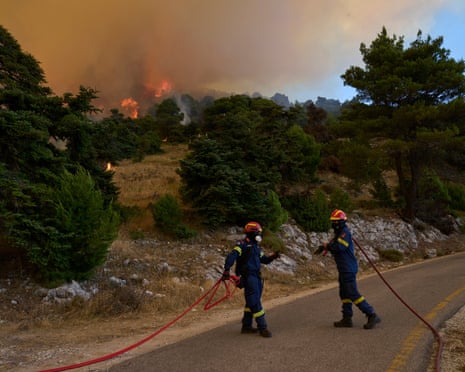
More than 30 aircraft joined 575 firefighters battling the blaze near the coastal village of Psatha, about 60 kilometres (37 miles) northwest of the capital, the fire service said.
“The situation has clearly improved compared to the last few days, but there are still many scattered hotspots, which means that forces remain on site to prevent a possible flare-up,” fire department communications chief Vassilis Vathrakoyannis told AFP.
But large areas of scorched terrain still concealed active and smouldering pockets that could quickly reignite if the wind picks up again.
Hungary hopes for rain to alleviate drought pressures on the Danube as operations at key power plant hangs in balance
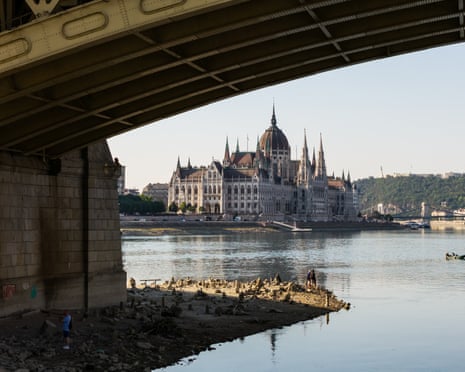
Hungary’s prime minister Péter Magyar said he was hopeful that “a potentially significant amount of rain could fall in the Austrian catchment areas sometime around Thursday,” which could help alleviate some of the immediate drought pressure on the Danube.
If it happens, the water level downstream in Hungary should increase within a week, he said.
But he added that “several factors” will determine whether Hungary’s critical nuclear power plant will be able to avoid a complete shutdown in the coming days, as country remains gripped by another heatwave.
The water level remained three centimetres above the lowest possible point, he said.
The current temperature in Budapest is 39C, and it’s expected to stay at this level for the next two to three days, putting extra strain on the country’s stretched energy grid.
German economy's prospect could be hit by impact from low levels in the Rhine
Other countries are also growing concerned about the impact of the current heatwaves and droughts on their economies.
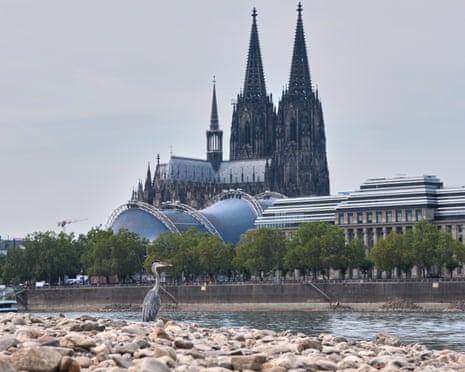
[• This caption was amended on 4 August 2026; an earlier version had misidentified the heron as a cormorant] Photograph: Martin Meissner/AP
Over in Germany, ING warned that record low water levels in the Rhine could shave 0.3% off Germany’s GDP growth this year.
In a note this afternoon, Carsten Brzeski, Global Head of Macro at ING, said that the Rhine is “Europe’s most important logistics corridor after the open seas,” connecting Rotterdam “directly with three of Germany’s largest industrial clusters.”
“When the Rhine runs low, the impact extends far beyond supply chains; it strikes at the heart of German industry,” it warned.
ING said that the river’s “historic importance also means there are no real alternatives,” as “replacing a single barge can require up to 100 trucks or an entire freight train.”
Austria breaks all-time temperature record
Meanwhile, Austria has become the latest country to report record-breaking temperatures today (12:48).
A new all-time high of 41C was measured in Vienna-Stammersdorf, surpassing the previous record of 40.8C reported, erm, earlier today, and 40.5C set in Bad Deutsch-Altenburg in 2013.
'Uncontrolled immigration is a threat to Europe and Denmark,' Danish minister says
Danish immigration minister Morten Bødskov also welcomed today’s meeting of EU ministers, stressing it is “absolutely crucial that we have control over the EU’s borders.”
Denmark has emerged as one of the countries most critical of Spain, with prime minister Mette Frederiksen joining calls to consider all options, including a move to suspend Spain’s participation in the Schengen area at one point.
But the language today is much softer, and Bødskov said he was “very pleased” with Spain’s “quick” response.
But he also insisted the continued pressure on the EU’s external borders “requires an immediate and firm response,” as he said “we will not accept a repeat of the situation from 2015,” and the previous large-scale migration crisis.
“Uncontrolled immigration is a threat to Europe and Denmark, and therefore it is a common European responsibility to secure the external borders and strengthen cooperation with the countries in our immediate vicinity, so that fewer people flee to Europe,” he said.
In his five-point manifesto, he called for more spending to be directed at strengthening the EU’s external borders, and a stronger border surveillance programme.
Asked by broadcaster TV2 specifically about the threat of restoring border controls, he said it was not a part of today’s discussions.
EU's Brunner criticises Spain's regularisation plans, even as he says no link to Ceuta
In another tricky question, Brunner curiously chooses to go out of his way to criticise Spain’s plans to regularise the status of over 1.2 million undocumented immigrants in the country.
Although he says there was no discussion or criticism on this point during today’s meeting, and asserts there is no “direct link” between the regularisation process and the events in Cueta, he then adds:
“But I always say to this regularisation discussion … it’s not a good signal, definitely not a good signal for the rest of Europe.
I do understand it’s a member state’s competence, and I do understand that Spain did it because it’s mainly about Latin Americans speaking the same language, having the same culture, but the signal for the rest of Europe is not a good one, definitely not.”
And that concludes the press conference.
Brunner also gets asked about alleged Russian disinformation on the migration crisis Cueta.
Ukraine’s foreign minister Andrii Sybiha warned about this problem last week, pointing to Russian networks using their connections to spread panic and disinformation.
Brunner says it is “a bit too early” to link it to Russia, although he has repeatedly acknowledged throughout the presser that there were repeated attempts to sow disinformation online more broadly.
He says there is an active EEAS – that’s the EU’s diplomacy service – investigation into whether it was just smugglers and human traffickers, or if there was a role played by Russia too.
Brunner also gets pushed on whether Italy was right to reintroduce border controls with Spain in the aftermath of this crisis.
He isn’t that keen to be drawn on this either, and says it’s a decision for individual member states.
But he delicately pushed back, saying that it’s now clearer that there will be no onward migration to the EU or Schengen, which he says was not clear when Italy made its decision on Friday.
He says he understands the images made EU citizens concerned, and that’s why some countries wanted to react strongly.
The Guardian’s Brussels correspondent Jennifer Rankin follows up on the question of whether the EU would be prepared to back some further work on the so-called return hubs and put some money into these projects.
But Brunner is evasive in his answer: he says it’s a matter for separate financial negotiations, and goes back to his broader point about the EU’s push to reform its asylum and returns policies.
Brunner also says it was clear there was some “interference from smugglers and human traffickers,” with “misinformation” spread on social media.
But he distances himself from any attempt to put the blame on Morocco too.
He says the Spanish minister actually acknowledged the role Morocco played in bringing the situation under control.
He also says he cannot comment on this further as there is a formal investigation into the crisis that will look at these things.
Brunner gets asked about Italy’s push for return hubs (13:26).
He says the idea was mentioned by some countries, as he references not just Italy’s plans with Albania but also separate proposals by five or six other countries.
He says it is one of the options, but also points to the need to focus on reforming the agreed asylum procedures.











.png)





.jpg)



 English (US) ·
  French (CA) ·