

.png) 4 hours ago
2
4 hours ago
2
PROTECT YOUR DNA WITH QUANTUM TECHNOLOGY
Orgo-Life the new way to the future Advertising by AdpathwayManqiang Liu, Lanzhou University, discusses their article: Elevated CO2 amplifies contrasting cultivar-specific plant‒soil feedbacks mediated by soil biota
Elevated CO2 concentration (eCO2) can promote plant biomass production, with these effects cascading to soil biota and, in turn, feeding back to plant performance. However, crop cultivars can differ greatly in their responses to eCO2. This raises a question: do soil biota-mediated plant–soil feedbacks (PSFs) contribute to these cultivar-specific responses? Answering this question could help us better understand and manage these feedbacks, and ultimately improve our ability to predict and regulate crop responses to climate change.
To find out, we combined a long-term rice free-air CO2 enrichment (FACE) experiment with a plant–soil feedback experiment. Two rice cultivars ‒ one with a weak response and one with a strong response to eCO2 ‒ had been grown under ambient or elevated CO2 conditions. We then used soil inocula from specific CO2 and cultivar combinations to test whether their legacy effects, including changes in soil microbial and nematode communities, influenced subsequent plant performance.
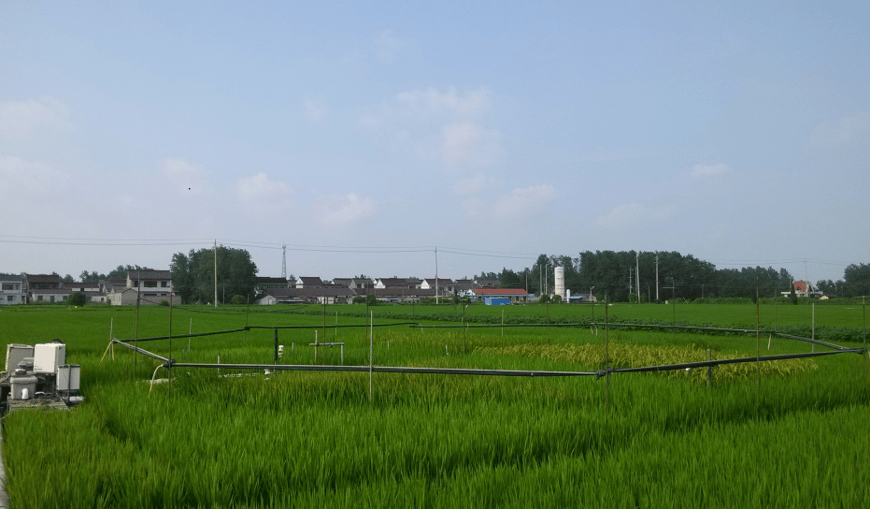 The free-air CO2 enrichment (FACE) platform in Zongcun Village, Yangzhou City, China (photo by Chunwu Zhu).
The growth-defence trade-offs and synergies in different rice cultivars are mediated by soil biota
We found that eCO2 amplified cultivar-specific PSFs, with the strongly responsive cultivar developing negative PSFs and the weakly responsive cultivar developing positive PSFs. Moreover, soil biota-mediated feedbacks altered growth–defence allocation under eCO2. The strongly responsive cultivar exhibited a growth–defence trade-off, with increased phenolic concentrations occurring at the expense of aboveground biomass production. In contrast, the weakly responsive cultivar showed a synergistic increase in both biomass and phenolic concentrations. Together, these findings demonstrate that eCO2 can induce contrasting soil biota-mediated feedbacks among rice cultivars, highlighting soil biota as a biological mechanism underlying cultivar-specific responses to eCO2.
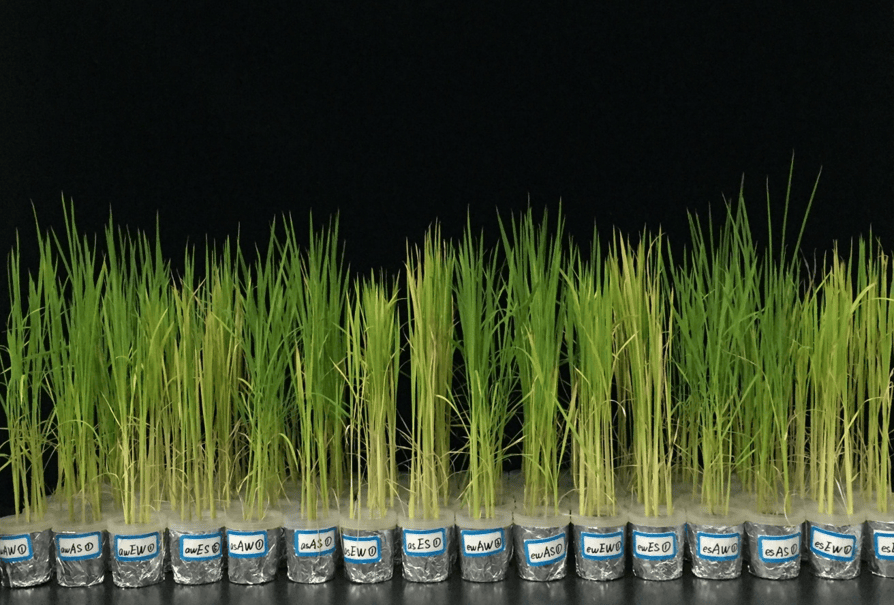 The performance of different rice cultivars in the plant-soil feedback experiment (photo by Linhui Jiang).
What does this mean for nature-based climate solutions?
Our findings suggest that climate-smart agriculture should consider plants and soil organisms together. Choosing high-yielding or strongly CO2-responsive cultivars may not be enough. Future breeding and cultivar selection should also prioritize cultivars that maintain positive responses to eCO2, interact beneficially with soil organisms, and resist soil herbivores.
By harnessing beneficial plant–soil feedbacks, we can develop nature-based solutions to climate change adaptation. This could help farmers translate the potential benefits of eCO2 into sustained crop production, enhanced agroecosystem functioning, and ultimately improved human well-being.












.png)






.jpg)



 English (US) ·
  French (CA) ·