

 15 hours ago
16
15 hours ago
16
PROTECT YOUR DNA WITH QUANTUM TECHNOLOGY
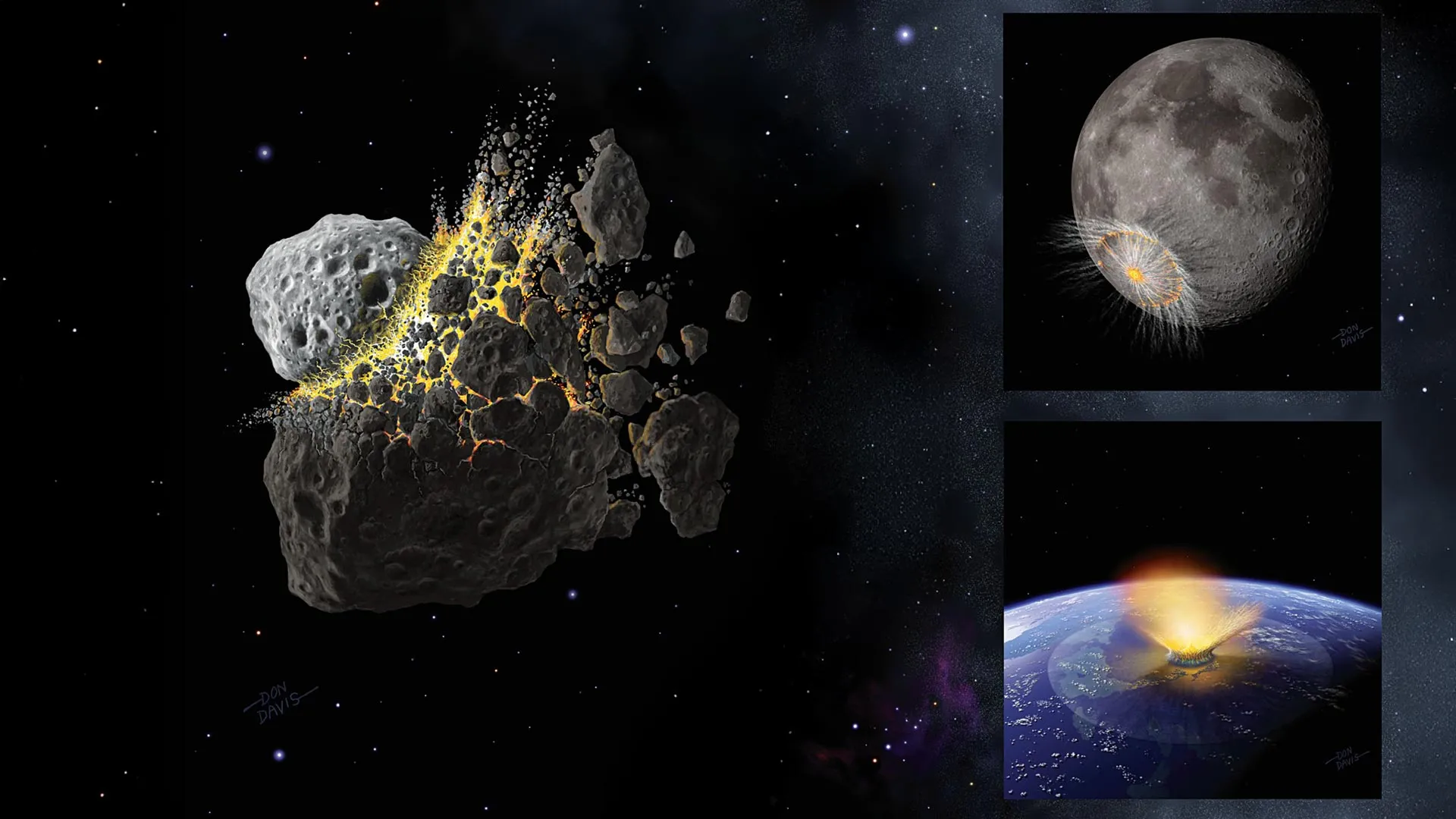
Orgo-Life the new way to the future Advertising by AdpathwayA rare type of meteorite known as a CO chondrite was likely the object that slammed into Earth 66 million years ago and triggered the extinction of about 75 percent of all species, including every non-avian dinosaur.
Researchers from the University of British Columbia (UBC), Paris, Brussels, and Vienna reached that conclusion by analyzing nickel isotopes preserved in material left behind by the Cretaceous-Paleogene impact. Their findings were published in Science Advances.
A Rare Meteorite Behind the Dinosaur Extinction
"Carbonaceous chondrites of the Ornans class are definitely not like the typical meteors you find in museum collections," says Dr. Philippe Claeys, who worked on the study as a visiting professor at UBC.
"A CO contains much less volatile elements -- like carbon, zinc, water and particularly sulfur -- than other classes of meteorites we've discovered so far on Earth. It doesn't alter our theory of what caused the extinction event -- but it makes it less likely that sulfur contained in the impactor was the smoking gun. The fine debris thrown into the atmosphere would have the primary factor."
That difference in composition could help scientists better understand how the impact caused such widespread destruction. Because CO chondrites contain relatively little sulfur, the new evidence suggests that sulfur from the meteorite itself may not have been the main driver of the catastrophe. Instead, enormous quantities of fine debris blasted into the atmosphere may have played the dominant role.
Nickel Isotopes Reveal the Impactor's Identity
Scientists from the Institut de Physique du Globe and Université de Paris carried out highly precise nickel isotope measurements on samples gathered over many years. The material came from a thin layer of clay deposited around the world after the impact.
"This is challenging work," adds Dr. Claeys, a professor with Vrije Universiteit Brussel currently visiting the Pacific Centre for Isotopic and Geochemical Research with Earth, Ocean and Atmospheric Sciences at UBC. "Only a minute fraction of the projectile is preserved in the planet's KT clay layer because the entire meteorite vaporized upon impact."
The global clay layer contains only faint traces of the original object, making it difficult to determine exactly what struck Earth. Even so, the nickel isotope signature allowed the researchers to narrow the impactor down to a rare class of carbonaceous meteorite.
Where Did the Dinosaur-Killing Meteorite Come From?
The meteorite's original source remains uncertain. It may have come from a distant region of the outer Solar System filled with rocky debris, or from the outer part of the asteroid belt near Jupiter.
Carbonaceous chondrites account for only about five percent of meteorites sampled on Earth. CO chondrites, also called carbonaceous chondrites of the Ornans class, represent only a very small portion of that group. They are considered some of the most primitive and least altered materials left from the formation of the solar system.
"Being impacted by such a rare, distant projectile really underscores how unlucky the dinosaurs were," says Dr. Claeys.
The Chicxulub Impact
The Cretaceous-Paleogene impactor measured an estimated 10 to 15 kilometers across, or about six miles wide. It struck Earth at roughly 64,000 km/h and created the enormous Chicxulub crater.
The impact site is now buried beneath Mexico's Yucatán Peninsula.











.png)






.jpg)



 English (US) ·
  French (CA) ·