

 3 hours ago
12
PROTECT YOUR DNA WITH QUANTUM TECHNOLOGY
Orgo-Life the new way to the future Advertising by Adpathway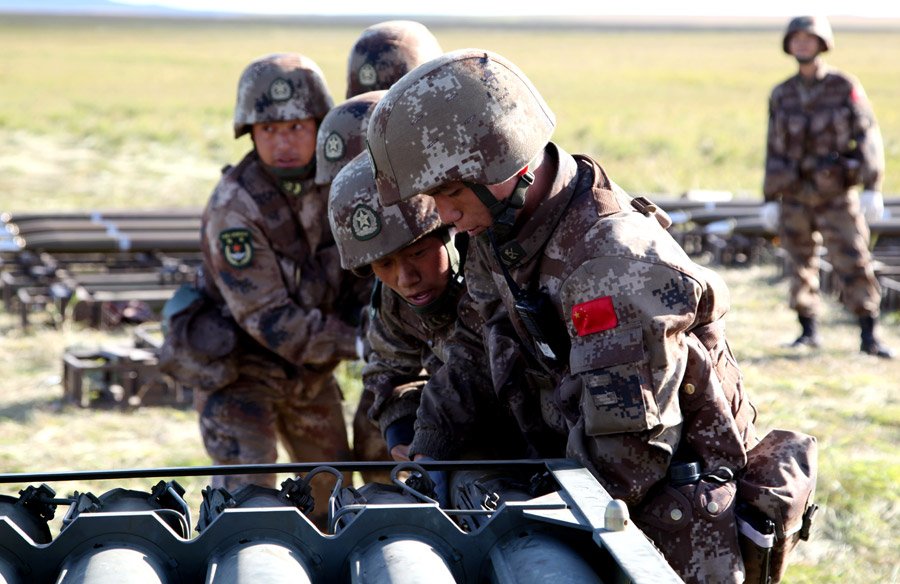 Soldiers from the People’s Liberation Army’s Northern Theater Command prepare for the Vostok-2018 military exercise in Russia’s Trans-Baikal region on Friday. Photo by Pan Mengqi/China Daily.
Russia is training Chinese soldiers in drone warfare and urban combat and has agreed to equip and train a battalion of Chinese paratroopers, while China supplies 90 percent of the sanctioned technology entering Russia.
“For decades, Russia armed China. Today the technology and the leverage flow the other way,” China Economic and Security Review Commission Vice Chair Mike Kuiken said. “Ukraine’s battlefields have become a classroom for the People’s Liberation Army,” he added, saying “the lessons are being studied with Taiwan in mind.”
From the 1990s into the early 2020s, Russia provided 77 percent of China’s arms imports while withholding its most advanced systems. The commission now cites reports of cooperation on China’s next-generation Type 096 ballistic missile submarine and on a missile defense system that would surpass Russia’s S-500. “If accurate, this cooperation directly affects U.S. naval posture and anti-submarine warfare planning in the Pacific,” the commission wrote.
That classroom moved to Russia’s Chelyabinsk region from Sept. 28 to Oct. 3 for Tsentr-2026, a strategic exercise involving more than 47,000 personnel. Russian Defense Minister Andrey Belousov said Russia built its preparations on its “unique experience” in Ukraine. Chinese troops from the Central Theater Command and its 82nd Group Army took part, and China Central Television reported that drone “swarms” fed target information to ground combat groups.
Chinese military commentator Song Zhongping argued that drones and precision-guided weapons now pose a greater threat to tanks than large armored clashes, and that studying armored losses can help the PLA counter such threats.
The paratrooper deal points directly at Taiwan. Contracts leaked by the hacktivist group Black Moon show Russia agreed in 2023 to supply equipment for a Chinese airborne battalion, including 37 BMD-4M amphibious assault vehicles, along with operator training and technology transfer.
The arrangement provides the PLA with experience directly applicable to a future campaign against Taiwan. The PLA also wants data on U.S. systems Taiwan fields, including HIMARS rocket launchers, and Russia may be passing along performance data on Western weapons.
Leaked material from a November 2023 China-Russia military-technical forum in Guangzhou shows how the two sides intend to pool what they know. Li Rong of the PLA Academy of Military Sciences noted that China has 160 types of loitering munitions but has barely tested them in combat, and proposed that Russia contribute frontline experience while China provides artificial intelligence and mass production to develop autonomous swarm munitions.
Researchers from China Aerospace Science and Technology Corporation presented a three-tier plan to neutralize Starlink through regulatory pressure, electronic warfare, cyberattacks and the destruction of satellites in orbit.
Beijing has its own reasons to keep Russia fighting. In July 2025, Foreign Minister Wang Yi reportedly told European Union foreign policy chief Kaja Kallas that China did not want Russia to lose the war because the United States would then focus entirely on China.
Since 2022, China has shipped $10.3 billion in high-priority export-controlled goods to Russia, including semiconductors, drone parts and machine tools. The commission also cited reports that China secretly trained Russian personnel on drone operations and provided satellite imagery to track Ukrainian targets and guide missile strikes.
The partnership reaches into the Pacific and the Arctic. In July, the two navies conducted joint operations and patrols featuring submarine, anti-submarine and drone operations. In 2024, Chinese bombers on a joint patrol with Russia entered the Alaskan air defense identification zone for the first time. Chinese state-owned companies hold a combined 20 percent stake in Russia’s sanctioned Arctic LNG 2 project, and the two countries are developing year-round commercial shipping along the Northern Sea Route.
Russia continues to test those methods in Ukraine. Its forces struck more than 200 petrol stations in June and July, and in early October its drones hit Kyiv’s Southern and Northern bridges over the Dnipro. Chinese industry supports that campaign. In October 2024, the Treasury Department found that Xiamen Limbach Aircraft Engine Co. produced the L550E engine for Russia’s Garpiya attack drones.
Washington has gone after the industrial side of the relationship. The Garpiya action marked the Treasury Department’s first sanctions on Chinese entities “directly developing and producing complete weapons systems.” Treasury has sanctioned nearly 300 Chinese and Hong Kong individuals and entities, and the Commerce Department has placed more than 158 on its Entity List, the commission said. Chinese state-owned firms suspended purchases of Russian seaborne oil in October 2025, yet China’s crude imports from Russia ended the year down only about 8 percent.
On Sept. 18, Trump signed the Lindsey O. Graham Sanctioning Russia and Iran Act of 2026. Section 113 directs duties of up to 100 percent on goods from the five largest importers of Russian crude oil or natural gas that keep buying, as well as from the top five countries facilitating evasion of Russian oil sanctions. The measure is expected to fall hardest on China and India, Al Jazeera reported. Trump and Xi discussed the war at the White House on Sept. 24, but China’s Foreign Ministry said only that they “exchanged views,” and neither side released details.
On Sept. 30, Secretary of War Pete Hegseth announced plans for an Autonomous Warfare Command to expand U.S. drone and robotic capabilities. In Taiwan, American Institute in Taiwan director Raymond Greene told a July drone industry forum that “nothing will deter conflict more effectively than turning Taiwan into a hornet’s nest of air, surface, and subsurface drones.” Both Beijing and Washington are drawing on the same war, one to prepare for an attack on Taiwan and the other to prevent it.
Ad block users: Some site features may not work correctly while an ad blocker is enabled, because they break scripts and content this website depends on. If you can't see comments below, for example, please disable your ad blocker.








.png)






.jpg)



 English (US) ·
 French (CA) ·