

 10 hours ago
1
10 hours ago
1

The abrupt dismissal of Ukraine’s Defense Minister Mykhailo Fedorov has ignited public outrage and exposed deep division within the country’s leadership.
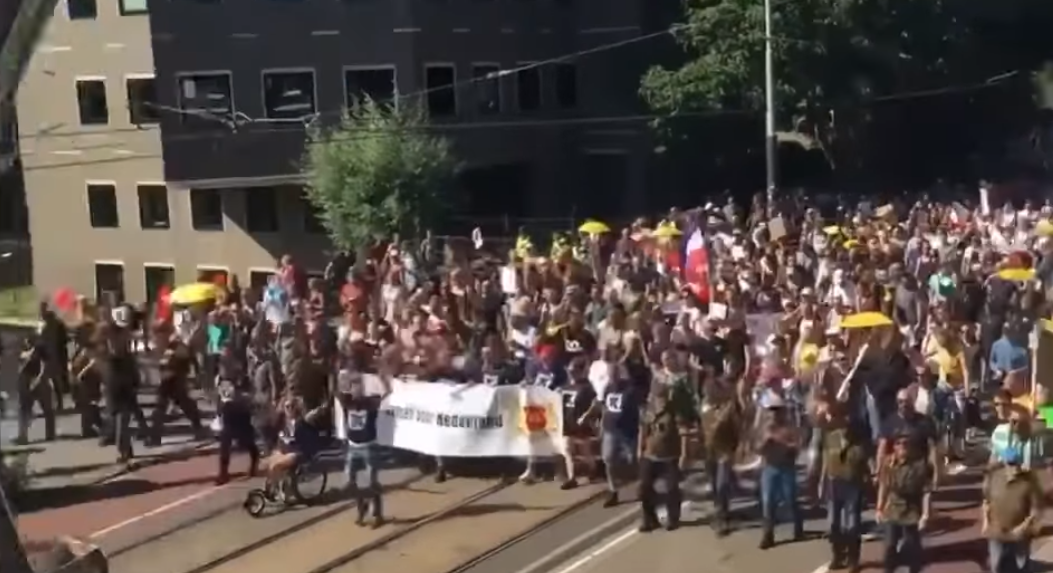
Hundreds took to the streets in Kyiv and other cities, waving signs reading “Hands off Fedorov” and “Stop sabotaging victory!”
These protests highlight broader concerns over wartime strategy, and the persistent influence of old power networks.
To read this article in the following languages, click the Translate Website button below the author’s name.
українська мова, عربي, Hebrew, Русский, Farsi, Български, Español, Portugues, 中文, Français, Deutsch, Italiano, 日本語, 한국어. And 40 more languages.
Fedorov, appointed in January 2026, brought a somewhat unusual profile to the role. A digital marketing entrepreneur and founder of SMMSTUDIO, he had served as an early architect of Zelensky’s social media strategy rather than rising through traditional nationalist or oligarchic circles.
Unlike many post-2014 figures tied to Rinat Akhmetov, oligarch Ihor Kolomoisky (President Zelensky’s former patron), or other established networks, Fedorov emerged from the IT startup world. Western observers often portrayed him as part of a “new generation” of technocrats. In previous roles as Minister of Digital Transformation, and Deputy Prime Minister of Ukraine, he cultivated close ties with Elon Musk on Starlink matters, and with Palantir, as well as with Microsoft, Google, and Amazon, pushing aggressively for drone innovation and modern procurement. It is perhaps fair to describe him as a sort of modernizing bridge between Ukraine and the West.
During his short tenure (as Defense Minister), Fedorov redirected salary funds into military tech, advanced Ukraine’s drone program for asymmetric strikes, and championed greater transparency in contracts. He played a key role in disrupting Russian operations to some degree, including efforts to limit Moscow’s use of Starlink as well as supporting mid- and long-range attacks that targeted supply lines and infrastructure.
These drone campaigns, while generating some economic pressure on Russia, have in fact had more limited strategic impact than headlines suggest, as Moscow has adapted through repairs, dispersal, and alternative routes. As I noted earlier, such strikes on energy assets (including in Crimea) create temporary disruptions but rarely deliver decisive blows without complementary ground pressure.
In any case, such campaigns have given Fedorov some fame, which partly explains the protests over his dismissal.
His removal stems from an escalating feud with Commander-in-Chief General Oleksandr Syrskyi. Zelensky cited an inability for the two to “work together”. Fedorov in turn has openly accused Syrskyi of blocking initiatives on drones and reforms, claiming the general had chosen to “split the country” rather than focus on “defeating Russia asymmetrically”.
General Syrskyi, for his part, has responded curtly, emphasizing his focus on the battlefield, with commanders reportedly being ordered to post video messages in support of Syrskyi. Cabinet divisions became evident as complaints grew and even some officers, like deputy air force commander Col. Pavlo Yelizarov, resigned in protest, warning of weakened defenses.
One would be mistaken in seeing all of this as just some personality clash. Responsible Statecraft expert Mark Episkopos described Fedorov as someone who walked into a “Zelensky corruption buzzsaw.” His efforts to make procurement more competitive purportedly threatened well-connected suppliers and alleged crony networks profiting from inflated contracts.
By cutting out politically favored companies and enforcing transparency, the former minister allegedly angered powerful circles in politics and defense. Episkopos notes that executing a viable “middle strike” strategy required dealing with entrenched misconduct within the war effort, something that made Fedorov enemies in the bureaucracy and defense-industrial sector. His dismissal thus risks stalling reforms precisely when innovation could offer Kyiv one of its few operational advantages.
This episode reveals deeper structural problems. Ukraine has long struggled with a corruption issue that undermines its defense and energy sectors. Endemic graft previously damaged even infrastructure and aid effectiveness (as I remarked back in 2024), with Transparency International ranking it at 104 out of 182 countries in 2025, and The Guardian describing it as “the most corrupt nation in Europe” back in 2015, on level with Uganda in this issue.
The “shady business” factor is a persistent challenge, amid years of Western support during the West’s proxy war against Moscow – and billions supposedly missing in an imbroglio that cuts both ways.
The Ukrainian President’s recent decision, part of a broader cabinet reshuffle including a new Prime Minister with energy sector experience, comes amid ongoing mobilization pressures and questions over how billions in aid are managed.
Image: Syrskyi with Valerii Zaluzhnyi (right) during the battle for Kyiv, 2022 (CC BY 4.0)

More broadly, this crisis fits a pattern of underreported intrigues within Kyiv’s deep state. One might recall earlier tensions, such as those involving former commander Valerii Zaluzhny, typically including rivalries among security services, oligarchs, and at times the far-right nationalist networks that have shaped Ukrainian politics since 2014.
A cynic could argue Fedorov is a bit of an outsider in post-Maidan Ukraine for not having enough oligarchic or neo-Fascist connections. Be as it may, intense power struggles, including reported assassination plots and influence plays have haunted the country during wartime.
Such dynamics may of course complicate any coherent strategy against Russia that maintains advantages in manpower, industrial output, and territorial momentum despite Ukrainian limited drone successes.
In any case, Fedorov’s ouster has drawn mixed reactions even within the country. Protests reflect mostly frustration among younger Ukrainians who saw Fedorov as a symbol of modernization.
In general, Ukraine’s challenges are compounded by his reliance on external aid.
This episode is yet another chapter in the systemic issues that have haunted the country for over a decade. High levels of corruption and elite rivalries still undermine any potential breakthroughs, even as innovative tools offer some tactical gains. In this context, political will and internal unity may prove as decisive as battlefield technology.
*
Click the share button below to email/forward this article. Follow us on Instagram and X and subscribe to our Telegram Channel. Feel free to repost Global Research articles with proper attribution.
This article was originally published on InfoBrics.
Uriel Araujo, Anthropology PhD, is a social scientist specializing in ethnic and religious conflicts, with extensive research on geopolitical dynamics and cultural interactions. He is a regular contributor to Global Research.
Featured image is from the author/InfoBrics
Global Research is a reader-funded media. We do not accept any funding from corporations or governments. Help us stay afloat. Click the image below to make a one-time or recurring donation.













.png)






.jpg)


 English (US) ·
  French (CA) ·