

.png) 1 month ago
35
1 month ago
35
PROTECT YOUR DNA WITH QUANTUM TECHNOLOGY
Orgo-Life the new way to the future Advertising by AdpathwayNEW YORK (AP) — Oil prices plunged below $100 a barrel and Asia markets and U.S. stock futures jumped after the U.S. and Iran agreed to a two-week ceasefire that includes the reopening of the Strait of Hormuz.
Japan’s benchmark Nikkei 225 rose 4.8% and South Korea’s Kospi gained 5.6%. Futures for the S&P 500 advanced 2.3% as of 9:30 p.m. EDT, while Dow futures rose 2%.
Futures for U.S. crude oil sank 14.3% to $96.83 a barrel and Brent crude oil, the international standard, dropped 13.3% to $94.74. Oil prices had spiked because the war snarled the production and transportation of crude in the Persian Gulf. Much of that oil exits the gulf through the Strait of Hormuz to reach customers around the world, but Iran had blocked it to enemies.
Late Tuesday, Trump said he was holding off on his threatened attacks on Iranian bridges, power plants and other civilian targets. Iran’s foreign minister said passage through the strait would be allowed for the next two weeks under Iranian military management.
The dramatic moves in prices are just the latest swings to hit financial markets since late February because of constantly shifting signals about when the conflict may end. Even with word of a ceasefire, neither Iran nor the United States said when it would begin, and attacks took place in Israel, Iran and across the Gulf region early Wednesday.
Earlier, U.S. stocks swung sharply during regular trading as uncertainty about the war with Iran increased after Trump had threatened that a “whole civilization will die tonight, never to be brought back again” if Iran does not meet his deadline at 8 p.m. Eastern time to open the Strait of Hormuz.
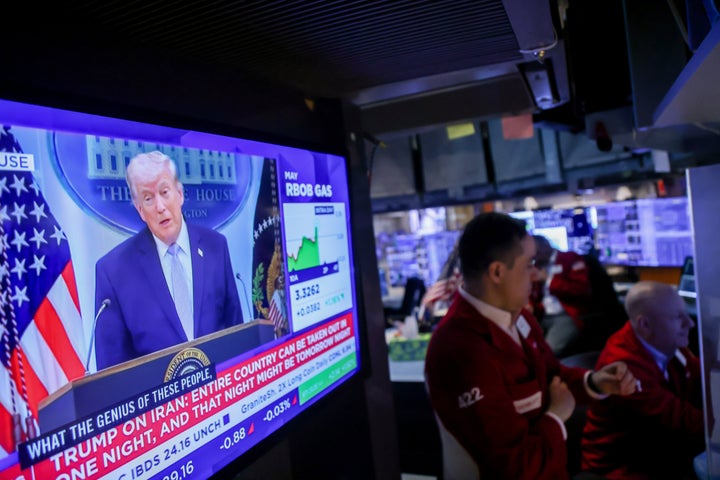
Bloomberg via Getty Images
The S&P 500 fell as much as 1.2% but stocks rallied at the end of trading after Pakistan’s prime minister urged Trump to extend his deadline for another two weeks and asked Iran to open up the strait for the same amount of time.
The S&P 500 erased all its losses and ended with a modest gain of 0.1%. The Dow Jones Industrial Average dipped 85 points, or 0.2%, and the Nasdaq composite added 0.1%.
They’re the latest swings to hit financial markets since late February because of deep uncertainty about when the fighting may end.
Oil prices were likewise shaky. The price for a barrel of benchmark U.S. crude to be delivered in May briefly climbed above $117 before settling at $112.95.
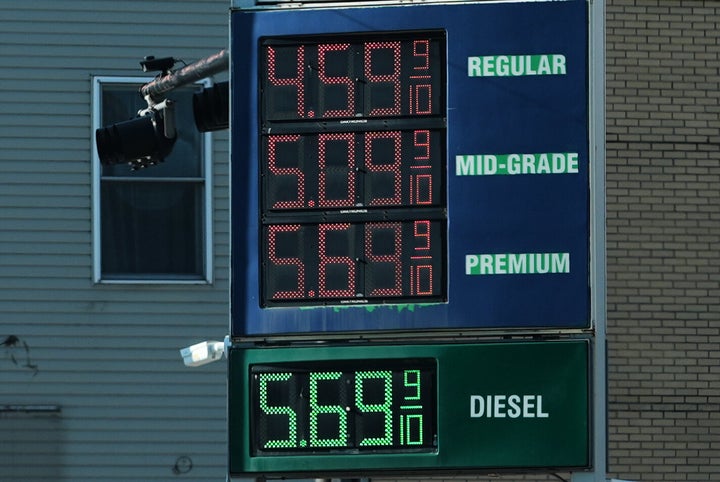
via Associated Press
Oil prices have spiked because the war has snarled the production and transportation of crude in the Persian Gulf. Much of that oil exits the gulf through the Strait of Hormuz to reach customers around the world, but Iran has blocked it to enemies.
The worry in markets has been that a long-term disruption will keep oil prices high for a long time and send a painful wave of inflation crashing through the global economy. Trump kept traders on edge by making a series of threats to blow up Iranian power plants only to delay several times.
The average price for a gallon of regular gasoline across the United States has leaped to $4.14, according to AAA. It was below $3 a couple days before the United States and Israel launched attacks to begin the war in late February.
In the bond market, Treasury yields eased on word of a potential cease-fire. The yield on the 10-year Treasury fell to 4.24% from 4.30% earlier Tuesday.
That’s still well above its 3.97% level from before the war, and the rise has pushed up rates for mortgages and other loans going to U.S. households and businesses, which slows the economy.










.png)






.jpg)



 English (US) ·
  French (CA) ·