

.png) 10 hours ago
6
10 hours ago
6
PROTECT YOUR DNA WITH QUANTUM TECHNOLOGY
Orgo-Life the new way to the future Advertising by Adpathway
Natural remedies for menopause symptoms 2026 are getting more attention because symptom burden is rising, not falling. According to Bonafide’s State of Menopause 2026 survey, 72% of respondents said their symptoms were more disruptive than expected, up from 58% in 2023.
Natural remedies for menopause symptoms covers herbs, food-based phytoestrogens, acupuncture, movement, and stress work. Evidence quality varies wildly: some hold up in trials, while others, like wild yam cream, have failed double-blind testing.
The throughline: match the remedy to the symptom, and measure whether it works for you.
Black Cohosh and Soy for Menopause: What the Evidence Actually Shows
Black cohosh and soy for menopause are the two most studied options, but they work in different ways. Black cohosh is an herbal extract. Soy contains phytoestrogens, plant compounds that weakly mimic estrogen.
Black Cohosh: Trial Data and Dosing Reality
Black cohosh has the strongest trial base of any herb on this list. A 2023 review covering 22 randomized controlled trials reported that black cohosh reduced the occurrence of vasomotor symptoms, according to Natural Health Research’s review of menopause approaches.
What most guides miss is the interaction risk: black cohosh is not appropriate with a history of liver problems and can interact with other medicines. Talk to your clinician first.
Soy, Phytoestrogens and Red Clover: Food First, Pills Second
Soy foods are the safer starting point. Tofu, edamame, tempeh and soy milk deliver phytoestrogens alongside protein and fiber. Red clover is another phytoestrogen source, and the NHS guidance on herbal menopause remedies lists it among the complementary medicines women use.
Whole soy foods are cheap, well tolerated, and easy to add to meals you already eat.
| Black cohosh | Hot flashes, night sweats | Moderate (22 trials) | Liver history, drug interactions |
| Soy foods | Hot flushes, general support | Moderate | Thyroid medication timing |
| Red clover | Hot flushes | Limited | Blood-thinning drugs |
| Wild yam cream | Not recommended | Failed vs placebo | No measurable benefit |
Natural Ways to Relieve Menopause Sleep Issues
Natural ways to relieve menopause sleep issues work best when you match the remedy to the reason you’re waking up. Night sweats and anxiety-driven insomnia need different approaches.
First, Separate the Two Types of Menopause Insomnia
Menopausal sleep problems fall into two patterns:
- Vasomotor-driven waking: You wake drenched in sweat, often around 2-4 a.m. The trigger is a hot flash, not a sleep disorder.
- Anxiety- or cortisol-driven waking: You wake and can’t fall back asleep, often with a racing mind. No sweating involved.
The fix is different for each. A cooling intervention won’t help anxiety-driven waking, and a breathing practice won’t stop a night sweat.
What the Evidence Shows for Sleep-Specific Remedies
| Cognitive behavioral therapy for insomnia (CBT-I) | Both types; first-line for chronic insomnia | Strong (well-established in general insomnia; increasingly studied in menopause) | 4-8 structured sessions, in person or digital | Requires active participation; effects build over weeks |
| Black cohosh | Night sweats that wake you | Moderate (22 RCTs, benefit described as modest) | Commonly 20-80 mg standardized extract daily in trials | Liver history, drug interactions |
| Soy isoflavones | Hot flushes and associated night waking | Moderate for flushes; limited for sleep specifically | Food-first; supplement trials often 40-80 mg isoflavones daily | Thyroid medication timing |
| Magnesium | General sleep quality, muscle tension | Limited in menopause specifically; better data in older adults | Commonly 200-400 mg elemental magnesium in the evening | Loose stools at higher doses; kidney disease caution |
| Vitamin D3 | Sleep quality where deficiency exists | Limited for sleep; correcting deficiency is reasonable | Typical 1000-2000 IU daily; dose depends on blood level | Toxicity at very high doses |
| Melatonin | Sleep-onset difficulty (less useful for night sweats) | Moderate for sleep onset generally; limited menopause-specific data | Commonly 0.5-3 mg, 30-60 minutes before bed | Interactions with blood thinners, some antidepressants |
A key distinction: evidence for reducing hot flashes is not the same as evidence for improving sleep. Black cohosh and soy may reduce night sweats, indirectly improving sleep continuity, but they are not sleep aids. Magnesium and melatonin target sleep directly but have weaker menopause-specific data.
A Practical Order to Try Things
- Cool the sleep environment first. Free, immediate, and addresses vasomotor waking directly. Layer bedding you can peel off.
- Cut caffeine after midday and alcohol in the evening. Both worsen night sweats and sleep fragmentation.
- Add one targeted intervention. Night sweats waking you? Consider black cohosh or soy isoflavones. Waking without sweating? Consider CBT-I or magnesium.
- Give it 6-8 weeks before judging. Sleep changes are slow and placebo effects are strong.
- Escalate if nothing changes. Persistent insomnia deserves clinical assessment, not another supplement.
Pro Tip
Track your wake-ups for two weeks before changing anything. Note the time, whether you were sweating, and how long it took to fall back asleep. If you wake at 3 a.m. drenched, that’s a vasomotor issue. If you wake and can’t fall back asleep, that’s more likely anxiety or cortisol timing. The fix is different for each.
When Sleep Problems Need Medical Assessment
See a clinician if insomnia lasts more than a few weeks, if you snore heavily or gasp during sleep (possible sleep apnea), or if daytime sleepiness affects your safety. Natural remedies support sleep; they don’t replace evaluation for a sleep disorder.
Acupuncture for Menopause Hot Flashes: What to Expect From a Course of Treatment
Acupuncture for menopause hot flashes is usually delivered as a course, not a single session. Cleveland Clinic and other major health bodies list acupuncture among the mind-body options for symptom management, according to Cleveland Clinic’s menopause resource pages.
Expect reduced hot flash frequency and severity for some women, little change for others; the effect often fades after treatment stops.
Here’s how to judge a course honestly:
- Record hot flash frequency daily for two weeks before you start
- Keep recording through the full course
- Compare week 1 with week 10, not day to day
Acupuncture is generally well tolerated. The main downside is cost and time, since sessions are frequent and rarely cheap.
Menopause and Anxiety Management: A Step-by-Step Plan
Menopause and anxiety management works best as a structured plan: falling estrogen affects mood regulation, poor sleep worsens it, and worry about symptoms adds another layer. Here’s the evidence and a measurable sequence. Establishing a consistent routine for managing menopause symptoms provides the necessary stability to navigate the broader spectrum of Menopause Symptoms in Midlife Women.
What the Evidence Shows for Anxiety-Specific Approaches
| Cognitive behavioral therapy (CBT) | Anxiety, mood, hot flash distress | Strong for anxiety generally; growing menopause-specific data | 6-12 structured sessions | Requires active participation; effects build over weeks |
| Regular aerobic exercise | Mood, anxiety, sleep, hot flushes | Moderate across multiple outcomes | 20-30 minutes most days, ideally outdoors | Start gradually; overtraining can worsen cortisol |
| Mindfulness and breathing practices | Anxiety, stress reactivity | Moderate for anxiety; limited for hot flushes specifically | 10 minutes daily, or 8-week structured programs | Benefits depend on consistency |
| Yoga | Anxiety, sleep, general wellbeing | Moderate for mood; limited for vasomotor symptoms | 2-3 sessions weekly, 30-60 minutes | Avoid hot yoga if night sweats are an issue |
| St John’s wort | Low mood | Moderate for mild-to-moderate depression in general populations | Commonly 300 mg standardized extract three times daily in trials | Significant drug interactions, including antidepressants, birth control, blood thinners; not appropriate with many prescriptions |
| Omega-3 fatty acids | Mood support | Limited and inconsistent for anxiety specifically | Commonly 1-2 g combined EPA/DHA daily | Fishy aftertaste; bleeding risk at high doses with blood thinners |
A key distinction: evidence for reducing hot flashes is not the same as evidence for improving mood. Exercise and CBT have the broadest evidence across mood, anxiety, and sleep. St John’s wort has evidence for depression but carries interaction risks that make it a poor first choice for many women on other medications.
A Step-by-Step Sequence
- Stabilize sleep first. Anxiety and insomnia feed each other; use the sleep section above before adding anything new.
- Add 20-30 minutes of daily movement, ideally outdoors. Morning light plus exercise beats either alone for mood.
- Practice 10 minutes of breathing or mindfulness daily. Consistency matters more than duration.
- Cut alcohol. It worsens sleep and mood and can trigger hot flashes.
- Consider a structured program if symptoms persist. CBT or an 8-week mindfulness course has better evidence than most supplements for anxiety.
- Talk to a clinician if low mood lasts more than two weeks. This is not a supplement decision.
Safety and Interaction Cautions
- St John’s wort interacts with many prescription medicines, including antidepressants, oral contraceptives, and blood thinners. Do not combine it with SSRIs or SNRIs without medical supervision.
- Black cohosh should be avoided with a history of liver disease.
- Soy can affect thyroid medication absorption, so separate doses.
Watch Out
Do not treat persistent low mood, hopelessness, or loss of interest as “just hormones.” These need medical assessment. Natural approaches support treatment; they don’t replace it. If you have thoughts of self-harm, seek help immediately.
When Anxiety Needs Medical Assessment
See a clinician promptly if anxiety interferes with daily life, if you have panic attacks, or if low mood persists beyond two weeks. Natural remedies support symptoms; they don’t diagnose or treat a mental health condition.
Building Your 10-Week Natural Remedies Plan: Dosing, Duration and Measurement
Structure matters more than the products you pick.
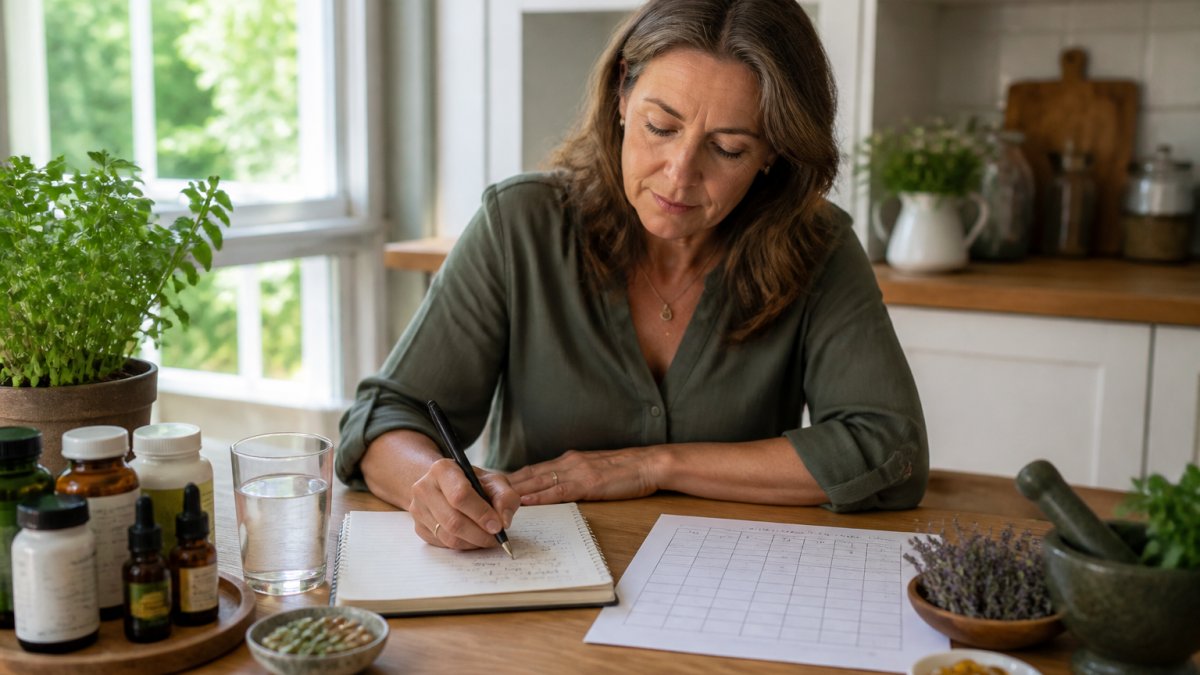 A woman in her early fifties sitting at a sunlit kitchen table with a notebook, pen and a glass of water, writing notes beside a weekly symptom tracker sheet
Start with one change at a time. Add black cohosh, soy, acupuncture and a new sleep routine in the same week, and you’ll never know which one helped.
What to Track and When to Stop
Track four things daily: hot flash frequency, night sweats, sleep quality, and mood. Score each from 1 to 5. A one-third reduction in your main symptom by week 10 is a reasonable sign the remedy is working.
Stop a remedy if:
- There’s no change by week 8
- You get side effects
- It interacts with a medicine you take
| 1-2 | Baseline tracking | Symptom scores, no changes yet |
| 3-4 | Add one remedy | Daily scores, side effects |
| 5-6 | Add movement or stress work | Sleep quality, mood |
| 7-8 | Review | Compare to baseline |
| 9-10 | Keep, adjust, or stop | One-third reduction target |
Safety, Interactions and When Symptoms Need Medical Assessment
Safety comes before effectiveness. The NHS lists evening primrose oil, black cohosh, angelica, ginseng, St John’s wort and red clover as complementary medicines used for menopause symptoms, per NHS herbal remedies guidance.
Key cautions:
- St John’s wort interacts with many prescription medicines, including antidepressants
- Black cohosh should be avoided with a history of liver disease
- Soy can affect thyroid medication absorption, so separate doses
See a clinician promptly if you have bleeding after menopause, a breast lump, chest pain, or symptoms that disrupt daily life. Natural remedies support symptoms; they don’t diagnose anything.
Key Takeaway
The safest approach is to tell your doctor about every herb and supplement you take. Bring the bottle. Most interactions are manageable when someone knows about them.
Conclusion: How to Decide What Is Worth Trying
Deciding what’s worth trying comes down to three questions: does the evidence support it, is it safe for you, and can you measure a change? A 2026 study in Frontiers in Global Women’s Health found that women’s awareness of menopause symptoms and treatment options remains inadequate.
At Alternative Medicine, we built our coverage around that idea: evidence-based information on natural remedies and holistic treatments, a focus on integrative medicine, and guidance rooted in our “food is medicine” approach. No hype, no miracle claims.
Start with one remedy, track it for ten weeks, and keep what works.
Frequently Asked Questions
What is the best natural thing to take for menopause?
There is no single best option, because evidence varies by remedy and by symptom. A 2023 review of 22 randomized controlled trials reported that black cohosh reduced the occurrence of vasomotor symptoms, though the review does not specify the size of that effect. Wild yam cream, by contrast, performed no better than placebo for menopause symptoms or hormone levels in a double-blind crossover study summarized in a 2019 PMC review. Match the remedy to your main symptom, set a review date, and track hot flash frequency and sleep quality rather than relying on how you feel in week one.
Which natural remedies may help with menopause hot flashes?
Black cohosh has the clearest trial support among the herbs the NHS lists for menopause symptoms, based on the 2023 review of 22 randomized controlled trials. Soy foods and other phytoestrogen sources such as red clover are commonly used, and the NHS also names evening primrose oil, angelica, ginseng and St John’s wort as complementary medicines people try. Acupuncture is another option for hot flashes. Because the supplied research does not establish consistent effectiveness across all of these, treat each one as a time-limited trial with a measurable outcome, not a guaranteed fix.
Can lifestyle changes help with menopause-related sleep problems?
Yes, and they are usually the first thing to adjust. Cleveland Clinic, Breastcancer.org and the World Health Organization all present lifestyle and mind-body approaches, including yoga, meditation, physical activity, dietary changes and sleep measures, as options for managing menopause symptoms. A 2026 Frontiers in Global Women’s Health study found that women’s knowledge and awareness of menopause symptoms and treatment options remained inadequate, which suggests many people never get told how much sleep hygiene and stress management can shift night sweats and fatigue. Start with a consistent sleep window and a cooler bedroom, then add one mind-body practice.
Are menopause supplements and herbs safe to take?
Not automatically. The NHS lists evening primrose oil, black cohosh, angelica, ginseng, St John’s wort and red clover as complementary medicines used for menopause symptoms, but the supplied research does not show these are appropriate for everyone. St John’s wort is the classic example of a herb that can interact with prescription medicines, and anyone already taking HRT, antidepressants or treatment for a chronic condition should check with a pharmacist or doctor before adding anything. Talk to a healthcare professional if symptoms are severe, if bleeding returns after menopause, or if a remedy causes new side effects.









.png)





.jpg)



 English (US) ·
  French (CA) ·