

 8 months ago
96
8 months ago
96

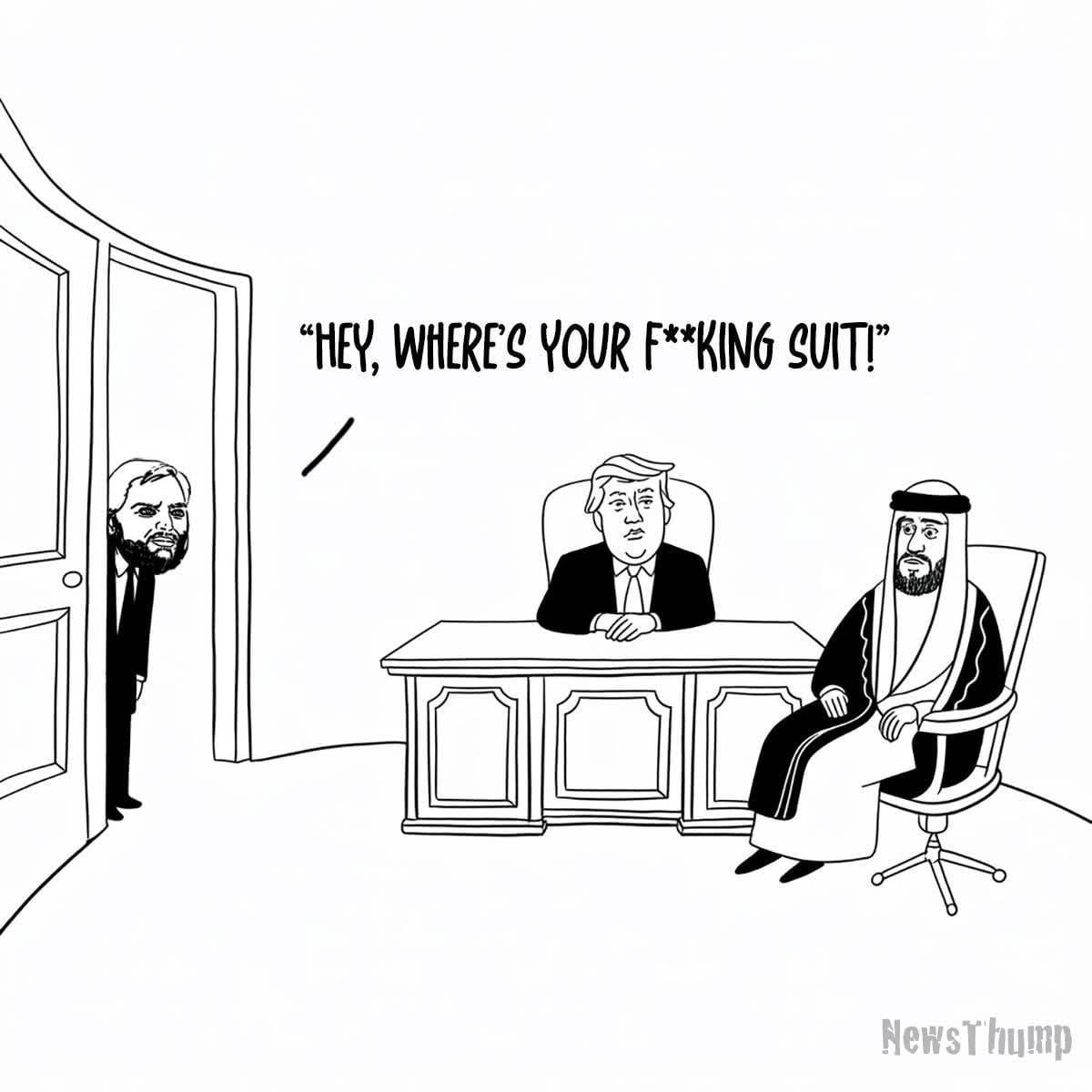
Author’s Note: Sometimes a single cartoon reveals a century of geopolitics. In a vicious image circulating across Arab social media, Donald Trump sits at the Resolute Desk, Saudi Crown Prince Mohammed bin Salman (MBS) sits opposite him in a thobe, and a frantic aide screams: “Where’s your fucking suit?”
Crude as it is, the insight is clean: power in the region still depends on Arab rulers dressing for Western approval. That truth — bare and unembarrassed — is exactly why Gaza is now pushing the entire architecture of Western dominance to its breaking point.
***
The Politics of Attire
In the week before Mohammed bin Salman traveled to Washington, Arab social media buzzed with a debate that should have been trivial: Would he appear in a suit or in his thobe? The intensity of this discussion was telling. Gulf rulers are almost alone in the contemporary world in preserving their traditional dress on international stages — a rare insistence on cultural continuity in arenas designed to enforce sameness. Their attire is not fashion; it is identity, history, sovereignty stitched into fabric.
Yet the frenzy over MBS’s clothing choice revealed an uncomfortable truth: attire has become a political signal, a visible shorthand for geopolitical alignment. In the Middle East, clothing is not merely personal expression but an index of power — how close one stands to the West, how much one wishes to reassure it, how willing one is to perform deference for Western approval.
In the American imagination, the symbolism is even starker. An Arab ruler becomes “respectable” only when he sheds his own cultural skin and adopts the costume of Western alignment. The thobe marks autonomy, an unruly reminder of a world not shaped around Western norms. The suit signals obedience — submission masked as sophistication. Clothing becomes a soft language of deference.
Beneath this expectation lies a deeper, older stereotype: the Arab caricature — oil-rich but primitive, dangerous or unserious unless dressed in Western clothes. This is the Cold War cartoon still animating elite imaginations: the desert potentate made legible only when wrapped in Western fabric. The choice of attire is thus not merely aesthetic; it is a test. Wear the thobe, and you risk being read as defiant or uncivilized. Wear the suit, and you reassure the metropole that you know your place.
What circulated on social media as a wardrobe question was, in reality, a referendum on political subordination. The cartoon simply made explicit what the diplomatic stage always implied.
.
.
Hierarchy of Power
These stereotypes do not operate in isolation; they anchor a political architecture that has structured the Middle East for nearly a century. The region’s order is not a loose arrangement of alliances but a hierarchy with clearly differentiated roles, each calibrated to sustain Western dominance.
At the top sits the United States, which designs, oversees, and enforces the regional order. It sets the rules of diplomacy, adjudicates the limits of acceptable violence, controls access to global financial systems, and decides which actors are insulated from consequence. Its military footprint — from bases to fleets to weapons sales — creates the security environment in which all others must operate.
At the next level stands Israel, the designated Western outpost. It is not treated as a normal state but as a forward position for American power: a military laboratory, a regional intelligence hub, a dependable enforcer, and a strategic asset whose qualitative edge must be preserved at all costs. Israel’s supremacy is not merely protected; it is institutionally guaranteed, embedded in U.S. law, arms supply, diplomacy, and media narratives. This is why no amount of brutality imperils its standing: its role is structural, not moral.
And beneath them lies Saudi Arabia, indispensable yet never fully trusted. The kingdom’s function is transactional — to stabilize global oil markets, invest its vast capital in Western financial institutions, to contain regional anger, deflect public outrage, and provide political cover for U.S. strategy, punished when it deviates, and consistently reminded that its value lies in its predictability, not its independence. It is a partner only so long as it remains compliant.
Moments of Exposure
The hierarchy surfaced starkly after 9/11, when a single diplomatic gesture revealed the limits of Saudi agency. Prince Al-Waleed bin Talal offered New York City a US$10 million donation — an act meant as solidarity but accompanied by a mild observation: that the attacks could not be separated from U.S. policy toward Palestinians. Rudy Giuliani rejected the donation instantly.
The message was unmistakable: Saudi money was welcome, but Saudi interpretation was not.
Compassion was permissible only if emptied of political meaning — sympathy allowed, analysis forbidden. Even a billionaire prince could speak only if he spoke the American script.
This was not a rupture but a revelation. It showed the architecture of power in motion: Saudi Arabia could fund the American order, but it could not define the moral terms of that order. Arab agency was admissible only when silent.
The same script replayed, louder and bloodier, after the murder of Jamal Khashoggi in 2018.
The CIA concluded that MBS had ordered the killing. Congress called him a “thug.” Editorial boards labeled him a pariah. Western pundits declared him untouchable. For a moment, the veneer cracked: it seemed the kingdom’s brutality might finally disrupt the hierarchy.
But hierarchies do not collapse from moral outrage.
Within months, arms deals resumed, invitations returned, and the machinery of normalization clicked back into place. By 2025, MBS was once again photographed in Washington — this time not simply with officials, but beneath the John F. Kennedy Center for the Performing Arts, a marble-and-gold temple to American refinement.
The stage itself performed a political act: conferring civilization, legitimacy, and narrative absolution. The Saudi ruler returned to visibility not as a condemned murderer, but as a restored partner.
Why?
Because the strategic math had not changed.
Saudi Arabia still controlled oil flows that stabilize the global economy. It still parked its capital in Western financial institutions. It still occupied a crucial role in propping up Israel’s regional position. Once these calculations reasserted themselves, Khashoggi’s dismembered body became a footnote— a grotesque detail the system absorbed with chilling ease.
The episode did not challenge the hierarchy; it exposed it. It revealed a fundamental truth of the American order: morality is negotiable, but loyalty is not.
Conditional Indulgence
The respect on display was never genuine respect. It was conditional indulgence — a temporary reprieve granted because Mohammed bin Salman had resumed his assigned role within the American order.
Washington did not forgive Khashoggi’s murder; it simply recalibrated around it. Once the outrage cycle passed and the cameras dimmed, the hierarchy reasserted itself: the kingdom would be tolerated so long as it remained predictable, compliant, and strategically useful.
If Jamal Khashoggi’s murder briefly shook Saudi standing, it was not because targeted killing is alien to the U.S.-backed order. It is entirely compatible with it. Targeted killing has been normalized for decades — as long as it is carried out by the right actor.
Israel has assassinated Palestinian leaders in Beirut, Tunis, Dubai, and Damascus; Iranian nuclear scientists in Tehran; and alleged militants across continents — Europe, Asia, Africa — often in spectacular extraterritorial operations.
Yet none of these actions diminish its standing in Washington.
None trigger sanctions.
None prompt calls for pariah status.
Instead, these operations are framed as strategic necessity, self-defense, or counterterrorism. Israel’s violence is interpreted through a vocabulary of justification. Saudi Arabia’s, by contrast, is read through a vocabulary of barbarism.
The difference has nothing to do with brutality.
It is structural.
Saudi Arabia’s act was cast as barbarism not because it was uniquely grotesque, but because it crossed the hierarchy’s red line: only the outpost — Israel — is permitted to operate with impunity.
The monopoly on unrestrained violence is part of Israel’s structural role within the American order. The hierarchy requires that Israel act decisively, aggressively, and without constraint — because Israel functions as an extension of American regional power. Saudi Arabia is not meant to imitate that role; it is meant to underwrite it.
By killing Khashoggi in a consulate, MBS inadvertently stepped into a domain reserved for the outpost. He performed impunity without the license of impunity.
The punishment was swift, but temporary: humiliation, media condemnation, political distance. And when Saudi Arabia returned to its transactional duties — oil stabilization, capital flows, quiet cooperation with Israel — the indulgence resumed.
This is what conditional respect looks like in a hierarchy: you may be brutal, but only within the lines drawn for you.
Imperial Origins and Structural Dependence
To understand the Saudi posture today, one must return to its birth under empire. The kingdom was not born as an independent national project but as a fusion of tribal consolidation and British imperial sponsorship. The early alliance between Abdulaziz Ibn Saud and British Empire was not a partnership of equals. London backed Ibn Saud because he was useful — because he could impose order on the peninsula cheaply, reliably, and without threatening British interests.
The logic of that arrangement mattered more than the arrangement itself.
Saudi sovereignty emerged through external validation, not internal consent. Its survival depended on patrons who valued the monarchy not for regional leadership but for predictability, containment, and obedience. The kingdom’s political DNA was imprinted with this reality: legitimacy flowed downward from clerical sanction and outward from foreign protection — not upward from popular sovereignty.
This structure never disappeared. It merely shifted from British to American hands. What colonial officials once called “reliable Arab intermediaries” became, in the Cold War lexicon, “moderate allies.” The underlying logic held: the kingdom would be protected as long as it did not disrupt the architecture of Western power, particularly around oil, Israel, and regional security.
This is why Saudi Arabia today is structurally disinclined to confront Western power, even when doing so would align with the moral, religious, or political expectations of the wider Muslim and Arab public. The kingdom’s survival mechanism is not sovereignty but alignment; not popular legitimacy but external insurance.
Against this backdrop, Saudi claims to religious authority ring increasingly hollow. The custodian of Mecca and Medina will not risk even a single barrel of oil to stop a war on Muslims, because the structure that guarantees the monarchy’s stability is the same one enabling the violence. The contradiction is not incidental — it is foundational.
Saudi Arabia cannot lead the Muslim world because its role in the hierarchy requires it not to.
And this is what millions of Arabs and Muslims now see clearly: Saudi caution is not prudence; it is a structural dependency inherited from empire.
The Betrayal of Arabness
Arabness itself — its language, its cultural grammar, its earliest poetic and political imagination — was born on the soil of the Arabian Peninsula, the very ground claimed today by Saudi Arabia. Long before modern states carved the region into borders, a shared linguistic world stretched across the Levant, the Gulf, Mesopotamia, and North Africa. It was a world in which Arabs — Jewish, Muslim, and Christian alike — were united not by statehood but by a civilizational vocabulary, a way of seeing and describing the world that transcended geography.
From this cultural matrix grew a modern Arab political consciousness, shaped by struggle against European colonialism and animated by the insistence that no foreign power should govern Arab destinies. Whether in the revolts against the British in Iraq, the uprisings against the French in Syria, the anti-colonial movements in North Africa, or the pan-Arab projects of the mid-20th century, the idea of Arabness was inseparable from sovereignty, dignity, and collective liberation.
But Saudi Arabia — despite being the birthplace of this cultural universe — positioned itself outside that tradition. While intellectuals, workers, students, and resistance movements across the region mobilized for autonomy, the kingdom aligned itself with Western protection, offering stability and access in exchange for security guarantees. Instead of joining Arab nationalist movements, it helped neutralize them; instead of cultivating regional solidarity, it cultivated dependency.
This choice was not merely political. It was civilizational.
For many Arabs, this is the deeper betrayal. It is not simply that the kingdom fails to defend a largely Muslim population under fire. It is that the guardian of the land where Arabness was born has abandoned the very political and cultural project rooted in its own soil. The place that once radiated identity now mirrors foreign priorities. The state that emerged from the heart of Arabness has become the state most insulated from its demands.
To millions across the region, the shock is not that Saudi Arabia acts cautiously. It is that the very custodian of Arab origins behaves as though those origins impose no responsibility at all. The fracture is felt not only in the realm of religion, but in the deeper wound of cultural disinheritance.
Present Moment: Gaza as Exposure
All of this history — imperial origins, dependence on foreign protection, the abandonment of an Arab project rooted in its own soil — flows directly into the present moment. It explains why Saudi Arabia moves with such visible caution even as Gaza burns, and why the wider Arab public now interprets the hierarchy not as distant geopolitics but as a lived reality, shaping the political possibilities and emotional landscape of their own future.
The hierarchy still commands overwhelming power, but it has lost the ability to make its violence look civilized. The performative language of “shared values,” “stability,” and “security cooperation” collapses under the weight of livestreamed devastation. The suit no longer fits. Gaza strips away the costume, revealing the choreography of power and obedience beneath: one state wielding unrestrained violence, one superpower shielding it, one monarchy ensuring regional anger never translates into political action.
Once the mask falls, neither rulers nor spectators can pretend the performance is anything but what it is.
For the first time in a century, millions across the Arab world — Muslim and Christian alike — are naming the hierarchy openly. And at the center of this exposure is the Palestinian cause, the one struggle the system has never been able to extinguish despite every military, diplomatic, and economic instrument deployed against it.
For decades, Palestinians were meant to be reduced to a residual population: fragmented into enclaves, dependent on aid, stripped of sovereignty, denied the right to resist. They were supposed to become a humanitarian problem, not a political people.
Gaza has shattered that expectation.
Despite siege, starvation, and annihilation, Palestinians have continued to narrate their own struggle with clarity and courage. Their armed resistance has survived long beyond every Israeli and American forecast. Their political relevance has intensified rather than diminished. Their steadfastness has reinserted their struggle into global consciousness with a resonance unmatched since the mid-20th century.
The Palestinians were supposed to be erased — an administrative inconvenience in a “post-conflict” Middle East. Instead, they have become the moral center of a global political realignment. Across the world — from campuses to streets to parliaments — people have come to see that the question of Palestine is not a parochial conflict but a diagnostic of global power itself, a measure of where one stands on oppression, sovereignty, and human dignity.
The hierarchy requires Palestinians to disappear; Gaza has made their presence impossible to ignore.
And this renewed visibility is not merely about survival.
It is about agency — armed, civic, intellectual, and existential — that refuses absorption into a system built to deny it. It is about a global audience that no longer accepts the old framings, that no longer mistakes conditional indulgence for legitimacy, and that no longer confuses Western costumes for civilization. It is about the collapse of narrative control, the unmasking of power, the irreversible recognition of Palestinian humanity and political will.
And it is about the enduring truth that systems of domination do not collapse when they are defeated militarily, but when they are fully exposed— when the rituals that held them together lose their power to disguise what lies beneath. Gaza has made that exposure unavoidable.
*
Click the share button below to email/forward this article. Follow us on Instagram and X and subscribe to our Telegram Channel. Feel free to repost Global Research articles with proper attribution.
Rima Najjar is a Palestinian whose father’s side of the family comes from the forcibly depopulated village of Lifta on the western outskirts of Jerusalem and whose mother’s side of the family is from Ijzim, south of Haifa. She is an activist, researcher, and retired professor of English literature, Al-Quds University, occupied West Bank. Visit the author’s blog.
She is a Research Associate of the Centre for Research on Globalization (CRG).
All images in this article are from the author
Global Research is a reader-funded media. We do not accept any funding from corporations or governments. Help us stay afloat. Click the image below to make a one-time or recurring donation.













.png)





.jpg)


 English (US) ·
  French (CA) ·