

 7 months ago
121
7 months ago
121
PROTECT YOUR DNA WITH QUANTUM TECHNOLOGY
Orgo-Life the new way to the future Advertising by AdpathwayPreviously: Horror Novels About Horror Movies.
When is a house not a home? When it’s a horrible home — the kind of house you absolutely wouldn’t want to live in. A house where something terrible happened. A house that consumes those who enter. A house that, should you enter, you’ll likely never come out again — or if you do, you’ll come out irrevocably changed, and not in a good way. But even if you’d never want to live in a horrible home, it can be awful fun to read about them — so, if you, like myself, love this kind of story, here are 20 horror novels about houses you wouldn’t want to live in.
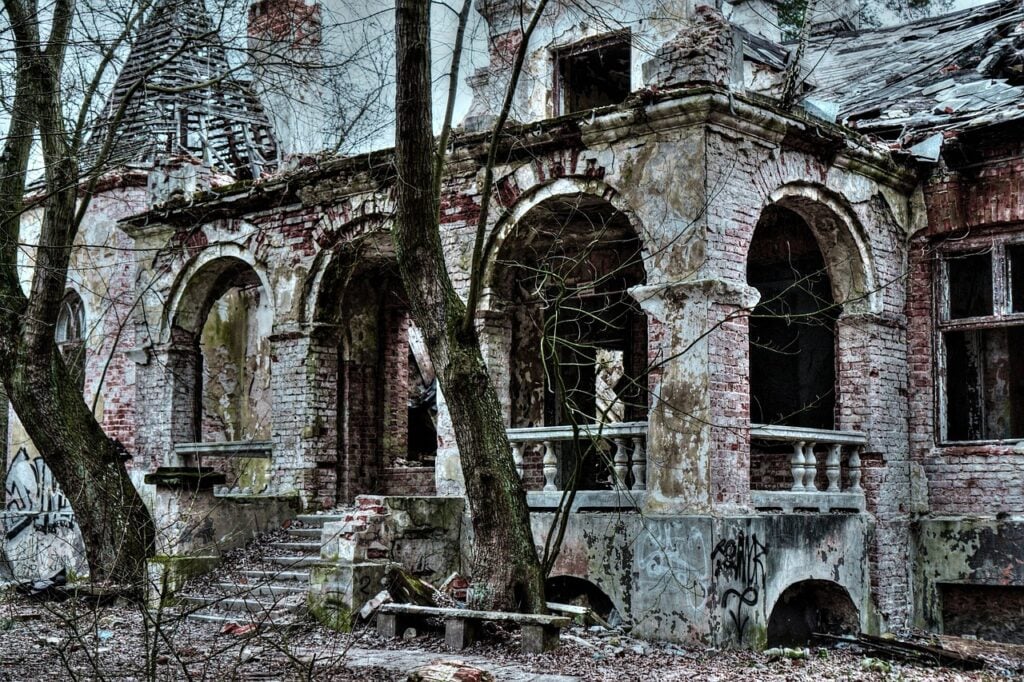
I should note, by the way, that the houses in these novels are not necessarily haunted. They can be, of course; sometimes, though, the homes are horrible because of something… else going on. Something that makes the home — typically a refuge for those who live in it — a dangerous place.
[Like what you read? Check out Dangerous Games To Play In The Dark, available from Chronicle Books now!]
I’ve spoken a few times before about the concept of unheimlich — typically in relation to the uncanny as laid out in Freud’s 1919 essay on the topic. Again with the caveat that I don’t prescribe to most Freudian theory, the uncanny is something I come back to again and again — the uncanny being defined as the familiar made strange, which results in a kind of horror I find particularly effective.
The idea of unheimlich is a big part of that — of what it means for the familiar to become strange. Indeed, in the original German, that’s what the essay is titled: Not “The Uncanny,” as it’s put in its English translation, but “Das Unheimliche.”
Directly translated from the German, “heimlich” means something like “homely” — something that feels like home. To be “unheimlich,” then, is to be unhomely — that is, not like home. It’s the home made un-home-like — the essence of uncanniness.
The horrible homes in all of these novels? They are all literally unheimlich — un-home-like.
Even if they look like homes… they aren’t.
Just… remember that, if you feel, for some reason, compelled to put the key in the lock, and turn it, and open the door.
These houses are not for living in.
Not if you want to survive.
1. Just Like Home by Sarah Gailey
I first recommended Just Like Home during the 2023 Halloween season, and it remains one of those “lives rent-free in my head” books — I just… can’t stop thinking about it.
Here’s what I said about it back in 2023:
“When Vera agrees to come ‘home’ at the behest of her dying mother, the homecoming is a fraught one. ‘Home,’ in this case, is a relative term; the house Vera grew up in — the house her father built — hasn’t been her home since her mother made the decision to cease being a parent to her when she was still a child.
Vera’s father, you see, had a secret — one built into the walls of the house he constructed. A secret that destroyed lives and families — and not just Vera’s own.
But when Vera arrives, she finds that she and her mother are not alone; there’s an ‘artist,’ as he calls himself, living in the guest house. All is not what it seems here, and as Vera peels back the layers of the house’s walls and of her own life…“
…Well, that’s probably all that I should tell you for now. This one has twists on twists on twists, and is therefore best gone into with only the barest of details to start.
Get it here.
2. The Good House by Tananarive Due
In the town of Sacajawea, Washington stands the Good House. It’s named that for a few reasons; one is the name of the original builder — Elijah Goode — and one is the fact that it survived a mudslide in 1929 that leveled every other home on the street on which it’s located. When Angela Toussaint was growing up, it belonged to her grandmother, Marie; then it came to Angela — though not before tragedies upon tragedies struck. Returning to the home years following the biggest tragedy of them all, Angela finds more than just memories waiting for her — and what’s waiting for her in the house is nothing short of sinister.
I first read this one in 2020, and although it’s one of Due’s earlier novels, I still think it’s one of her finest. Here’s what I took away from it back then:
“The Good House isn’t [just] a haunted house story. It’s about history — our personal histories and our familial ones. It’s about whether we can or should be held accountable for the sins of our ancestors. It’s about forgiveness — forgiving others, and forgiving yourself. And it’s about, ultimately, second chances, and what we choose to do with them.”
Truly a gut punch, this one. If you’ve read Due’s most recent novel, The Reformatory, but haven’t picked this one up yet, now is definitely the time to do so.
Get it here.
3. Strange Houses by Uketsu
I do love a good “the ground plan does not match the physical space” story—and wouldn’t you know it? Strange Houses is entirely built off of that premise.
It begins with a freelance writer — one who’s slightly obsessed by the strange and unusual (sounds, uh… familiar) — who, while investigating a stigmatized property in Tokyo, discovers that the home is not quite as it seems. Nor, as it turns out, are a number of other homes the same writer goes to investigate, and, well… these strange houses all have more in common than you might at first think.
Like Uketsu’s first novel, Strange Pictures, which I also loved, Strange Houses is a puzzle box of a book; reading both of them is an incredibly active experience. At first, each little story might seem like its own vignette, unrelated to the rest of the stories — but the further you go, the more the pieces come together, and when the big picture finally comes into focus, it’s the most delicious heart-dropping-into-your-stomach moment.
Get it here.
4. The Staircase In The Woods by Chuck Wendig
What would you do if you were out in the woods one day — hiking, taking a leisurely stroll, however you like to exist out in nature — and you found… a staircase? Just a staircase, seemingly not leading anywhere, but just… there? Would you leave them be? Would you examine them? Would you… attempt to scale them?
I wouldn’t try that last one if I were you — not if The Staircase In The Woods is anything to go by. Because if you go up them, you may not come back.
That’s what happened to a group of friends in Pennsylvania in 1998: Five of them found the stairs. Five of them went up them. Only four of them came back.
And when, years later, the four remaining no-longer-friends reunite, locate the stairs, and ascend them, they end up somewhere you never, ever want to be: A house of horror. A house of nightmares. A house that, seemingly, encompasses every single house that has ever existed in which something terrible occurred.
A house from which they may never escape.
I was lucky enough to be able to speak with Chuck about creepypasta and digital horror tropes on the podcast Way Too Interested in 2022, and there’s a lot I recognize in the topics we covered back then in the DNA of The Staircase In The Woods. You might even recognize the motif of stairs just hanging out in the woods as a popular creepypasta trope, of which the Search And Rescue series is probably the most well-known example.
But staircases in the woods are a real phenomenon, too — there are plenty of old ruins out in the wilderness, and sometimes stairs are the only structures sturdy enough to survive when everything else has collapsed — which is one of the things I like so much about this one: It takes a weird-but-real-thing and asks, “What if?”
And then it answers that question — and it does it in an enormously effective way.
The Staircase In The Woods isn’t a feel-good story. It’s upsetting to read, and not for the faint of heart. But although it deals with things that are mean and nasty and bitter, it in and of itself isn’t any of those things. It’s about coming to terms with the mean, the nasty, and the bitter, and figuring out how to function and go on knowing that the world is full of mean, nasty, bitter things.
And that’s oddly comforting, I would argue.
(Thanks to the publisher and NetGalley for providing me with an ARC for this one!)
Get it here.
5. Slade House by David Mitchell
David Mitchell’s books often span multiple genres, but very rarely would I classify them as straight-up horror. Slade House, though? It’s absolutely horror, and it’s absolutely horror about a horrible home.
The titular Slade House, you see… eats people. That’s an oversimplification, of course, but it’s accurate, to a degree. Though it may not be the house itself that eats people — but people go into Slade House, and then they don’t come out. That’s assuming they’ve found Slade House in the first place. Because the house, too, seems somewhat untethered from… time? Space? Reality? All of the above?
Both Slade House the place and Slade House the novel invite you in with enticing beauty, and then gobble you up once you’re in its clutches.
Like many other Mitchell novels, this one spans generations, and contains many stories within it, all of which ultimately come together into a one larger story that is much more than the sum of its parts. It is connected pretty closely to Mitchell’s slightly earlier novel The Bone Clocks, although you don’t need to have read The Bone Clocks for Slade House to make sense; it’s satisfying on its own, with an extra layer of the shared Mitchell universe giving you something additional to unravel if you feel like it.
If you remember and like The Dionaea House, you might like Slade House. Just, y’know… don’t wander inside gorgeous old houses with beautiful pubs that seem to just sort of appear somewhere you could have sworn there wasn’t a house before.
You’ve been warned.
Get it here.
6. The Spite House by Johnny Compton
Are you familiar with the concept of a spite house? It’s a house that’s built, as its name might suggest, to spite someone else nearby.
My idea of the classic spite house is usually one built in what’s essentially an alley between two other rowhouse or townhouse-type buildings: The Hollensbury Spite House in the DC region; the Skinny House in Boston’s North End; those kinds of places — incredibly thin houses that seem like they’d be as unpleasant to live in as they were meant to be to look at.
But a spite house can take many forms — including the titular spite house in Johnny Compton’s novel of the same name.
Eric Ross is on the run with his two daughters, Dess and Stacy. They’re always moving, and always trying to leave no trace as they go. Money, as you might expect, is hard to come by.
When Eric answers an ad looking for a caretaker for a spite house in Texas, it seems at first that the job might solve a couple of those problems: The money is good, and it includes a free place to stay. All they have to do is chronicle their experiences living in the house in a journal for its owner.
Because that’s the thing: This spite house is haunted by more than just bad vibes and the mean-spiritedness behind its construction. It’s actually haunted — and the things inside it? They’re even more spiteful than the house itself.
Lots of familiar themes are at play here: Generational trauma; trying outrun your past; issues that haven’t been dealt with, and subsequently fester and become even more of a mess; secrets, and how destructive they can be; and more. And like The Staircase In The Woods, it’s not a feel-good story, and yet still manages to deal with spite without being spiteful itself.
Boy, was I rooting for this family all the way through. And boy, do I wish they’d done things differently.
But then again, if they had, this book wouldn’t exist, now, would it?
Get it here.
7. A House With Good Bones by T. Kingfisher
To be fair, there are quite a few T. Kingfisher books I could put on this list — The Twisted Ones and What Moves The Dead also both come to mind, for instance — but I’m going to go with A House With Good Bones this time; The Twisted Ones deals more with the forest surrounding the home than the home itself, and What Moves The Dead covers some similar ground I’d rather cede to Mexican Gothic for the purposes of horrible homes.
In any event, A House With Good Bones is also interesting in that the horrible home at its core is much more mundane than the one in The Twisted Ones or What Moves The Dead… on the surface, at least. The house, you see, has depths both literal and figurative — especially when it comes to the rose garden out back.
To pick up there with how I summed it up when I first read this one back in 2023:
“The rose garden has secrets, you see. Just like Sam’s grandmother, who owned the house when she, her mother, and her brother lived in it when she was a child. And although Sam’s grandmother is dead and buried, that rose garden is still there. Its roots are still there. And those secrets are definitely still there. And when Sam’s brother tells her that their mother, who still lives in the house now, seems… off, the urge to dig those roots up is strong.
Trouble is — what Sam finds when she starts digging isn’t easily reburied.
And I’m not just talking about the jar of teeth she unearths from the garden.”
Like all of Kingfisher’s books, this one has so much heart — and that, ultimately, is what makes it tick. I’m not sure I’d call it “cozy horror,” but A House With Good Bones is a nice antidote to the sort of mean-spirited horror I’ve seen a lot of in recent years.
Get it here.
8. The Graveyard Apartment by Mariko Koike
A horrible home doesn’t have to be a house. Homes, after all, can be many things. And if you, like myself, spent many, many years dwelling in apartments, rather than houses… well, fun fact: Haunted apartments are no less scary than haunted houses. How haunted a place might be certainly isn’t determined by the square footage.
Although The Graveyard Apartment was originally published in 1986, its 2016 English language translation put it back on the map more recently; I read it in 2020. Here’s what I had to say back then:
“When the Kano family move into the Central Plaza Mansion apartment building, it’s brand new and seemingly perfect — just what Teppei, Misao, and their young child, Tamao are looking for. Its perfection is marred only by its neighbors: The building is bordered by abandoned and derelict houses, a Buddhist temple, a crematorium, and — as the title suggests — a cemetery. Soon, it becomes clear that there’s more going on here than meets the eye, and, well… there’s a reason that so many of the residents move out again so quickly after moving in.
Like Alex Brown, who reviewed this translation over at Tor.com [now Reactor Mag] in 2016, I found the first two-thirds of the book a bit slow; I can’t say whether that’s because of the translation itself, because of the fact that some of the tropes are now overly familiar to me, or both, but it feels a bit pedestrian at times. The last third, though? Well, when things start rolling, they really start rolling. The finale is viscerally horrifying in ways that I… probably shouldn’t tell you too much about, lest it spoil the reading experience. Regardless, it absolutely sticks the landing.
Don’t forget to read the last two pages. They’re after the epilogue, so they’re easy to miss — but they’re actually some of the most important pages in the book.
To me, they change everything.”
I stand by that still. If you can stick it out through the slower bits, it’s got incredible payoff.
Get it here.
9. How To Sell A Haunted House by Grady Hendrix
Grady Hendrix seems to be somewhat divisive these days; people either love his stuff or hate it, with not many opinions falling into the “meh” or “I could take it or leave it” realm. I’ve enjoyed most of what I’ve read from him, though, and How To Sell A Haunted House is one of my favorites. As a former theatre person who spent a fair amount of time studying and performing puppetry, who also happens to love a good oh-no-the-house-is-bad story… well, to say I’m the highly specific target audience for this one would be an understatement.
From my 2023 Halloween reading recommendation list:
“Louise left her hometown of Charleston basically as soon as she could. After a lifetime of always feeling like she came in last place to everything — her father’s career as an academic, her mother’s preoccupation with puppetry and dolls, her golden child brother Mark, who, from where Louise is sitting, had everything handed to him despite squandering it all without fail — she left, and had no intention of returning.
Return, however, she does, after her parents die in an accident; after all, if she doesn’t sort out the funeral arrangements, the estate, and, crucially, selling her parents’ house — the house in which she and Mark grew up, alongside their mother’s puppets — no one else will.
But the house is still full of all those puppets and dolls — including Pupkin, a vaguely malevolent figure Louise has always felt uneasy around. And, well… suffice to say that some things are even more difficult to sort through than they already seem.”
And, to paraphrase slightly: Like a lot of haunted or otherwise horrible home stories, this one is about adults returning to their childhood home and having to deal with the trauma they experienced there. That’s the thing with undealt-with trauma; it doesn’t dissipate. It’s like standing water: It sits and festers and gets grosser and harder to clean up the more time goes on. And when you return “home,” finally — because inevitably, you will — it will come back to haunt you. Literally.
If you’re lucky, it won’t be haunting you in the form of a terrifying puppet.
Get it here.
10. Our Share Of Night by Mariana Enriquez
Another prior recommendation from the 2023 Halloween season, Our Share Of Night is a big ‘un, but 100 percent worth it if you can stick with it. Here’s how I described it back then:
“Three families. A shadowy cult obsessed with immortality. A father and a son, mourning a wife and mother, who also both have certain… gifts — gifts that make them valuable to the families and their cult, and which have a habit of using up and exhausting the human vessels capable of channeling them.
These are just some of the elements that make up Our Share Of Night, a sprawling, multi-generational epic set primarily in Argentina and spanning the early 1960s through the late 1990s. … As we bounce back and forth between multiple perspectives, narrators, and even, I would argue, genres and subgenres, the tale that unfolds bit by bit paints for us a portrait of a group of people hellbent on their own destruction — even if they don’t realize it — because there are some things that simply cannot be harnessed. That shouldn’t be harnessed. To do so — or to attempt to do so — is folly, and the way things unravel is… truly something to see.”
To be fair, the house is not the focus of Our Share Of Night — but it does factor prominently into the whole thing, which, y’know, makes sense when you consider the multi-generational nature of this sprawling family epic: Houses are often passed down through families, and, well, home is where the heart is, in more ways than one. As I put it in 2023: “If one of your favorite horror tropes is interior spaces doing things they… probably shouldn’t be able to do (think TARDIS, but less benign), you’ll probably find a lot here to love.”
Get it here.
11. We Used To Live Here by Marcus Kliewer
If there is one thing I’ve learned from horror media, in all forms, it’s that if someone you don’t know knocks on your door and asks for… pretty much anything — if they can borrow some eggs; if Tamara is home; if they can come in and take a look around just for 15 minutes, because they used to live there, long before you moved in — never, ever say yes. Don’t even open the door in the first place, if you can get away with it. Pretend you’re not home. Because the odds of things going pear-shaped is very, very high.
That last scenario — “This used to be our home; can we come look around, just for a few minutes? We just miss it so much” — is the setup for We Used To Live Here. Charlie and Eve don’t even really intend to live in the home they’ve just purchased; they flip houses, and this one is their latest project. So when a family shows up on their doorstep, the father asking if he can show his kids the house he used to live in long ago, it’s no problem for them to say yes.
But then… things start happening. And unlike in Funny Games or The Strangers, the things happening might not be entirely… let’s call it earth-bound.
We Used To Live Here began life as an r/NoSleep story — similarly to Dathan Auerbach’s Penpal a decade earlier — and like Penpal, it made so much of a splash that it was developed into a full novel. If you miss the days of vintage NoSleep, We Used To Live Here might scratch that itch.
Also, don’t open the door.
I mean it.
Get it here.
12. She Is A Haunting by Trang Thanh Tran
The house in She Is A Haunting is hungry. A French colonial house in Đà Lạt, Vietnam, it’s literally falling apart, although Jade Nguyen’s estranged father has big plans to restore it an open it as a bed and breakfast.
He often comes up with grand schemes and doesn’t follow through. Jade knows this about him. And she absolutely doesn’t want to be spending the summer with him in that house—but he’s promised to pay for college for her if she and her sister, Lily, do, and help get the B&B up and running while they’re there, so she doesn’t feel like she has much choice.
But the house — again — is hungry.
So. Very. Hungry.
Horror tends to be a particularly fruitful genre for examining generational trauma, and that’s certainly the case here. From my 2023 Halloween recommendations list:
“This one tackles [generational trauma], and colonialism, and racism, and drives the lasting effects of them deeply into your heart, where they, like the house at the center of the story, grow, and grow, and consume. A terrifying take on the concept of the hungry ghost that is about so much more than just an unquiet spirit rattling a few chains, She Is A Haunting sticks with you long after you finish turning its damp, waterlogged pages.”
Tangential content warning: Bugs. LOTS of bugs.
Get it here.
13. The Hacienda by Isabel Cañas
One of my favorite reads of 2022, The Hacienda is one of the modern gothic greats. There’s a ton of Rebecca in its makeup — a new bride who is a second wife; the metaphorical and maybe literal ghost of the previous wife; the husband with a secret; the house to which he brings his new bride and second wife, where she is an outside to the community already living there — but, as I noted in my 2022 recommendation, The Hacienda is also very much its own beast:
“Set during the aftermath of the Mexican War for Independence, the ghosts that haunt this story aren’t just literal — and although that’s usually the case for any good ghost story, here, there’s just so much to unpack. It’ll hover over you while you’re reading, making you peer over your shoulder or strain your eyes into the darkness as you try to convince yourself that there’s nothing watching you from the shadows. And it’ll stick with you long after you’ve finished.”
You know those books that you start reading before bed, and then literally cannot put down because you just need to know what happens next, so you’re exhausted all day the next day but you’re not even mad about it? This is one of those books.
Get it here.
14. The Grip of It by Jac Jemc
If you like your weird house stories — and stories in general — on the less-concrete side, The Grip Of It is one you might think about picking up.
The setup sounds fairly conventional: Julie and James’ marriage is in trouble, so they decide that moving into a totally new environment in an incredibly secluded location might be what they need to get back on track. (Fun fact: Moving into a totally new environment in an incredibly secluded location is not, in fact, how to do this!) A complete breakdown in the home, literally figuratively, ensues.
The way this story is told, though? That’s what makes it special. It poses more questions than it answers, and there’s so much ambiguity throughout it that honestly, every single person who reads it could walk away with a totally different interpretation of what’s going on, why it’s happening, and how things ultimately shake out (or don’t).
Maddening? A little. But also worth puzzling through.
Get it here.
15. House Of Leaves by Mark Z. Danielewski
I know, I know — House Of Leaves tends to show up on my reading recommendation lists with quite a high degree of frequency. It just scratches so many itches for me, so although I know it’s fairly divisive (people either love it or hate it — there’s not much of an in-between) and possibly suffering from overexposure at this point, indulge me one more time.
In case you need the recap: House Of Leaves is formed from a number of nesting narratives: The Navidson Record, an alleged documentary film chronicling the experiences of a family who moves into a house that does not obey the laws of space and time; the academic record and commentary on The Navidson Record of a man known only as Zampano; and the story of Johnny Truant, Zampano’s neighbor, who finds Zampano’s manuscript regarding The Navidson Record upon his death.
Also, The Navidson Record does not, as far as Johnny knows, actually exist.
I’ve noted in the past that my favorite of the narratives is the one contained within The Navidson Record itself. This is partially because of the form — I love a good “looks like a screenplay” style of storytelling — but also because the centerpiece of it is the House On Ash Tree Lane. The house that… doesn’t behave as it should. The house that changes dimensions. The house with an interior that sometimes measures a quarter-inch more than the exterior. The house that holds fathomless depths, in a very literal sense.
When I first read House Of Leaves, I was living in an old, old apartment that had absolutely no right angles anywhere in it; if you placed a marble on the floor, it would roooooooll all the way to one of the walls or corners every time. You can imagine what reading about a house like the House On Ash Tree Lane late at night when I was alone at home might have done to me. A-plus reading experience, highly recommend.
Get it here.
16. Starling House by Alix E. Harrow
In the fading coal town of Eden, Kentucky, there’s a house—a mansion, really, although, like any gothic mansion worth its salt, it’s falling apart. Starling House’s gates are always closed and locked, and its lone resident — the reclusive Starling heir, Arthur — almost never seen.
But Starling House is infamous for more than just its current resident. It’s also infamous for its past residents — and what may or may not have happened to them. The house, you see, was built by Eleanor Starling, who married into the family, wrote and published a puzzle box of a children’s book, and then vanished.
Opal doesn’t know entirely what she’s getting into when she takes a job as a cleaner — a housekeeper, of sorts — at Starling House. Because the house, you see, requires a different sort of housekeeper — a house keeper — and Arthur, who will barely look at Opal, let alone speak to her, seems to be fighting a losing battle on that front.
But there’s something about Starling House — something that keeps Opal coming back. And it’s not just the money. It’s not just the (relative) security it offers her and her younger brother, Jasper — Jasper, who is smart enough to accomplish anything, if only he had the resources and the support to help him get there; Jasper, who Opal wants to see succeed more than anything she’s ever wanted for herself.
Starling House calls to Opal. But whether it wants her help, or whether it wants to consumer her — she doesn’t know.
Starling House is the second of Alix E. Harrow’s books that I’ve read; I did very much enjoy the first, The Once And Future Witches, but this one hit every single button for me. If you like your eerie, gothic, houses with a dose of dark, dark magic — it might do it for you, too. IT’s absolutely delicious.
Get it here.
17. Mexican Gothic by Silvia Moreno-Garcia
Like The Hacienda, Mexican Gothic takes the familiar tropes and conventions of gothic literature and does some wonderful, beautiful, terrifying, new things with them. It was one of my favorite reads of 2020, and worth every ounce of hype that surrounded it at its release.
In 1950s Mexico, Noemí Taboada’s cousin Catalina has married an Englishman, Virgil Doyle, and been sequestered away in the Doyles’ family estate outside of the town of El Triunfo. The marriage, though, is not what it seems, and when Catalina reaches out to Noemí for help, Noemí herself travels to the estate, where she finds Catalina ill, the Doyle family controlling, and the environment all together too strange for comfort.
There are mysteries upon mysteries nested in El Triunfo, in the Doyle family, and in the estate itself — in more intrusive ways than you might expect.
There are very good reasons I am now firmly behind mushroom horror as a thing, and Mexican Gothic is one of them. (T. Kingfisher’s What Moves The Dead, mentioned above, is another one, by the way, so if you, too, are interested in fungi-tastic horror, add that one to the list while you’re at it.)
Get it here.
18. White Is For Witching by Helen Oyeyemi
Another “this house eats people” type of tale, White Is For Witching’s horrible home is a bed and breakfast in Dover, UK. Inside the home live Miranda and Eliot Silver, the twin teenage children of the B&B’s owners, Lily Silver and Luc Dufresne. But the home — for all that it’s meant to be a welcoming place for visitors to stay and be comfortable — has… tendencies. Inclinations. Or, more accurately, disinclinations. There are people the house does not like, and those it does not like tend not to make it back out.
There’s a lot going on in this one, and, much like The Grip Of It, it doesn’t often explain itself. You’ll need to read between the lines here, and be comfortable with ambiguity. But it’s beautifully horrifying and horrifyingly beautiful if you’re willing to work with it — as is the case for most, if not all, of Oyeyemi’s works — and I, for one, think it’s definitely worth it.
Get it here.
19. & 20. The Haunting Of Hill House and We Have Always Lived In The Castle by Shirley Jackson
I mean… what would this list be without these two?
The homes in these two books are horrible for different reasons; Hill House is the more traditional haunted house (sort of), while the Blackwood estate is more a topsy-turvy kind of environment than a haunted one. Hill House shows us what happens when a group of people who agree to be subjects in a sort of paranormal experiment stay for what’s meant to be an extended period of time in a house that is, as the novel itself puts it, “born bad”; Castle, meanwhile, shows us a house where the societally-accepted “normal” order of things has been upended, and what happens when an outside attempts to “restore normality.” (The thing Charles doesn’t understand, of course, is that the relative “abnormality” of the Blackwood estate is normal for the home, so attempting to “restore normality” is… not a thing he should be doing, really.)
From a more academic perspective, I might draw similarities between the two in that they both zoom in on the societal expectations of women in the domestic sphere — especially during the era in which they were written and first published — and subsequently subvert them, with the house as the lenses that both set the stage for and magnify these issues. Eleanor has always done what was expected of her; Merricat has never done what was expected of her. Both chafe against the confines of what society deems acceptable for women of their ages and stations… and the houses?
The houses help them fight back.
Or, the houses further confine them.
How horrible the homes are, precisely — and to whom — depends on your perspective.
How do you see them?
Get Hill House here and Castle here.
***
Follow The Ghost In My Machine on Bluesky @GhostMachine13.bsky.social, Twitter @GhostMachine13, and Facebook @TheGhostInMyMachine. And for more games, don’t forget to check out Dangerous Games To Play In The Dark, available now from Chronicle Books!
[Photo via jarko7/Pixabay]








.png)





.jpg)


 English (US) ·
  French (CA) ·