1 month ago
49
1 month ago
49
PROTECT YOUR DNA WITH QUANTUM TECHNOLOGY
Orgo-Life the new way to the future Advertising by AdpathwayCelebrate Our Anniversary with Trivia!
Join us on August 23 for a free virtual trivia party featuring questions about ancient civilizations, U.S. history, unusual historical facts, pop culture, and more.
$513 / $5000

History is filled with numbers: years of rule, distances travelled, armies mobilized, cities besieged, territories conquered, and generations transformed. History by the Numbers brings together a collection of visual infographics that use rankings, timelines, comparisons, and carefully selected examples to explore patterns across world history. From long-lived dynasties and imperial expansion to famous sieges, voyages of exploration, military disasters, technological change, and religious history, each infographic turns complex historical subjects into an accessible visual story.
The numbers, however, are only the starting point. Behind every ranking or comparison lie different political systems, geographic conditions, technologies, societies, and historical circumstances that cannot be reduced to statistics alone. Designed for students, educators, and curious readers, this collection combines quantitative comparison with historical context to encourage a deeper understanding of scale, continuity and change, cause and consequence, and historical significance across different periods and regions of the human past.
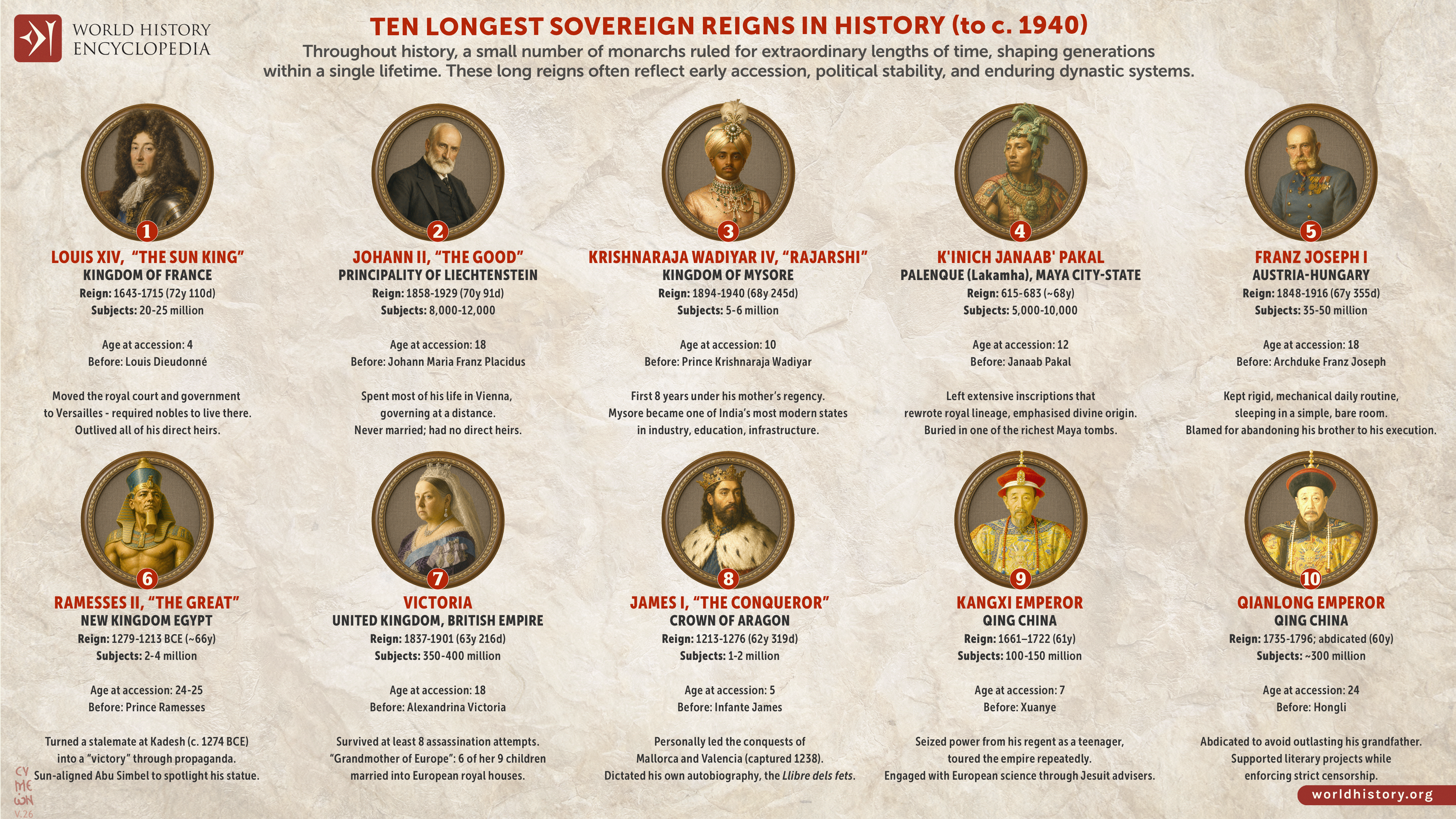
Ten Longest Reigns in History
Across recorded history, the duration of a ruler’s reign has depended as much on circumstance as on personal authority. In hereditary monarchies, early accession, often in childhood, combined with stable succession practices could produce exceptionally long reigns, as seen from Louis XIV (reign 1643–1715) in France to the Kangxi Emperor (reign 1661–1722) in Qing China. These reigns frequently spanned periods of regency, consolidation, and mature rule, reflecting the durability of dynastic institutions rather than uninterrupted personal governance. In some cases, longevity also coincided with political centralization, territorial expansion, and administrative reform, reinforcing the monarch’s position over successive decades.
At the same time, long reigns reveal important contrasts in the nature of sovereignty across regions and periods. While rulers such as Ramesses II (reign c. 1279–1213 BCE) projected divine kingship within highly centralized states, others, such as Victoria (reign 1837–1901), ruled within constitutional systems that increasingly shared power with representative institutions. Similarly, the Qing emperors, including the Qianlong Emperor (reign 1735–1796), demonstrate how exceptionally long reigns could coexist with vast territorial governance, bureaucratic sophistication, and enduring dynastic authority across generations.
World History Encyclopedia is a non-profit organization publishing free history content that has been carefully researched and reviewed. If you liked this content, please consider donating at www.worldhistory.org/donate/. To remove this message from printouts, you can become a supporting member at www.worldhistory.org/membership/. Thank you for supporting our work!















.png)






.jpg)



 English (US) ·
  French (CA) ·