

 6 months ago
55
6 months ago
55

Donald Trump isn’t the first president to look at a world map and dream of adding Greenland to US territory.
It looks even bigger on most maps than it is. But until recently, Harry Truman made the most serious attempt.
In 1946, Truman’s administration secretly offered to buy Greenland from Denmark for $100 million in gold (that’s up to $11 billion in gold today). As the Cold War began, a State Department memo argued that control of Greenland— the world’s largest island, about 836,000 square miles, roughly the size of Western Europe or three times larger than Texas — was “indispensable to the safety of the US.”
Denmark rejected the offer. Most Danes considered it an insult to their sovereignty and a potential provocation to the Soviets at a sensitive point in the early Cold War. Still, the US did later establish military installations on the icy island, including what is now Pituffik Space Base. A World War II agreement was formalized in 1951 in a new US-Danish defense treaty that allowed the construction of strategic bases like Pituffik for early warning and missile defense. Internal federal discussions about acquisition of Greenland continued during the Eisenhower years.
Nine decades earlier, Andrew Johnson also thought about buying Greenland. After the purchase of Alaska in 1867, his administration explored other Arctic expansion prospects. Secretary of State Seward commissioned a report that recommended the US acquire both Greenland and Iceland. The official reason then was their mineral wealth and strategic fishing grounds, but no formal offer was made to Denmark.
During the Taft administration, US Ambassador to Denmark Maurice Francis Egan proposed a territory swap, suggesting the US give Denmark the island of Mindanao (in the Philippines) in exchange for Greenland. At the end of the Spanish-American war, Spain had sold the entire Philippine archipelago to the US for $20 million. Mindanao was home to the Lumad (indigenous non-Muslim groups) and Islamized Moro peoples, who had resisted Spanish colonization for centuries and continued to struggle under US rule.
At home, US territorial acquisitions haven’t been popular for a century. Forced expansion after the Spanish-American War led to the formation of the American Anti-Imperialist League, which included notable figures from Mark Twain to Andrew Carnegie. They effectively argued that imperialism violated the core American principle of “consent of the governed.”
For decades, most Americans have believed both that A) the US should focus on domestic issues, and B) managing an empire is incompatible with our values. Not surprisingly, Trump’s proposals to acquire Greenland and Canada face overwhelming opposition. Polls show over 76 percent of Americans oppose annexing Greenland while more than 86 percent oppose annexing Canada.
Trump himself first floated the idea of a Greenland “purchase” in 2019. Since starting his second term, the efforts have intensified and his tactics have become more aggressive. In January 2025, the new administration announced that acquiring Greenland is a “national security priority.”
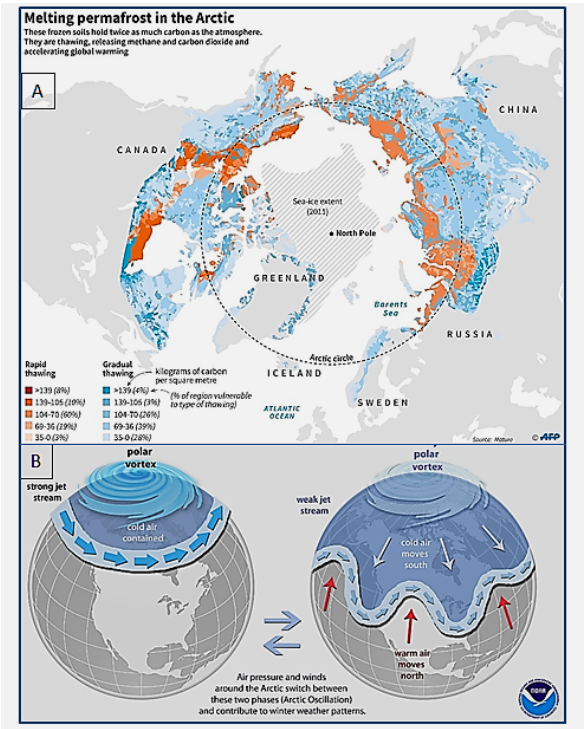
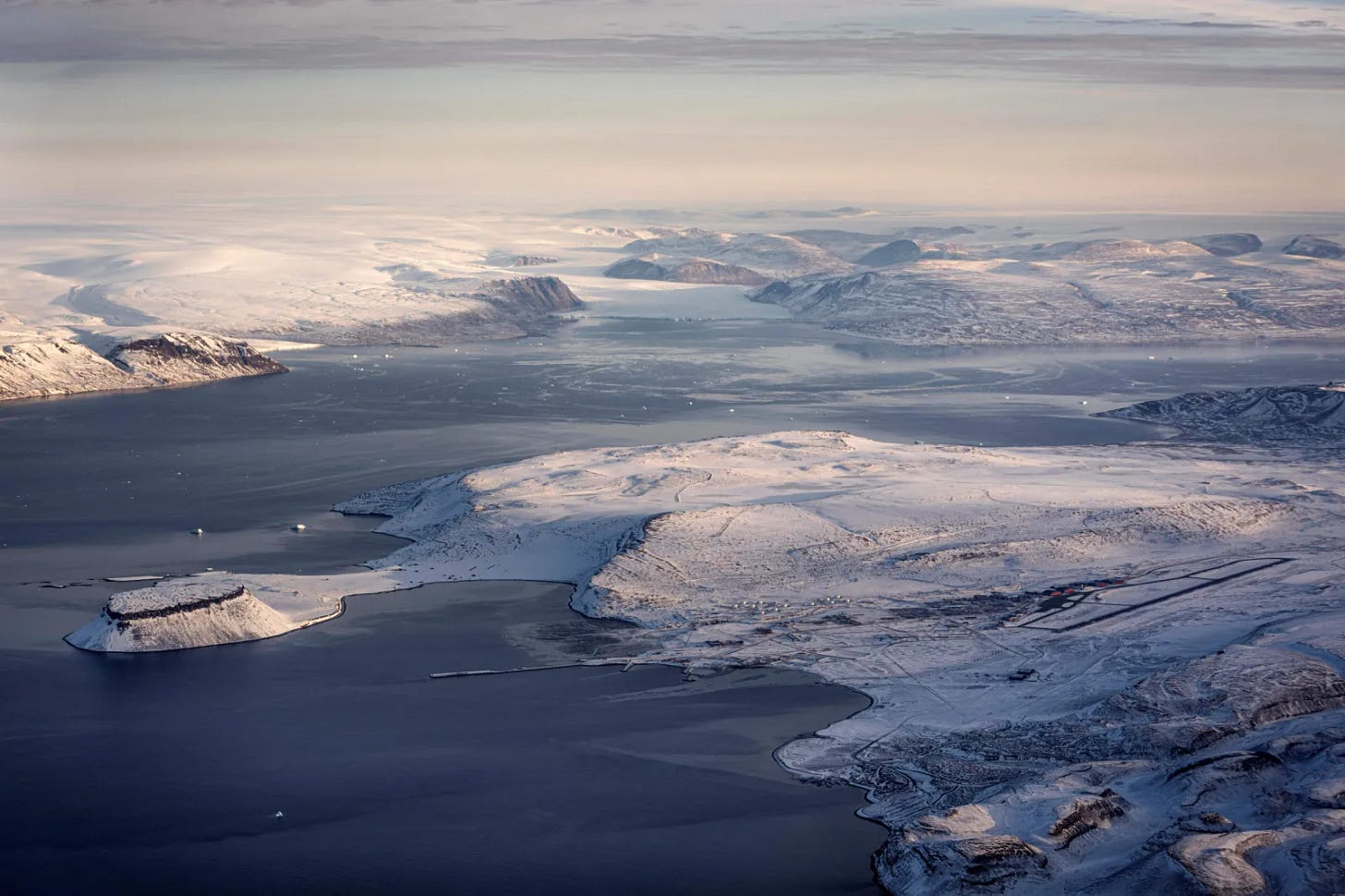
With a population of only about 57,000, mostly Inuit, it is one of the planet’s least densely populated countries. Most people live along the ice-free southwest coast in towns like the capital, Nuuk. Growth is slow, and only 20% of the land is free of ice. On the other hand, it has vast untapped natural resources — minerals, rare earths, oil/gas, and, due to melting ice, is playing a larger role in Arctic shipping. All of this makes it a focal point for US, Russian, and Chinese strategic competition.
The Pituffik Space Base provides missile defense and surveillance, and monitors a vital North Atlantic naval chokepoint known as the GIUK Gap (which stands for Greenland, Iceland and the UK), a gateway between northern European waters and the Atlantic. The potential for new trade routes has intensified global interest in the autonomous Danish territory. The Trump administration claims to want control of Greenland to deter Arctic threats and enhance US defense capabilities. It also fits well into Trump’s “spheres of influence” view of global power sharing.
But would the US actually “go to war” to control Greenland? Or perhaps a more accurate question is this: Has a war of some kind already begun? While pundits speculate about what Trump means when he talks about “owning” it, at the very least a significant and escalating information war is already underway. So far it includes competing influence campaigns, strategic disinformation, and high-level diplomatic pressure from various global powers.
In late 2025, Denmark’s Security and Intelligence Service (PET) confirmed that Greenland is the target of “influence campaigns of various kinds.” Danish officials angrily summoned US diplomats over reported covert operations aimed at seeding discord between Denmark and Greenland. The operations reportedly involve “physical agents” and the spread of disinformation intended to influence Greenland’s pro-independence movement.
The US Department of State has been coy, declining to address alleged actions by “private US citizens” in Greenland and telling Danish officials to “calm down” over the interference claims. A growing majority of Greenlanders support eventual independence from Denmark, but debates continue over economic viability. Like Brexit, it is a divisive issue that could be weaponized to create an insurrectionary atmosphere.
.
.
Belligerent US messaging has moved into the open, with the Trump administration utilizing various public platforms to pressure Greenlandic and Danish leadership. One thread — call it the maximalist view — is to promote the idea of annexation. The White House has publicly stated that using the military to acquire Greenland is “always an option,” a stance echoed by senior advisors like Stephen Miller.
Other US officials, notably Vice President Vance and Secretary of State Rubio, have offered a strategic justification, arguing that Denmark is unable to provide adequate security against rising threats from Russia and China. In March 2025, Vance explicitly urged Greenlanders to sever ties with Denmark, claiming the latter had not invested enough in the island’s protection. This is what passes for a “moderate” GOP response these days.
But beyond the public noise, there is also a digital and intelligence front to the conflict. Here the weapons are intensified surveillance and digital infrastructure control. In May 2025, when reports indicated that US spy agencies were ordered to prioritize Greenland, a “growing number of reports” began circulating within the executive branch. Some experts have described Greenland as a critical node for a “space war.” Greenland-based ground stations securely funnel data from satellites — ranging from consumer orders to military intelligence — into subsea cables, but they have been targets of physical and digital interference. Ideally, such stations can bypass vulnerable radio frequencies and physical cable risks, enhancing resilience against hacks or sabotage of traditional links.
In response to US moves, Denmark and Greenland have launched their own coordinated communication strategies. Their main thrust is currently unity. Leaders from both nations have issued joint statements rejecting annexation as “fantasy” and emphasizing that Greenland’s fate is for its people alone to decide. In addition, the government has increased its military and surveillance capabilities in the Arctic to assert sovereignty. Officials warn that any forceful US action would destroy the NATO alliance. For Trump, however, that could be another incentive to act.
EU and NATO leaders have increasingly aligned their messaging to treat Arctic security as a strategic priority, pushing back against US territorial ambitions to protect the “High North” — the circumpolar area north of the Arctic Circle, which includes parts of Russia, Canada, Alaska (US), Greenland (Denmark), Norway, Sweden, Finland, and Iceland —from both Russian and potential US destabilization.
Will the current info-war eventually “go kinetic,” as the military likes to say, and raise all those pesky questions about sovereignty and international law? Not necessarily. An “influence” campaign is only a few steps away from destabilization, and the US certainly has experience with that. It worked in Iran, Guatemala, Chile and more. Once things get sufficiently chaotic, it becomes easier to make the case for “boots on the ground” to “restore stability and create law and order.” Almost any pretext will do, You can apparently change it later.
Based on recent actions in Venezuela, Greenland could be the next example of the Donroe Doctrine, Trump’s cheeky update of Monroe’s policy of exclusive US dominance in the Western Hemisphere. But Monroe understood that the deal included a US promise not to meddle in European affairs. Trump is apparently attempting to redefine the US “sphere of influence” to include anywhere that works as a resort, trading or military post— from South America to Canada and Greenland, even the Gaza Strip, where his redevelopment vision is a “Gaza Riviera” with luxury resorts, AI-powered smart cities, and a manufacturing hub.
Yet the push to “own” Greenland — a considerably tougher resort site — may also inadvertently spark more European solidarity to stop it. Using military force is unlikely in the short term. But whatever the tactics, it will prove to be a more complex empire move than its tiny population and Danish connection suggest.
*
Click the share button below to email/forward this article. Follow us on Instagram and X and subscribe to our Telegram Channel. Feel free to repost Global Research articles with proper attribution.
Greg Guma is a Vermont writer, former editor, and author of 15 books, including Managing Chaos: Adventures in Alternative Media. Visit the author’s blog. He is a regular contributor to Global Research.
All images in this article are from the author
Global Research is a reader-funded media. We do not accept any funding from corporations or governments. Help us stay afloat. Click the image below to make a one-time or recurring donation.















.png)





.jpg)



 English (US) ·
  French (CA) ·