

 5 months ago
60
5 months ago
60

US President Donald Trump has publicly and unabashedly announced that the United States is taking over Greenland, by hook or by crook, come hell or high water. The announcement has been met with widespread ridicule. Commentators across the political spectrum have dismissed it as unserious, diplomatically naïve, or even absurd. To many observers, the suggestion appears to echo a bygone era of 19th-century territorial expansion, i.e., an age of imperial conquests seemingly incompatible with modern norms of sovereignty and international law. Framed as not just a transactional real-estate deal, but an invasion, the idea seems more like a headline-grabbing provocation than a coherent policy initiative.
Русский, Español, 中文, Portugues, Français, عربي, Hebrew, Deutsch, Farsi, Italiano, 日本語, 한국어, Türkçe, Српски. And 40 more languages.
Yet taken solely at face value, such reactions may obscure the broader strategic environment in which the statement was made. Viewed through a geopolitical lens, the Greenland episode can be interpreted less as a literal attempt to invade a territory and more as a form of strategic theater: rhetoric intended to draw attention to the Arctic’s rapidly increasing importance in global military, economic, and technological competition. In this reading, the announcement functions symbolically, forcing both domestic and international audiences to confront a region long considered peripheral but now emerging as a central arena of great-power rivalry.
The Arctic has undergone profound transformation in recent decades. Accelerating climate change has reduced sea ice coverage, opening new maritime routes that shorten transit times between North America, Europe, and Asia. At the same time, the region contains vast untapped reserves of hydrocarbons, rare earth minerals, and other strategic resources critical to modern industries and defense systems. These developments have drawn intensified interest from major powers, particularly the United States, Russia, and China, each of which has expanded its Arctic strategies, military infrastructure, and scientific presence.
Greenland occupies a uniquely sensitive position within this evolving landscape. Though sparsely populated, its geographic location places it astride the shortest flight paths between North America and Eurasia, making it militarily significant for missile defense, early-warning radar, and power projection. The United States has maintained a presence there since World War II, most notably at Thule Air Base (now Pituffik Space Base), which remains integral to U.S. and NATO strategic monitoring capabilities. As Russian Arctic militarization has accelerated and China has declared itself a “near-Arctic state,” Greenland’s strategic relevance has only increased.
.
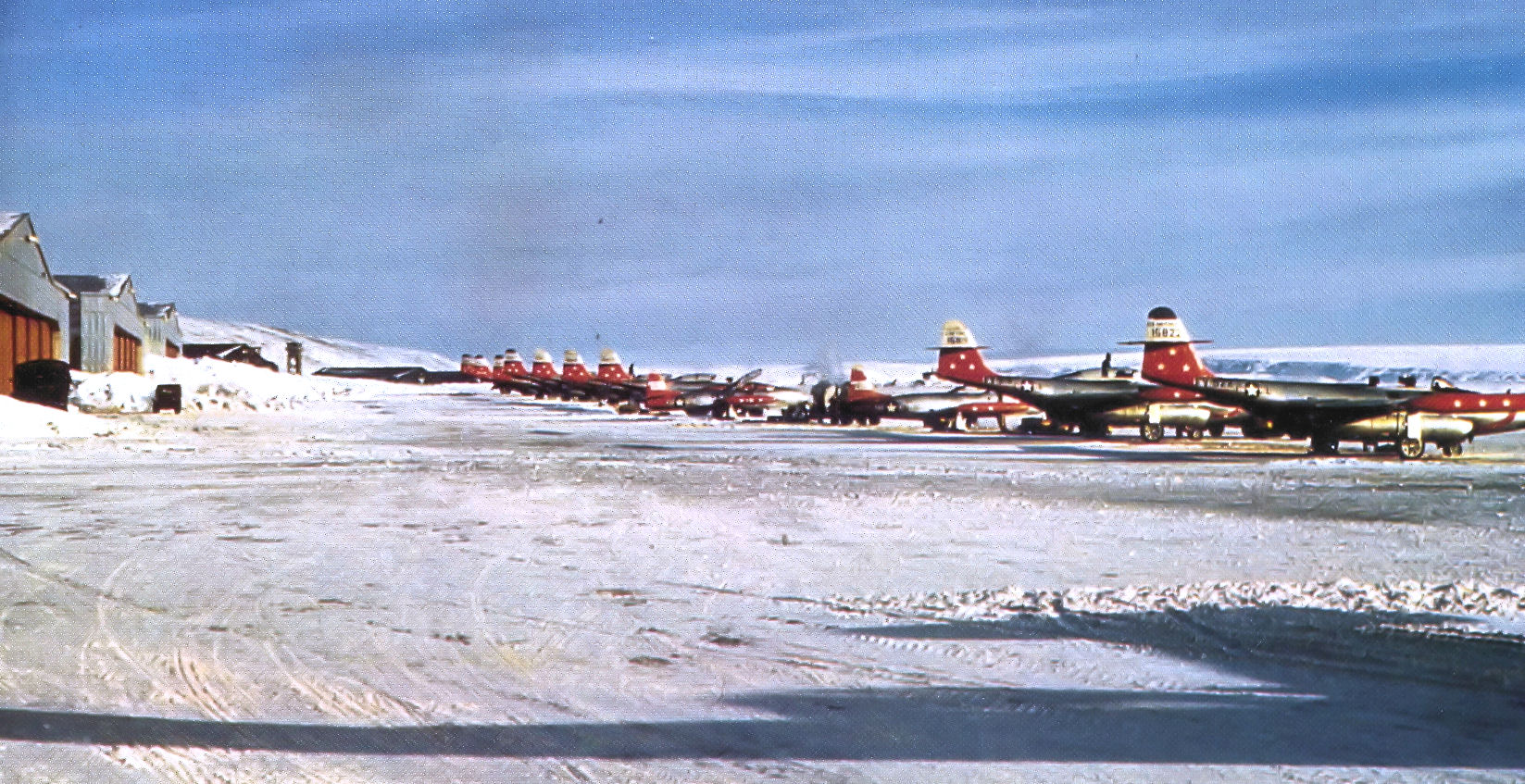
74th Fighter-Interceptor Squadron F-89s, Thule Air Base, Greenland, 1955 (Public Domain)
.
Against this backdrop, Trump’s remarks can be interpreted as an unorthodox attempt to reassert American attention and influence in the High North. Rather than signaling an intent to resurrect territorial acquisition, the statement arguably serves to dramatize U.S. concerns about losing strategic ground in a region where competitors are moving aggressively. The controversy itself generates precisely the attention that routine policy statements rarely achieve, placing Arctic geopolitics into public discourse almost overnight.
It is important, however, to be clear at the outset about the limits of this interpretation. There is no public evidence that Trump, or any U.S. administration, possesses a concrete plan to annex Greenland, coerce Denmark, or prepare imminent large-scale military operations against Russia from the island. No official documents, budgetary initiatives, or allied consultations support such conclusions. What follows, therefore, should be understood as an analysis of political rhetoric and strategic signaling rather than a claim of established intent or hidden policy.
Seen in this light, the “take over Greenland” episode illustrates how modern geopolitics often operates through spectacle as much as substance. Statements that appear erratic or unserious may nonetheless function as tools of agenda-setting, forcing allies, rivals, and domestic audiences alike to reassess geographic priorities that had previously received limited attention. Whether effective or counterproductive, such rhetoric reflects the growing centrality of the Arctic to 21st-century security calculations, a reality that persists regardless of the peculiar manner in which it enters public debate.
The “Takeover” as a Bluff
The notion of “taking over” Greenland collapses quickly under scrutiny. Greenland is not an unclaimed frontier or a vulnerable microstate; it is an autonomous territory within the Kingdom of Denmark, a longstanding U.S. ally and fellow NATO member. Any attempt to acquire it against the will of Copenhagen or, more importantly, against the democratic wishes of Greenland’s own population would trigger a profound diplomatic crisis. Such an action would violate international law, undermine NATO cohesion, and contradict the very alliance-based order the United States depends upon for its global influence. From this perspective, the idea was never a realistic policy option.
Yet dismissing the proposal as mere ignorance misses its political function. Rather than a serious acquisition plan, the announcement operates as a strategic provocation. It compels allies, adversaries, journalists, and policymakers to talk about Greenland and by extension, the Arctic region itself. A territory rarely mentioned in mainstream geopolitical debate suddenly now becomes the subject of global headlines, parliamentary statements, and security analyses.
In diplomacy, exaggerated or even implausible positions are sometimes introduced not because leaders expect them to be enacted, but because they reshape the conversation. By proposing something so radical, the speaker expands the “Overton window,” i.e., the range of ideas considered discussable in public policy. Once the most extreme option is aired, more moderate steps can appear reasonable by comparison: increased military presence, expanded basing rights, infrastructure investment, or deeper political engagement with Greenlandic authorities.
Viewed through this lens, the “bluff” is not about territorial ownership. It is about attention and signaling. It communicates that the Arctic is no longer peripheral to U.S. strategic thinking, but central to future competition. As climate change accelerates ice melt, new shipping lanes emerge, and access to rare earth minerals becomes more consequential, the Arctic is transforming from a frozen backwater into a contested geopolitical arena.
The proposal also serves as an implicit message to rivals, particularly Russia and China, that the United States intends to contest influence in the High North rather than cede it by default. By making Greenland suddenly visible, the United States signals that Arctic geography, infrastructure, and political alignment are no longer negotiable afterthoughts.
In this sense, the “takeover” rhetoric functions less as foreign policy planning and more as strategic theater. Its value lies not in feasibility, but in disruption: forcing a recalibration of priorities, accelerating long-delayed discussions, and asserting that the Arctic, once ignored, has become a frontline of twenty-first-century geopolitics.
The Arctic’s Strategic Weight
The Arctic has become a central arena of great-power competition, shifting from a remote periphery to a core theater of twenty-first-century geopolitics. Rapid climate change is reducing sea ice at unprecedented rates, opening seasonal and eventually permanent maritime corridors such as the Northern Sea Route and the Northwest Passage. These routes have the potential to shorten transit times between Asia, Europe, and North America by thousands of miles, altering global trade patterns and reducing dependence on traditional chokepoints like the Suez and Panama Canals.
Alongside commercial implications, melting ice is exposing vast reserves of hydrocarbons, rare earth minerals, and other strategic resources. Estimates suggest the Arctic contains a significant portion of the world’s undiscovered oil and natural gas, as well as minerals critical to advanced technologies and defense production. Control over access, infrastructure, and governance in the region therefore carries long-term economic as well as strategic consequences.
For military planners, however, geography matters even more than resources. The Arctic sits astride the shortest flight paths between North America and Eurasia, making it the most direct corridor for long-range bombers, intercontinental ballistic missiles, and emerging hypersonic weapons. In a conflict between major powers, the High North would be among the first regions implicated, not the last.
This reality is not new. During the Cold War, Greenland already occupied a pivotal position in U.S. defense architecture. Thule Air Base (now Pituffik Space Base) formed a critical node in America’s ballistic missile early-warning network, designed to detect Soviet launches crossing the polar region. Radar installations, satellite tracking systems, and undersea monitoring all reflected the Arctic’s role as a strategic gateway rather than a frozen buffer.
From this perspective, renewed emphasis on Greenland aligns with a broader, bipartisan American reassessment of Arctic security. Across successive administrations, U.S. defense planners have expressed growing concern about Russia’s expanded military posture in its northern territories. Moscow has invested heavily in refurbishing Soviet-era bases, constructing new airfields, deploying advanced air-defense systems, and expanding its fleet of nuclear-powered icebreakers. These are assets that give Russia unmatched mobility and endurance in polar conditions.
These developments are not merely symbolic. They provide Russia with the ability to project power across the Arctic, secure its northern coastline, protect its ballistic-missile submarine bastions, and potentially restrict access to emerging sea routes. From Washington’s standpoint, this concentration of capability risks creating a strategic imbalance in a region once governed largely by low tension and cooperative norms.
In response, the United States and its NATO allies have intensified their own Arctic engagement. This includes expanded joint exercises, increased intelligence and surveillance activity, renewed investment in cold-weather capabilities, and rotational deployments across the High North from Alaska and Canada to Norway, Iceland, and Greenland itself. The objective is not militarization for its own sake, but deterrence: ensuring that no single power can dominate a region whose strategic importance is rising faster than its institutional governance.
Taken together, these trends explain why Greenland and the Arctic now command disproportionate attention in Western strategic planning. What was once viewed as a distant frontier has become a central junction of climate change, resource competition, and military geography where developments unfolding today will shape the balance of power for decades to come.
NATO Consolidation, Not Conquest
Seen this way, Trump’s rhetoric can be interpreted less as a literal policy proposal and more as crude but effective strategic signaling. The message is not that the United States intends to annex foreign territory, but that it intends to remain militarily dominant in the rapidly evolving Arctic theater and that Greenland is central to that posture. As climate change opens new sea lanes and increases access to undersea resources, the Arctic is shifting from a peripheral frontier into a core arena of great-power competition.
From a military standpoint, consolidating NATO capabilities in the region does not require ownership of territory. What it requires is dependable access, interoperability, and political alignment among allies. Radar installations, missile-defense sensors, forward airfields, satellite ground stations, and logistics hubs can all be expanded through bilateral and NATO agreements. These arrangements already exist in limited form and can be strengthened without altering sovereignty or provoking unnecessary diplomatic crises.
Framing the issue publicly as a potential “take over” may have been a blunt instrument, but it serves to underscore a strategic reality that policymakers in Washington, Copenhagen, and Brussels already understand: Greenland occupies a uniquely valuable position in the defense of the North Atlantic. Its geography makes it indispensable for early warning systems, tracking Russian submarine activity moving from the Arctic into the Atlantic, and maintaining the integrity of the Greenland-Iceland-United Kingdom (GIUK) gap which is still one of NATO’s most critical maritime chokepoints.
Russia’s expanding Arctic military infrastructure, including upgraded air bases, ice-capable naval assets, and long-range missile systems, has only heightened Greenland’s importance. In this context, strengthening NATO’s footprint on the island is less about expansionism than about continuity by updating Cold War–era defense architecture for twenty-first-century conditions.
Crucially, this strengthening can occur incrementally and quietly. Enhanced basing agreements, increased rotational deployments, infrastructure investment, and joint surveillance systems allow NATO to deepen its operational reach without dramatic territorial moves or political theatrics. Such an approach preserves alliance unity while achieving the same strategic outcome: sustained deterrence, improved situational awareness, and assured access in a region that is becoming increasingly contested.
In this light, the episode reflects not an ambition of conquest, but a recalibration of priorities. Greenland already matters enormously to NATO’s security architecture. The question is not whether it will play a central role in Arctic defense, but how openly and how cooperatively that role will be reinforced as great-power competition moves northward.
A Dangerous Narrative
The greater risk lies not in the strategy itself, but in how it is communicated. Public claims that Greenland could serve as a launchpad for “massive attacks” on Russia feed worst-case assumptions in Moscow and reinforce long-standing fears of encirclement. Even when intended primarily as deterrent signaling, exaggerated language can blur the line between defensive posture and offensive intent.
In nuclear and near-nuclear theaters, perception is often as consequential as capability. Overstatement risks hardening threat narratives on all sides, prompting preemptive military planning, accelerating force deployments, and deepening mistrust. The Arctic, long governed by a tradition of relative restraint and technical cooperation, becomes vulnerable to the same spirals of escalation that have destabilized other regions.
This is particularly dangerous in an environment where emerging technologies of hypersonic weapons, dual-use missile defenses, space-based sensors compress decision times and magnify uncertainty. When rhetoric portrays geography itself as inherently threatening, stability erodes even in the absence of new deployments.
Ultimately, the Greenland episode reveals more about political style than strategic substance. Trump’s approach favors spectacle over subtlety, transforming alliance signaling into headline-grabbing drama. Statements that might once have been delivered quietly through diplomatic channels are instead broadcast as maximalist claims, inviting misunderstanding both abroad and at home.
Beneath the noise, however, the underlying strategic reality remains unchanged. The Arctic is becoming a focal point of NATO–Russia competition, driven by geography, technology, and climate transformation rather than by any single leader’s rhetoric. Greenland sits at the geographic heart of that competition not as a prize to be seized, but as a platform whose stability, cooperation, and governance are essential to preventing escalation.
Whether framed as a bluff, a provocation, or a diplomatic misstep, the episode serves as a reminder that in geopolitics, words themselves can become weapons. Used carefully, they deter. Used recklessly, they distort intentions, harden fears, and generate consequences far beyond their original intent especially in a region where silence and stability have long been the Arctic’s greatest safeguards.
*
Click the share button below to email/forward this article. Follow us on Instagram and X and subscribe to our Telegram Channel. Feel free to repost Global Research articles with proper attribution.
Prof. Ruel F. Pepa is a Filipino philosopher based in Madrid, Spain. A retired academic (Associate Professor IV), he taught Philosophy and Social Sciences for more than fifteen years at Trinity University of Asia, an Anglican university in the Philippines. He is a Research Associate of the Centre for Research on Globalization (CRG).
Sources
“Explainer: The Geopolitical Significance of Greenland”
“Greenland in the Crosshairs: Arctic Power Plays and Polar Politics”
Greenland in the Crosshairs: Arctic Power Plays and Polar Politics – The Soufan Center
“Trump’s Greenland Flirt is Clumsy Arctic Geopolitics”
“Greenland: High-Stakes Politics in the Arctic”
GREENLAND – High-Stakes Politics in the Arctic – Europe Diplomatic Magazine
“Strategic competition in the Arctic intensifying”
Global | Strategic competition in the Arctic intensifying | Dragonfly Intelligence
“Great Power Interactions in the Arctic: EU, Russia, USA, and China”
https://www.inss.org.il/strategic_assessment/arctic/?
“Greenland says it should be defended by NATO, rejects any US takeover”
Greenland says it should be defended by NATO, rejects any US takeover | Reuters
Featured image source
Global Research is a reader-funded media. We do not accept any funding from corporations or governments. Help us stay afloat. Click the image below to make a one-time or recurring donation.













.png)






.jpg)



 English (US) ·
  French (CA) ·