

 1 month ago
29
1 month ago
29

The Anglo-Saxon powers that emerged victorious from World War I, World War II and later the Cold War, particularly the United States and Britain, have sought to suppress virtually every geopolitical challenge to their dominance over the past century.
Different actors, from communist movements to nationalist independence struggles, from Korea and China to Iran, have faced this pressure.
Korea, Vietnam and today Iran stand out as examples of resistance against a hegemonic order far more powerful than themselves.
What these countries have in common is their understanding of war not merely as a contest of military power, but as a struggle shaped by time, geography, social resilience and the ability to impose costs on an adversary. In many respects, Iran’s resistance today represents a continuation of the long tradition of anti-hegemonic struggles seen in Korea and Vietnam.
To read this article in the following languages, click the Translate Website button below the author’s name.
Farsi, tiếng Việt, українська мова, Hebrew, Español, Portugues, عربي, Русский, 中文, Français, Deutsch, Italiano, 日本. And 40 more languages.
Although their duration, casualties and outcomes differ significantly, the Korean War, the Vietnam War and the 107-day Iran–U.S.–Israel War share important similarities in their culture and spirit of resistance. Iran’s contemporary strategy of resistance reveals the same historical reality when examined alongside the experiences of Korea and Vietnam. The hegemon approaches conflict through the prism of financial power, technology, firepower, precision-guided munitions, air superiority, economic pressure and logistical capability. The resisting side, by contrast, views war through the lens of time, geography, society, ideology, belief, political will and the capacity to impose costs on its opponent. Throughout military history, great powers have often controlled the battlefield, enjoyed air superiority and possessed more ships, aircraft and economic resources. Yet what has frequently determined the outcome of wars is not the quantity of weapons available, but whether one side could break the other’s will to resist.
 Henry Kissinger’s famous observation in his article “The Vietnam Negotiations,” published in Foreign Affairs in January 1969, captures this reality,
“The guerrilla does not have to win the war; it is enough not to lose. The conventional army, however, cannot be satisfied merely with not losing; it must win.”
In On War, Clausewitz argued that the purpose of war is not simply to destroy the enemy’s army but to break the enemy’s will to resist. Therefore, the decisive question is not how many tanks, aircraft or ships are destroyed. What matters most is which side can sustain its determination to continue the struggle for a longer period of time. Clausewitz’s concept of war as a clash of wills provides the theoretical foundation for the culture of resistance stretching from the Yalu River and Saigon to the Strait of Hormuz.
For this reason, Korea, Vietnam and contemporary Iran can be viewed as different links in the same historical chain, emerging in different eras but confronting similar strategic realities. In each case, one side represented the most powerful military and economic force of its time. The other was militarily weaker and economically more fragile, yet possessed a stronger political will and a greater determination to endure.
The First Example of Resistance, Korea
Image: A U.S. Air Force Fairchild C-119B Flying Boxcar (s/n 48-343) near Chungju, Korea, in 1951. (Public Domain)

The People’s Republic of China, founded in 1949, was an impoverished, war-ravaged and technologically backward state. In contrast, the United States was the undisputed victor of World War II, a nuclear-armed superpower possessing the world’s largest industrial capacity. The United States could not remain indifferent to North Korea’s attack on the South on June 25, 1950. The establishment of the People’s Republic of China under Mao Zedong in 1949 had already been perceived in Washington as a major strategic setback. The United States had failed to prevent one of the world’s greatest civilizational centers from re-emerging outside its sphere of influence. Poor, devastated by civil war and economically exhausted at the time, China would eventually become the world’s manufacturing hub, the largest industrial power and the principal strategic rival capable of challenging American hegemony in the Pacific.
George Kennan, the architect of the Soviet containment strategy, and many American strategists of the era understood the long-term significance of this development better than anyone else. The establishment of the People’s Republic of China was therefore not merely a regime change from Washington’s perspective, but a geopolitical turning point that fundamentally altered the global balance of power. During the Cold War, the event became known as the “Loss of China” and was remembered as one of the greatest strategic shocks to American geopolitics after Pearl Harbor. For this reason, North Korea’s advance into the South and the prospect of communism reaching the Pacific in yet another country after China were considered unacceptable by Washington.
When American forces advanced into Pyongyang in October 1950 and continued their march toward the Chinese border, Beijing concluded that the conflict was no longer merely about Korea, but about China’s own future security. China crossed the Yalu River and entered the war. The Chinese leadership did not seek outright victory over the United States. Its objective was to halt the American advance and prevent hostile forces from establishing themselves on China’s border.
In the end, China did not defeat the United States militarily. Yet when the armistice was signed in July 1953, Washington had failed to achieve its principal objectives. Communist North Korea survived. American forces did not establish themselves along the Yalu River. The war effectively ended near the line where it had begun. As a result, despite the extensive American military presence and alliance network established in South Korea over the subsequent seven decades, the strategic reality of the Korean Peninsula remained fundamentally unchanged. North Korea continued to exist as a buffer state separating South Korea from the Asian mainland. It is also worth noting that no formal peace treaty has ever been signed between the United States and North Korea; technically, the war remains suspended under an armistice agreement.
The most consequential decision made by China during the war was its willingness to intervene despite overwhelming American military superiority. Beijing chose to enter the conflict at the very moment it perceived a direct threat to its security. The risk assumed by China in 1950 laid the foundation for its rise over the following decades. The central lesson that Korea offers Iran today is that a weaker power does not need to defeat a great power outright. It is often enough to prevent that great power from achieving its strategic objectives.
Vietnam, The War Won in Washington, not on the Battlefield
In many respects, the challenge Iran faces today bears a closer resemblance to Vietnam than to Korea. During the Vietnam War, which lasted from the early 1960s until 1975, the leadership in Hanoi did not seek to destroy the American military. It lacked the means to do so. North Vietnam was not comparable to the United States in economic strength, technological sophistication, military capability or global political influence. Yet the Hanoi leadership understood something fundamental, the true center of gravity of the war was not in the jungles of Southeast Asia, but in Washington, D.C. The objective was therefore not to annihilate American forces, but to erode American political will. In that sense, Vietnam’s decisive victory was won in the American capital rather than in Saigon.
.

Black smoke covers areas of Sài Gòn during Tet offensive. (Public Domain)
.
The clearest demonstration of this reality was the Tet Offensive of 1968. During the Vietnamese Lunar New Year, Viet Cong and North Vietnamese forces launched coordinated attacks against numerous cities, military installations and strategic targets across South Vietnam. Militarily, the offensive inflicted severe losses on the attacking forces. From a purely tactical perspective, Tet can even be regarded as a military setback. Yet its true significance lay elsewhere.
For years, the American public had been assured by the White House and the Pentagon that victory was within reach. The Tet Offensive shattered that perception. It demonstrated that resistance against the world’s most powerful military remained intact and that the end of the war was nowhere in sight. Images from the battlefield entered millions of American homes through television screens, while anti-war sentiment continued to grow across the country. Although the Viet Cong suffered heavily on the battlefield, North Vietnam gained a decisive advantage in the political and psychological dimensions of the conflict.
The consequences were profound. Following Tet, President Lyndon Johnson announced that he would not seek re-election. Washington gradually abandoned the objective of outright victory and began searching for a path toward disengagement. During the Nixon administration, the policy of “Vietnamization” was introduced, and American forces were progressively withdrawn. Ultimately, the United States left the battlefield, and Saigon fell in 1975. The outcome of the war was therefore determined not by tactical engagements at the front, but by the gradual exhaustion of American political will.
Vietnam’s greatest achievement was not the defeat of the American military in conventional combat. Rather, it was the erosion of the determination of the American state and society to continue the war. The element of political will that Clausewitz placed at the center of warfare proved far more decisive in Vietnam than tanks, aircraft or bombs.
It is also important to remember the scale of American power at the time of the Tet Offensive. The United States was then producing roughly half of the world’s manufactured goods, accounting for more than a quarter of global economic output, exercising unrivaled dominance through the dollar and carrying a national debt that was only a fraction of today’s burden. This is precisely why Vietnam’s achievement remains so remarkable. The leadership in Hanoi succeeded in eroding, and ultimately breaking, the willingness of what was arguably the most powerful state in modern history to continue the war.
Hormuz’s Hanoi, Iran’s Strategic Framework
The strategic approach employed by Iran today is, in many respects, remarkably similar to the model once applied by Vietnam. Iran is not attempting to defeat the U.S. Navy in a decisive naval engagement, nor is it seeking air superiority over its adversaries. Nor does it aim to destroy Israel militarily. Instead, it seeks to shift the conflict to the Strait of Hormuz, American military bases in the Gulf, strategic targets inside Israel, energy terminals, tanker insurance markets, oil prices, air-defense stockpiles, global supply chains and ultimately to the comfort zone and political patience of the American public.
Image: Strait of Hormuz (Public Domain)

In modern warfare, the decisive factor is not always the number of platforms destroyed. A rise in gasoline prices from $2.95 per gallon to $4.95 over a period of one hundred days can have far greater political consequences for American society than the loss of a fighter aircraft. Iran’s objective is not to sink the U.S. Navy, but to deprive the Gulf of its status as a secure American-controlled maritime space. Indeed, every attack on Iran places the energy infrastructure, economic facilities and American military bases located in the Gulf Cooperation Council states at risk from missiles and armed drones. This reality not only undermines confidence in American security guarantees but also fuels criticism, both internationally and within the United States, of an American policy that many perceive as being excessively influenced by Israeli interests.
Iran also possesses a powerful strategic advantage in the geography of the Strait of Hormuz. Even without fully closing the waterway, Tehran can use the threat of disruption as a deterrent instrument comparable in some respects to the political effect of nuclear deterrence. Permanent control of Hormuz by an outside power would require the occupation of Iran through a large-scale ground campaign. The political, military and economic costs of such an undertaking would be extraordinarily high. Moreover, the consequences of any disruption in Hormuz would not be confined to the Gulf region. Through its impact on energy markets, it would affect billions of people worldwide. The resulting global economic and political pressure is therefore unlikely to be a burden that Washington could sustain indefinitely.
Just as Vietnam sought to exhaust American resolve through mounting casualties, military mobilization and the prolonged burden of war rather than by destroying the American military outright, Iran seeks to erode American strategic will through economic pressure and escalating costs. The model adopted by Iran is therefore not a strategy aimed at achieving a conventional military victory. Its primary objective is to break the opposing side’s willingness to continue the conflict by steadily increasing its political, economic and socio-psychological costs. History offers many examples of hegemonic powers retreating not because they were defeated on the battlefield, but because their political will gradually eroded under the weight of rising costs and diminishing returns.
From Tunnels to Granite Missile Cities
Underground missile cities, command centers in granite mountains, swarms of UAVs, ballistic and hypersonic missiles, proxy power networks and the geography of Hormuz are to Iran what tunnels, forests, public support, propaganda and patience are to Vietnam, but the most important thing is that its people continue to support the state despite decades of sanctions and blockades. One of the symbols of the Vietnam war was the Cu Chi tunnels. The Americans dominated the skies, but an invisible war was raging beneath the ground. The Cu Chi Tunnels were one of the most striking examples of the asymmetrical warfare developed by the weaker side against the strong side. This underground network, which reached 250 kilometers around Saigon, was almost like an underground city with command centers, ammunition depots, hospitals and shelters. Despite the overwhelming air and fire superiority of the United States, the Vietcong survived, maneuvered and maintained its fighting capability thanks to these tunnels.
.
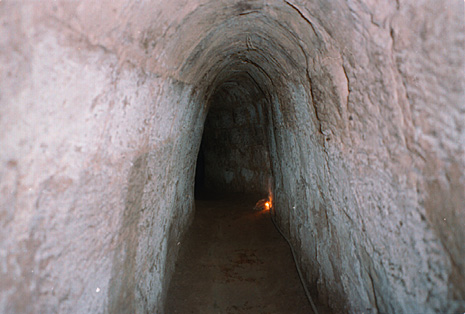
Part of the tunnel complex at Củ Chi, this tunnel has been made wider and taller to accommodate tourists. (Public Domain)
.
A similar situation was seen in the tunnel networks built by Hamas in Gaza today. Despite Israel’s absolute air superiority, precision-guided munitions and advanced intelligence systems, underground tunnels were able to sustain the organization’s command-control, logistics and fighting capacity for a long time. Both examples demonstrate an important fact of modern warfare, technological superiority is not always enough to eliminate the will and resistance capacity of the enemy. Sometimes the fate of the war is determined not by the planes in the sky, but by the tunnels under the ground. Today, Iran has similarly established a second battlefield underground. Missile production facilities, warehouses, command centers and logistics networks have largely been moved underground. For this reason, the concept of “underground warfare” developed by Iran is extremely important for the wars of the future.
The Limits of Bombardment
During the 107-day war against Iran, the United States and Israel struck approximately 13,000 targets with aircraft and missiles. Iran’s air force and much of its naval capability were severely degraded. Yet Iran did not surrender. Aerial bombardment can devastate cities, destroy infrastructure, intimidate civilian populations and inflict enormous material damage. However, by itself, it is often insufficient to break a nation’s political will.
The experience of the Second World War illustrates this reality. The German Blitz against London failed to break British morale and political determination despite the extensive destruction it caused. During the later stages of the war, Allied bombing devastated Dresden on an unprecedented scale. Yet even such destruction alone did not compel Germany to surrender. In the summer of 1945, American bombers set large parts of Tokyo ablaze through massive incendiary raids. Nevertheless, Japan’s surrender came only after the Soviet Union entered the war and the strategic shock created by the atomic bombings of Hiroshima and Nagasaki.
Image: The Yugoslav city of Novi Sad on fire in 1999 (CC BY-SA 3.0)
A similar pattern emerged during NATO’s 78-day bombing campaign against Yugoslavia in 1999. Air power alone did not produce the desired political outcome. The eventual Serbian decision to withdraw from Kosovo resulted from a combination of sustained military pressure, the threat of a ground offensive, diplomatic coercion and Russia’s calculations. The lesson is clear, neither the number of bombs dropped, nor their tonnage alone determines the outcome of a war. Military success becomes possible only when aerial bombardment is integrated into a broader political and strategic framework capable of breaking the opponent’s will to continue the struggle. Otherwise, bombing campaigns often produce little more than ruined cities and unbroken societies.
The Vietnam War provides perhaps the most striking example. The United States dropped more bombs on Vietnam than it had used against Germany during the entire Second World War. Between 1962 and 1973, American aircraft delivered approximately 7.6 million tons of ordnance over Vietnam, Laos and Cambodia. This figure exceeded by more than three times the roughly 2.15 million tons of bombs employed by the United States across all theaters of World War II. Yet Hanoi did not surrender.
Today, Israel and the United States possess capabilities that far exceed those available during previous wars, overwhelming air superiority, satellite-based intelligence, precision-guided munitions and artificial-intelligence-assisted targeting networks. Yet technological superiority alone does not automatically produce political results. As demonstrated in Vietnam, Iraq, Afghanistan, Lebanon and Yemen, technology is often insufficient to overcome a deeply rooted culture of resistance or to break the political will of a determined adversary.
Spreading the War, Increasing the Cost, Not the Front
There are striking similarities between Vietnam and Iran in the way they seek to expand the strategic effects of war without necessarily expanding the conventional battlefield. The Vietnam War eventually spread into Laos and Cambodia. One of the key factors behind North Vietnam’s success was the vast logistical network that connected North Vietnam with Viet Cong forces operating in the South, a network that became known as the Ho Chi Minh Trail. Stretching across Laos and Cambodia, it was far more than a single road. It consisted of thousands of kilometers of footpaths, supply depots, warehouses, fuel pipelines and concealed transportation routes. Throughout the war, the United States dropped millions of tons of bombs in an effort to sever this network, yet it never achieved a lasting result. Ultimately, the Ho Chi Minh Trail became a symbol of North Vietnam’s determination to continue the war and of its extraordinary logistical resilience. The principal reason the conflict spread into Laos and Cambodia was the need to protect and sustain this vital network. As a result, the war evolved into a regional struggle of attrition and cost imposition that extended far beyond Vietnam itself.
To a certain extent, Iran’s contemporary strategy follows a similar logic. Through its influence across the Strait of Hormuz, Iraq, Syria, Lebanon and Yemen, Iran has sought to create a multi-layered strategic depth designed to raise the costs for its adversaries by moving the conflict beyond the immediate battlefield. The transportation corridors that Iran has developed with Russia through the Caspian Sea should also be viewed within this broader strategic framework.
Just as Vietnam was never the only battlefield in Southeast Asia, Iran does not view the conflict as confined solely to its own territory. Iraq, Syria, Lebanon, Yemen, the Strait of Hormuz, the five Gulf Cooperation Council states and the American military bases located within them, energy terminals, maritime trade routes and even the Greek Cypriot Administration of Southern Cyprus, which has become part of the Eastern Mediterranean energy equation, can all be regarded as indirect extensions of the conflict.
This is not the expansion of the battlefield in the traditional sense. Rather, it is an effort to reach the strategic nerve centers of the United States and Israel, the dominant powers in the confrontation. Vietnam waged a psychological war that stretched from the rice fields of Southeast Asia to the political corridors of Washington. Iran, in turn, is attempting to create an economic and geopolitical pressure mechanism extending from the Strait of Hormuz to the Eastern Mediterranean, from the energy exports of the Gulf monarchies to global maritime trade, from international energy markets to Wall Street itself. The objective is not to open new fronts, but to continuously increase the costs of conflict for the United States, Israel, the Gulf monarchies and their economic partners.
Sociology of Resistance
The socio-cultural similarities between Vietnam and Iran are particularly striking. In Vietnam, the resilience of peasant society, anti-imperialist nationalism, a culture of sacrifice and the ideal of national independence constituted the true foundation of the war, far more than communist ideology itself. In Iran, a comparable role is played by the historical memory of Shiite resistance, the cultural significance of martyrdom in Shiite society, the legacy of the Iran-Iraq War’s “Sacred Defense,” decades of experience living under sanctions and embargoes, and a deeply rooted sense of national dignity in the face of foreign intervention.
At this point, it is important to recognize that the regime and the state are not always the same thing. In Vietnam, North Vietnamese soldiers and Viet Cong fighters were prepared to die rather than surrender. What sustained them was not primarily a romantic devotion to communism, but a culture of resistance forged through centuries of foreign domination and humiliation, whether under Chinese, Japanese, French or American intervention. This enabled the leadership in Hanoi to present the conflict not merely as an ideological struggle, but as a war of national liberation and independence.
As a result, American bombing campaigns destroyed cities, bridges and infrastructure and delivered millions of tons of ordnance across the country. Yet they failed to break the determination of Vietnamese society to live independently. In Iran, a significant portion of society has likewise demonstrated a common national reflex against foreign intervention even while continuing to criticize the government. Many Iranians have observed that nearly every Muslim country subjected to American military intervention since 1990 has experienced fragmentation, civil conflict and, in many cases, a descent into the status of a failed state.
In societies characterized by a strong culture of resistance, the instinct to oppose the humiliation of the homeland often emerges independently of support for any particular government. This reflex frequently becomes a strategic asset more powerful than advanced technology, superior firepower or economic strength. Ultimately, the durability of resistance is often rooted not in military capability alone, but in a society’s collective determination to preserve its sovereignty, dignity and historical continuity.
Conclusion
Korea, Vietnam and Iran can ultimately be seen as three links in the same historical chain. Korea established the first strategic limit to American hegemony in the post-Second World War era, when the United States enjoyed both overwhelming power and a nuclear monopoly. Behind that resistance stood Chinese and North Korean blood, sacrifice and logistical support. Vietnam demonstrated that even the political will of the most powerful military machine in the world could be broken. Behind Vietnam stood the logistical backing of both the Soviet Union and China. Iran, in turn, has challenged the unipolar order that emerged after the Cold War.
Like Vietnam before it, Iran has sought to erode its adversaries’ willingness to continue the conflict. It has not merely increased the costs of war for the United States and Israel; it has internationalized those costs. In doing so, it has imposed burdens not only on its adversaries but also on their allies and partners. At the same time, Iran has presented itself as a state willing to bear significant costs in support of the Palestinians and Lebanese who have suffered during the conflict with Israel. As a result, it has gained sympathy in many parts of the world. Most importantly, it has emerged as the only state in either the Sunni or Shiite Muslim world that has challenged Israel through direct action rather than rhetoric alone.
The Korean War and the Vietnam War demonstrated that a militarily weaker state can achieve strategic success by denying a superior power the victory it seeks. In a similar manner, Iran chose not to retreat in the face of pressure from the United States and Israel. Instead, by combining the advantages of its geography with asymmetric capabilities and an effects-based strategy, it succeeded in bringing the United States back to the diplomatic table after 107 days of conflict. If Iran can sustain this posture over the long term, and if it can preserve its ability to impose meaningful costs on Israel under virtually any circumstances, it may secure its strategic position for decades to come. North Korea followed a comparable path after 1953, continuously strengthening its military capabilities and ultimately establishing a nuclear deterrent that made direct attack prohibitively risky. For Iran, the long-term objective may be the establishment of a durable model of active deterrence following a permanent settlement. From this perspective, deterrence rather than victory becomes the ultimate strategic goal.
The Iranian case also demonstrates a broader lesson, the decisive factor in such conflicts is often not military victory but strategic patience. The objective is not necessarily to destroy the opponent, but to prevent the opponent from achieving victory. The hegemonic powers may have won two world wars and declared the triumph of a unipolar order at the end of the Cold War. Yet they were checked in Korea and saw their political will eroded in Vietnam. Today, Iran continues a similar challenge on a new battlefield shaped by seas, straits, energy corridors, armed drones, ballistic missiles, underground military infrastructure and anti-access/area-denial strategies. What remains unchanged despite evolving technology is the endurance of nations and their capacity to resist.
*
Click the share button below to email/forward this article. Follow us on Instagram and X and subscribe to our Telegram Channel. Feel free to repost Global Research articles with proper attribution.
This article was originally published on Mavi Vatan.
Ret Admiral Cem Gürdeniz, Writer, Geopolitical Expert, Theorist and creator of the Turkish Bluehomeland (Mavi Vatan) doctrine. He served as the Chief of Strategy Department and then the head of Plans and Policy Division in Turkish Naval Forces Headquarters. As his combat duties, he has served as the commander of Amphibious Ships Group and Mine Fleet between 2007 and 2009. He retired in 2012. He established Hamit Naci Blue Homeland Foundation in 2021. He has published numerous books on geopolitics, maritime strategy, maritime history and maritime culture. He is also a honorary member of ATASAM.
He is a Research Associate of the Centre for Research on Globalization (CRG).
Featured image is from the author
Global Research is a reader-funded media. We do not accept any funding from corporations or governments. Help us stay afloat. Click the image below to make a one-time or recurring donation.
















.png)






.jpg)



 English (US) ·
  French (CA) ·