

 3 weeks ago
61
3 weeks ago
61
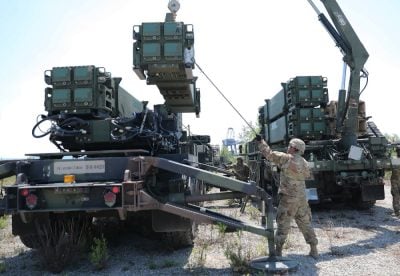
United States President Donald Trump’s recent statements about arming Ukraine through licensed Patriot missile production have sparked debate and prompted adjustments to Western strategies.
Fear of Russian strikes is driving a major shift away from establishing production in Ukraine toward more secure European locations, underscoring the challenges of producing advanced air defense systems amid ongoing conflict.
To read this article in the following languages, click the Translate Website button below the author’s name.
українська мова, Русский, Italiano, Dutch, Български, Español, Portugues, 中文, Français, Deutsch, 日本語, 한국어, Türkçe, Српски. And 40 more languages.
“We’re going to give a license to you to make Patriots. That’s pretty cool. This way, you can’t complain that we’re not giving ‘em enough,” Trump said at a meeting with Ukrainian President Volodymyr Zelensky on the sidelines of the NATO summit in Ankara.
Despite this opportunity to manufacture Patriot missiles, Ukraine is likely to source them from European factories rather than establish large-scale domestic production. Building such facilities in Ukraine would pose significant risks, as they would become prime targets for Russian forces, complicating logistics and strategy. This would mean European countries need to take on a greater share of manufacturing responsibility, something Europe has repeatedly shown it is incapable of achieving.
While Trump proposed that the US could permit Ukraine to produce American Patriot missiles under license—aiming to enhance the country’s air defenses and distribute manufacturing responsibilities among NATO allies—concerns about Russian strike capabilities are prompting planners to reconsider potential locations for new production facilities.
Production activities are underway in Europe, with MBDA, owned by Airbus, BAE Systems, and Leonardo, opening a new plant in southern Germany. The plant is scheduled to begin operations soon, with initial deliveries expected by early 2027. Reports indicate that Ukraine has finalized deals with Germany for approximately 600 missiles. Funding appears to be secured through NATO commitments made at the Ankara summit, totaling around $140 billion—$70 billion this year and $70 billion next year.
Establishing such specialized factories requires significant time, typically 18 to 24 months. During this period, Ukraine would need to meet its immediate requirements by purchasing completed systems, primarily from German stocks.
Lockheed Martin, the main US producer of Patriot systems, is building a factory in Romania, expected to be operational soon. Ongoing security threats and the risk of Russian attacks on Ukrainian territory make full-scale missile manufacturing unlikely in Ukraine. Consequently, safer European locations, especially Romania, are becoming the preferred sites.
In a possible Romanian configuration, the US would supply advanced parts such as active radar seekers, motors, and complex electronics. Local facilities would assemble simpler components, including missile bodies and transport-launch containers. These sites could operate under Ukrainian branding or as joint ventures, allowing Kiev to claim involvement while reducing risk. Even shipments from European plants could be intercepted or targeted during transit or deployment.
Complementing production efforts, US Deputy Secretary of Defense Michael Duffy announced plans for a European maintenance and support facility for Lockheed Martin’s advanced PAC-3 missiles. Speaking at a defense industry event on the sidelines of the NATO summit in Ankara, Duffy said the host country has yet to be finalized. Participating nations reportedly include Germany, the Netherlands, Poland, and Sweden.
This maintenance hub aims to boost missile availability, reduce repair times, and improve operational readiness for NATO members. The initiative builds upon 2024’s earlier efforts, when Germany, the Netherlands, and Spain signed a €5.1 billion agreement to create Europe’s first dedicated Patriot missile production line, targeting up to 1,000 PAC-2 missiles.
Trump’s licensing proposal and similar ideas, like effectively “closing the skies” over Ukraine, are mainly political statements rather than actionable policies. Producing full Patriot systems in Ukraine faces significant technical, logistical, and security challenges that are currently insurmountable.
Despite Ukraine’s Patriot systems facing a significant shortage of interceptor missiles, Trump has opposed rapid increases in US shipments, emphasizing that American stockpiles are limited and must support US military requirements.
When asked whether the US would send additional Patriot interceptors immediately, Trump said “some” could be sent right away.
“We have Patriots, but we don’t have that many. We need them for ourselves too,” he added.
While there is a goal to arm Ukraine with sophisticated defensive tools and decrease dependence on direct US aid, the realities of modern warfare—especially the success of Russian long-range attacks—require more careful placement of industrial sites. This “offshore” manufacturing model could set a precedent for future conflict, highlighting that industrial security might become as crucial as technological supremacy.
In this context, as Europe expands its manufacturing capacity, concerns persist about long-term dependence on US components and about whether the alliance can boost production without escalating tensions.
Currently, the collective West expects that Trump’s licensing efforts, European factory expansions, and strategic site selections represent a pragmatic approach to countering Russian strike threats. Nonetheless, it remains uncertain whether increased production will occur quickly enough to significantly affect the front-line situation in Ukraine. Most likely, as other false hopes have proven, it will not.
*
Click the share button below to email/forward this article. Follow us on Instagram and X and subscribe to our Telegram Channel. Feel free to repost Global Research articles with proper attribution.
Ahmed Adel is a Cairo-based geopolitics and political economy researcher. He is a regular contributor to Global Research.
Featured image source
Global Research is a reader-funded media. We do not accept any funding from corporations or governments. Help us stay afloat. Click the image below to make a one-time or recurring donation.












.png)






.jpg)



 English (US) ·
  French (CA) ·