

 1 month ago
90
1 month ago
90
PROTECT YOUR DNA WITH QUANTUM TECHNOLOGY
Orgo-Life the new way to the future Advertising by AdpathwayPreviously: Mary-san no denwa.
Type: PE (Preternatural Entity).
Period/location of origin: Circa 10th – 13th century CE, Korea. Note, though, that the period identified here is merely the date of subject’s first written documentation; reports of dokkaebi, or 도깨비 in the original Korean, undoubtedly existed long before the this period, passed down through oral record before its first written reference appeared.
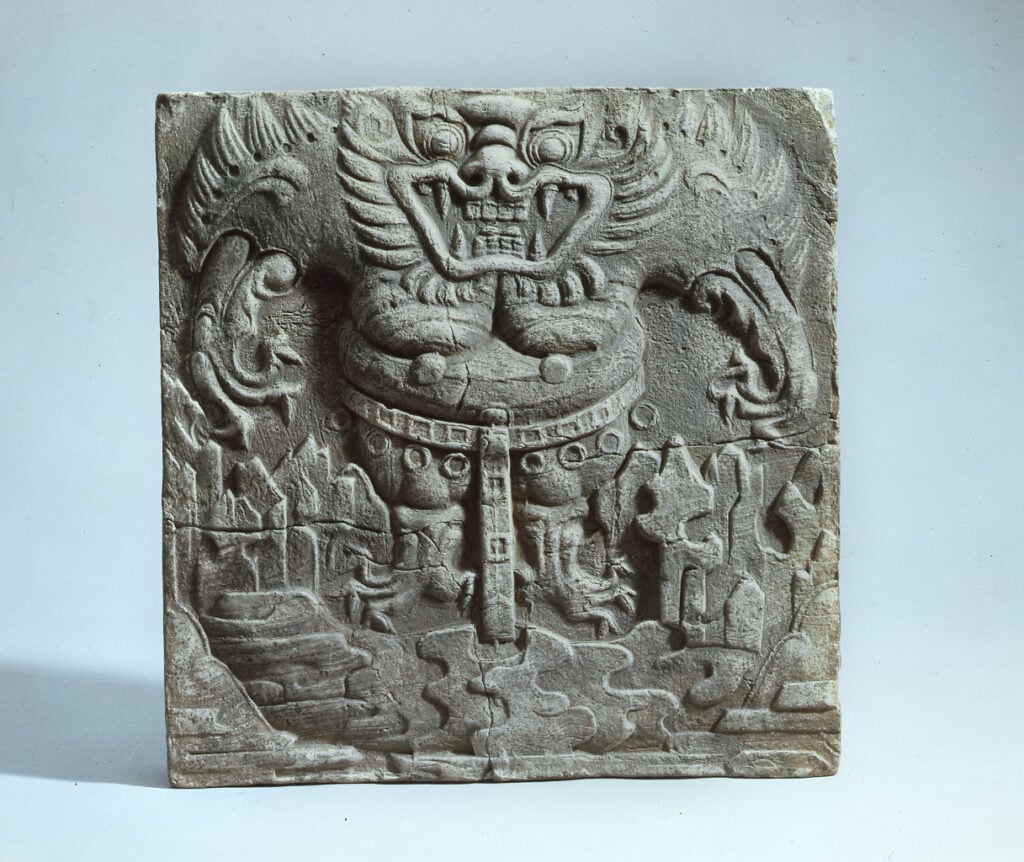 A patterned tile depicting subject from the Baekje era (18 BCE – 660 CE).
Appearance: Subject, known as dokkaebi — 도깨비, often translated as “goblin” in English — may have any number of appearances, due to the fact that the term encompasses many varieties of beings.
[Like what you read? Check out Dangerous Games To Play In The Dark, available from Chronicle Books now!]
They are often said to resemble humans, though they are not human; when in human form, they typically — though not always — present as male, and often wear hanbok and traditional paeraengi (패랭이) hats.
Sometimes they wear not hanbok, but animal skins, such as those from tigers.
Sometimes they bear with them magical objects, such a hat that grants invisibility or a club that grants wishes.
They may have horns, or they may not. They may have only one leg, or they may not. They may have only one eye, or not. They may be giants, or not.
Some dokkaebi may sometimes appear as everyday objects, such as brooms, pokers, pestles, keys, pots, and sieves. These dokkaebi are — not unlike some Japanese yokai such as the kasa obake or bakezori — said to have once been simply objects, but which have since gained life either due to their age and use, or due to coming in contact with blood of some variety. These dokkaebi may be encountered first in their human form, only for targets to find later, after leaving subject alone for some time, their object form in their place.
Dokkaebi are said to have a thousand faces.
Modus operandi: Subject is not generally malevolent, though dokkaebi are often mischievous.
They enjoy human company, and may seek out and/or befriend humans through social rituals such as sharing meals or drinks. Targets who spend significant amounts of time with dokkaebi while partaking in these types of social rituals may find themselves taking on the characteristics of a dokkaebi themselves, though whether this is intentional on the part of the dokkaebi or not is not clear.
 Memorabilia Of The Three Kingdoms, as viewed in the Seoul National University Kyujanggak Institute for Koreanology Studies.
They enjoy wrestling, and may challenge targets to wrestling matches. Should a target win, subsequently confine subject in some way, shape, or form, such as tying them to a tree, and then leave for a time, target may find upon their return that where they thought they had tied their opponent, they have seemingly tied up a broom or other similar household object.
Dokkaebi are fond of many things of which humans are also fond, including but not limited to: Buckwheat jelly; makgeolli, a fermented rice wine; stories and storytelling; songs and music; wrestling, as previously noted; and playing pranks.
They prefer gloomy, damp environments, and typically appear only when it is raining, or at night. They prefer to live in dark forests, isolated or abandoned houses, and other such locations.
Their appearance may sometimes be preceded by the presence of dokkaebi fire — a glimmering light or tall, blue flame without an apparent source, similar to Western-style ghost light or will-o-the-wisp. Dokkaebi fire often serves as an announcement or indication that a dokkaebi’s arrival is imminent, although it can also signify any of the following, depending on the region in which it occurs and in accordance with local custom and the beliefs of that region: Bad luck; good luck; a spot where fishing will be abundant; bad weather; a good harvest; drought; or abundant water.
When asked to identify themselves by name, dokkaebi will often choose the surname “Kim.” According to some reports, this is because it is literally the only human-style name they know.
Containment: Subject does not typically require containment, although in certain circumstances, targets may find it beneficial to do so. If this is the case, the following methods often prove effective:
Dokkaebi dislike the color red, particularly when it is experienced through the presence of blood. As such, subject may be repelled with blood, such as that from animal spread around a target’s home. Red beans may also be used in this way, although they may be less effective than blood.
Dokkaebi are often somewhat foolish and may tricked or outwitted fairly easily. According to one account, an old man who frequently shared drinks with a dokkaebi was startled to find one day that he had started to resemble a dokkaebi himself; so, the next time the dokkaebi visited, he asked the dokkaebi what it feared most. The dokkaebi answered blood, and then asked the old man the same question. The old man answered money, and said that was why he lived alone in the mountains. After the dokkaebi left, the old many slaughtered a cow and spread its blood all around his house. The next time the dokkaebi appeared, it was shocked and horrified at the presence of the blood, and vowed revenge; then it returned with what the old man had told it was his greatest fear: Money. Lots and lots of money. The dokkaebi then ran off, never to be seen again, and the old man lived out the rest of his days in extravagant wealth.
 The “Mysterious Road” dokkaebi road on Jeju Island as it appeared in October of 2018.
However, dokkaebi may also enact revenge if they discover they have been tricked or decieved. According to another account, for instance, an old man who convinced a group of dokkaebi that a lump on his back was the source of a beautiful song he sang. The dokkaebi took away the lump and gave the old man a large sum of money. But the old man was not content with this, and so he attempted the same trick with another group of dokkaebi. Displeased with his lies, they gave him another lump, putting him right back where he was before.
Should a subject challenge a target to a wrestling match, as previously noted, target may, upon winning, tie subject to a tree or other nearby object with ropes or vines. This will contain subject and, according to one account, result in it returning to its original form — typically a common and well-used household object such as a broom. However, note that dokkaebi are very good wrestlers, and that winning against them is a difficult task.
Additional notes: The first known written reference to dokkaebi occurs in the story “Lady Dohwa and Bachelor Bihyeong,” from the Samguk yusa (삼국유사), or Memorabilia Of The Three Kingdoms. Compiled during the late Goryeo era, which spanned 918 to 1392, this five-volume collection documents both historical events and folktales or legends of the Three Kingdoms Of Korea. “Lady Dohwa and Bachelor Bihyeong” is from the Silla kingdom.
Some regions are home to rituals intended to placate, scare off, or even summon dokkaebi. These rituals and their functions vary depending on the location in which they are performed, though many are situated in or along coastal regions. In these locations, the rituals or rites are often intended to ensure bountiful fishing, and involve presenting food or other offerings to the local dokkaebi to appease them and encourage them not to drive away all the fish.
A common saying in Korean for gloomy days is ‘김서방 올 것 같은 날이다,’ or roughly, “It’s a day when Mr. Kim seems likely to come.” This is due both to subject’s preference for gloomy weather and its frequently-chosen name of Mr. Kim.
Dokkaebi are rife throughout modern Korean popular culture, with examples including the 2016 K-drama Guardian: The Lonely And Great God, numerous songs with dokkaebi themes performed by K-pop groups, and the dokkaebi-like appearance and behavior of many of the demons in the 2025 film KPop Demon Hunters.
Gravity hills are called 도깨비도로 in Korean — “dokkaebi roads.” Local Road 1139 on Jeju Island, known as the Mysterious Road, is one of South Korea’s most famous dokkaebi roads.
Recommendation: Be careful who — or what — you interact with.
You never know what they might really be.
Resources:
Dokkaebi legend collected by the USC Digital Folklore Archives.
“Dokkaebi Fire And Foxes Once Signaled A Bountiful Harvest” at the Asia Business Daily.
“Did The Dokkaebi Help The Old Man Become The Richest Man In The Village?” at Mythlok.
Dokkaebi at the Encyclopedia Of Korean Culture. (In Korean.)
Dokkaebi at the Encyclopedia Of Korean Folk Culture. (In Korean.)
“The Tale Of The Hunchbacked Old Man” at the Encyclopedia of Korean Culture. (In Korean.)
Dokkaebi Test at the Encylopedia of Korean Folk Culture. (In Korean.)
The Encyclopedia Of Korean Folk Literature, vol. 3.
Dokkaebi at Namuwiki. (In Korean.)
“Types And Characteristics Of Korean Goblins” at the Legendary Age. (In Korean.)
Jeju Island Story: The Legend And Truth Of Dokkaebi Road. (In Korean.)
***
Follow The Ghost In My Machine on Bluesky @GhostMachine13.bsky.social, Twitter @GhostMachine13, and Facebook @TheGhostInMyMachine. And for more games, don’t forget to check out Dangerous Games To Play In The Dark, available now from Chronicle Books!
[Photos via National Museum Of Korea, Salamander724/Wikimedia Commons, available under the KOGL license and the public domain; screenshot/Google Maps.]









.png)






.jpg)



 English (US) ·
  French (CA) ·
