

 1 day ago
2
1 day ago
2

Opening: Two Dates
There are, in the history of the nineteenth century, two scenes that world historiography has never set face to face.
Seven and a half years separate them, and four thousand kilometres.
They stand in no causal relation: neither explains the other, neither commands the other.
What I am proposing, then, is not a thesis about how events unfolded; it is a way of reading.
I place these two scenes side by side because their comparison illuminates, better than any commentary, what the century called “civilisation.” The reader may judge whether the light is true.
First scene. At dawn on 4 December 1852, 6,000 soldiers of the French army stormed an oasis in the Algerian Sahara defended by a few hundred men armed with trade muskets. The town was called Laghouat. By nightfall the large majority of its population — women, children, the old, Muslims and Jews who had lived there side by side for centuries — was dead. The French reports say so themselves. Popular memory would name that year Âm el-Khalia, the year of emptiness, the year of annihilation.
Six months later a French painter, Eugène Fromentin, reached the site. He had only one word for the town, which he himself set in italics in Un été dans le Sahara (A Summer in the Sahara): a murdered city.
Second scene. On 9 July 1860, in Damascus, a mob poured into the Christian quarter of the city under the passive — when not complicit — eye of the Ottoman garrison. They killed, they looted, they burned. Then a man of 52, an exile, came out of his house with his guard of former Algerian fighters. He placed himself before the mob and opened his home to those fleeing.
For several days and nights he held the riot at bay. He had it proclaimed through the city that he would pay for every Christian brought to him alive. In this way he tore from the massacre — according to estimates we shall discuss below — anywhere from several thousand to many thousands of people. This man was the Emir Abd el-Kader ibn Muhyi al-Din al-Hasani al-Jaza’iri: the man France had defeated, the man whose state France had broken, whose country it had ravaged, whose given word it had betrayed.
There are the two scenes. Let us reduce them to a single sentence, as bare as it can be made: the power that called itself civilising destroyed a city; the man it had defeated in the name of civilisation saved another city from destruction. I add no adjective; the facts that follow will serve instead.
One calendar coincidence, however, deserves to be set down at once, because it is verifiable and no one has noted it. On 4 December 1852, the day Laghouat fell, Emir Abd el-Kader was still on French soil. Released from the château of Amboise on 16 October by Louis-Napoléon Bonaparte, paraded from reception to reception, applauded in Paris, he would not sail for the East until the end of the month. The same state, in the same month, thus held both ends of the tragedy: it crowned the just man it had betrayed, and its columns annihilated in the Sahara the city Fromentin would call murdered. This text is the account of the man who stands at the pivot of these two dates.
I. The Guetna of the Oued el-Hammam: The Heir
Everything begins with a zawiya — a Sufi lodge — that is, with the opposite of a barracks.
Abd el-Kader was born in 1808 (1223 of the Hijra) at the Guetna of the Oued el-Hammam, near Mascara, in the west of what was not yet called Algeria but the Regency of Algiers. His father, Sidi Muhyi al-Din, was the muqaddam — the regional representative — of the Qadiriyya, the Sufi order founded in Baghdad in the twelfth century by Abd al-Qadir al-Jilani, whose branches then covered the Muslim world from Senegal to India. The family was sharifian: it traced its line to Hasan, grandson of the Prophet, hence the title al-Hasani.
Before he was anything else, then, Abd el-Kader was a spiritual heir: heir to a chain of initiation (silsila) linking each master to his master back to the Prophet, and heir to an institution — the zawiya — that was at once school, hostel for the poor, court of arbitration, and repository of the religious sciences.
This point governs all that follows, and I offer it as a reading hypothesis rather than a settled fact: the state Abd el-Kader would build, the war he would wage, the protection he would extend at Damascus are perhaps not three successive episodes of a life but three expressions of a single source, the Qadiriyya. That order has always distinguished itself, among the Sufi ways, by joining legal rigour to the service of the weak raised to a spiritual discipline. If the hypothesis holds, the emir’s whole career reads from end to end as a Qadiri one.
The child was a prodigy. A hafiz — one who knows the Qur’an by heart — before adolescence, trained in Maliki law, grammar, and philosophy, he was also a horseman without equal. In 1825 his father took him on pilgrimage. The journey lasted more than two years and traced, though no one yet knew it, the map of his future life: Cairo, where the young man observed the reforms of Muhammad Ali; Mecca and Medina; Baghdad, where father and son paused at the tomb of Abd al-Qadir al-Jilani, the spiritual ancestor; and finally Damascus, where Abd el-Kader prayed at the tomb of the greatest metaphysician of Islam, Muhyi al-Din Ibn Arabi, who died in 1240.
He was 18. He did not know that he would return to die beside that tomb 57 years later, after editing the Andalusian master’s work and writing in its wake. The two Muhyi al-Dins — his father and Ibn Arabi — bear the same name, which means “Reviver of the Faith.” The emir’s whole life would be held between these two paternities.
Then came July 1830. Algiers fell. The pretext — a blow with a fly-whisk struck by the dey against an insolent consul — masked heavier motives: an unpaid French debt for Algerian wheat supplied under the Revolution and the Empire, the treasure of the Casbah, and a fading monarchy’s need for glory abroad. The act of capitulation had guaranteed respect for property, persons, and religion; it was violated within weeks. In the west, the vacuum left by the Ottoman collapse threatened to turn to anarchy, and the tribes went looking for a leader.
On 27 November 1832, on the plain of Ghriss, the assembled tribes swore allegiance — the bay’a — to the son of Muhyi al-Din, aged twenty-four. The father, too old, had named the son; the ulama had ratified it; the chiefs had extended their hands. The scene is worth pausing over: Abd el-Kader was not a warlord who had seized power, but a power constituted according to the classical forms of Islamic public law — conditional allegiance, contract. He took not the title of sultan but that of amir al-mu’minin, commander of the faithful. Ibn Khaldun would have recognised there, to the letter, the birth of a new asabiyya — group solidarity — cemented by religion, that alchemy he made the engine of every founding of a state.
II. The State Against the Conquest: The Legislator in Arms
What follows verges on the political miracle, and French officers were the first to acknowledge it. In 15 years, between 1832 and 1847, this young man raised out of chaos the first modern Algerian state.
Two treaties mark the ascent. The Desmichels Treaty (February 1834), by which the French commander at Oran recognised, in fact, the emir’s authority over the west. Then, after the Algerian victory at the Macta (June 1835), the Treaty of Tafna (30 May 1837), signed by Bugeaud himself, which left the emir the administration of two-thirds of usable Algeria. That France signed — twice — is an admission that it was dealing with a state.
Of that state, the witnesses said everything and the textbooks almost nothing. A regular capital first — Mascara, then Tagdempt — a coinage struck in his name, arms and powder manufactories, a fiscal administration founded on the canonical taxes, a network of grain magazines, a regular army — infantry, cavalry, artillery — doubled by tribal contingents.
And when war resumed and the towns became targets, the emir invented a nomadic capital. The smala, a city of tents holding tens of thousands of souls — family, government, courts, workshops, school, treasury — moved like a ship across the ocean of the high plateaus. It took the chance of a raid, on 16 May 1843, for the Duke of Aumale to surprise it at Taguin. The vast canvas Horace Vernet painted for Versailles, The Capture of the Smala, says by its 21 metres of length what prey the July Monarchy believed it had seized: not a camp, but the moving proof that a nation existed.
.
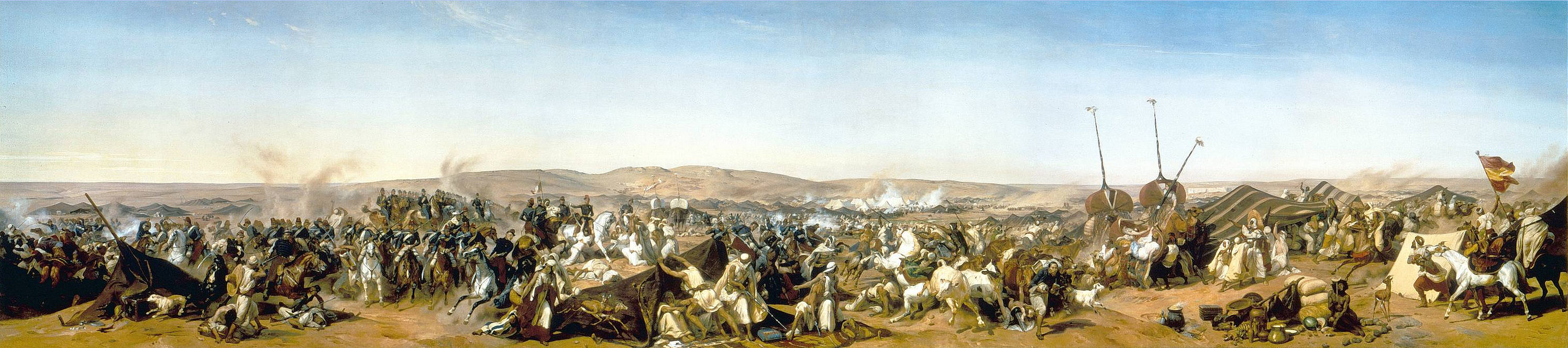
Oil painting depicting the 1843 French capture of Abd al-Qadir’s encampment, or smala, during the French conquest of Algeria (Public Domain)
.
Yet the emir’s deepest stroke of genius was not military. It was legal. From the first years of the war, Abd el-Kader issued to his troops a code for the treatment of prisoners: no killing of the captive, no mutilation, no stripping; the obligation to feed him as one feeds oneself; the emir even instituted a bounty for every enemy soldier brought in alive, reversing the economy of tribal war, which paid for severed heads.
When Monsignor Antoine-Adolphe Dupuch, first bishop of Algiers, wrote to him in 1841 to request a prisoner’s release, the emir granted the pardon and turned the request back: let the bishop obtain the same for captive Algerians. From this exchange was born, between the Catholic prelate and the Muslim emir, a friendship that never failed — Dupuch would later ruin himself pleading the cause of his imprisoned friend.
Legal historians have noted it: this code preceded by more than 20 years the first Geneva Convention (1864) and the founding of the Red Cross.[1] One will not claim here that Abd el-Kader “invented” humanitarian law — the phrase would be an anachronism, and he himself would have recognised in his conduct nothing that was not already in the law of Islam. One will observe more modestly, and it is already a great deal, that a Sufi master was applying in the field, two decades before Dunant, what Europe would soon believe it had given itself: the principle that war does not abolish the humanity of the enemy.
Facing him, the conquest chose the opposite road, and theorised it. Bugeaud, governor-general from 1840, applied total war: the systematic razzia (raid), the destruction of crops and silos, the felling of trees, the deportation of tribes. The enfumades (smoke-killings) of the Dahra (June 1845), where Colonel Pélissier — the future commander at Laghouat — asphyxiated by fire several hundred men, women, and children of the Ouled Riah tribe sheltering in caves, were no accident: Saint-Arnaud repeated the act two months later, and left in letters to his brother the calm admission of the method.[2]
There is no need here for the author’s indignation: the case is made by the French themselves. Alexis de Tocqueville, in his Travail sur l’Algérie (Essay on Algeria, 1841), had already observed that Muslim society had been made “more miserable, more disordered, more ignorant, and more barbarous” than before the conquest.[3] The most lucid of French liberals thus signs the verdict no colonised writer will need to pronounce after him.
The contrast did not escape the victors. Bugeaud, who used everything against him, would say of the emir that he was “a man of genius whom history will have to place beside Jugurtha.” Léon Roches, the adventurer who was his intimate secretary for two years before betraying him, would fill his memoirs with nostalgia for that prince who slept on a mat, fasted like an ascetic, and stitched his own burnous. This is the first paradox of the portrait: France never ceased to admire the man it was crushing — as though it sensed that in him it was fighting not a fanatic, but precisely what it claimed to be bringing: a state, a law, an ethic.
III. The Word Given, the Word Betrayed: Amboise
In December 1847, hemmed in between the French army and a Moroccan frontier that had turned hostile, Abd el-Kader took the heaviest decision of his life. He could have gone on: Saharan guerrilla warfare remained open to him. He chose to stop, and he would always give the reason: to spare his bled-white people a destruction without end.
On 23 December 1847, he handed over his war-horse to General de Lamoricière, who had accepted his conditions, confirmed by the governor-general in person, the Duke of Aumale, son of the king: the emir and his people would be conducted to a land of Islam, to Alexandria or to Saint-Jean-d’Acre. It was an engagement in due form: an officer’s word, countersigned by a prince of the blood.
The word was broken before the ship even docked. At Toulon, instead of the promised East, Fort Lamalgue. Then Pau. Then, from November 1848, the château of Amboise, where the emir and his suite — family, servants, companions, close to a hundred people — were crammed above the Loire. The Second Republic, which had just inscribed fraternity on the pediments of its town halls and abolished slavery, kept for four years in its prisons the man to whom two generals and a king’s son had given their word. Twenty-five of his people died there, among them children; they were buried in the garden, facing the river.
The emir, for his part, turned his prison into a zawiya: he taught, he prayed, he wrote. It was at Amboise that he composed, for the Asiatic Society of Paris, his Letter to the French, a meditation on reason, the religions, and law, in which the captive calmly gives his jailers a lesson in philosophy.
One must measure what is at stake here, for it is the knot of the whole colonial century. The betrayal of Amboise is no diplomatic footnote. It administers, before the eyes of the Muslim world, a demonstration: that Europe’s word does not hold once it is given to a Muslim. All the colonial history that follows — the treaties broken, the promises of 1914 and 1943 — is contained in embryo in this precedent.
And the reverse is true. The emir’s fidelity to his own word — he who, once freed, would swear never again to take up arms against France and would keep that oath to the point of scruple, against every solicitation — set for a century the contrast that Churchill, his first biographer, summed up in a line: the French generals themselves knew that the emir’s word was sacred, and that their own government’s was not.
On 16 October 1852, Louis-Napoléon Bonaparte came in person to Amboise to announce the emir’s release: “You have been the enemy of France, but I do no less justice to your courage, your character, your resignation in misfortune.” The prince-president needed to erase a shame and to attach the East to himself; the emir, for his part, had conceded nothing to get out.
Two strange months followed. The former “public enemy” was paraded through Paris, applauded at the Opera, invited to Saint-Cloud, taken to Les Invalides before the tomb of Napoleon I. The crowds who yesterday had burned him in effigy now pressed to catch sight of him. He observed everything — the machines, the printing houses, the railways — with the methodical curiosity every witness describes.
And here the calendars converge. While Paris applauds the freed emir, three columns close in on Laghouat.
IV. Laghouat, 4 December 1852
By the time the second act opens, the emir has been off the Algerian stage for five years. But the Sahara had not submitted. Around Muhammad ben Abdallah, known as the Sharif of Ouargla — a former French ally turned against them, and, be it noted, an adversary of the emir — revolt had spread through the oases.
Laghouat, the strategic lock that “opens” the south, a town ringed by gardens and tens of thousands of palms, became in the eyes of Governor Randon “a hotbed of agitation” to be reduced. Three columns — Pélissier, General Yusuf, General Bouscaren — invested the oasis from 21 November 1852, while Mac-Mahon covered toward Biskra. Against them: a thousand defenders at most, trade muskets, walls of earth.
The siege began on 21 November 1852; the bombardment and approach fighting dragged on, deadly, through the first days of December. Two dates frame the assault, and they are not neutral. On 2 December 1852, a short march away, the Second Empire was proclaimed, and the troops of the southern column voted the plebiscite that founded it; this 2 December is the great Bonapartist date — the anniversary of the 1851 coup. The decisive assault, for its part, was delivered on 4 December, the feast of Saint Barbara, patron of the artillery. Pélissier made no secret of it: his dispatch, as tradition reports it, congratulated his gunners on having “fittingly celebrated Saint Barbara’s day.” The massacre of a city was thus inscribed, by its own author, in the calendar of the imperial festival: the decisive operations run from 2 to 4 December, and the victory is announced in the register of Napoleonic triumph.[4]
The troops, having lost some of their own — General Bouscaren killed on the rampart — were given licence to kill everything. They killed in the streets, in the houses, in the great mosque.
Here, the precision of the figures matters more than their scale, for it is on them that the credibility of the account rests. The estimates vary by source; a work worthy of the name is bound to give them all, and to trace each to its origin. The population present at the time of the assault is estimated at between four and six thousand souls.[5] The number of dead, for its part, varies by source consulted. Pélissier’s official report to Marshal Randon, published in Le Moniteur of 14 December 1852, avoids any overall count.[6] The most cautious estimates, taken up today by the Laghouat Committee and by the City of Paris deliberation, hold to “more than 2,500” dead.[7] Algerian scholarly tradition advances the figure of 3,627 killed — two-thirds of a town of 6,000[8] — while certain recent presentations claiming archival grounding cite 3,786.[9] Whatever the range retained, one order of magnitude does not vary from source to source: the phrase “two-thirds of the population” wiped out, constant from the first witnesses to the official plaque of 2024.[10]
The key witness is French, and he is an artist. Fromentin reached Laghouat in June 1853, six months after the assault. On the spot he collected an officer’s account: the breach opened, a field-gun was pushed into the marabout pierced with embrasures and fired into the town; “of the two thousand and some hundred corpses gathered in the following days, more than two-thirds were found within the town,” he reports, before noting that “street fighting is atrocious.” And he lets fall the word, in italics: this murdered city.[11]
The testimony of a painter is not isolated, and it is this that puts the fact, for a demanding reader, beyond the reach of dispute. A participant, General du Barail, would concede in his Souvenirs that Laghouat suffered “all the horrors of war.”[12] The thing thus reads at three levels of French archive: the commander’s report (Pélissier), a junior officer’s testimony (collected by Fromentin), and a general’s retrospective admission (du Barail). As for the episodes carried by local memory alone — prisoners burned in sacks, bodies thrown into wells, an alleged use of chemical shells — I report them for what they are: an oral tradition relayed by writers, whose establishment still awaits a review of the Vincennes archives.[13] The central fact, however, is settled: a civilian oasis was destroyed, and a painter of the imperial army wrote the word “murder” as early as 1857.
A warning is called for here, and I borrow it from the historian Hosni Kitouni. The danger, in dwelling on Laghouat as an exceptional horror, is to leave in shadow what made it possible: not an excess, but a system. Kitouni shows that the fascination with spectacular episodes — the enfumades, Laghouat — has often functioned as a screen, masking the structural character of a “settler colonialism” whose aim was not to exploit the natives but to replace them.[14] Laghouat, then, is not an aberration in the conquest: it is its ordinary face, pushed one notch further. And this observation, far from weakening my argument, sharpens it. For if destruction was the routine regime of the conquering power, then the protection extended at Damascus eight years later stands out all the more: on one side a system that produced Laghouat as a matter of routine; on the other a single man who, without state or army, produced its exact opposite.
It took a 172 years for the Republic to concede it. On 4 December 2024, the City of Paris affixed, on the rue de Laghouat, a plaque restoring the “brilliant feat of arms” celebrated in 1864 to its truth as a war crime.[15] The key to one of the town’s gates, meanwhile, remains held in France, as do the standards of the resistance taken by the army — objects whose return is today demanded.[16]
It remains to lay the two calendars one over the other — not to draw an effect, but because the coincidence is real and has not been stated. 16 October 1852: the emir is freed at Amboise. 2 December: the Second Empire is proclaimed. 4 December: Laghouat falls, the emir still in France, guest of the state conducting the assault. 21 December: the emir sails from Marseille for the East. The new regime was thus born, in three weeks, between the freeing of a man and the destruction of a city, and it accomplished both with the same hand.
I will not conclude this paragraph in the reader’s place. I note only that the homage paid to the freed emir and the silence kept over Laghouat coexisted from the start in the same month, under the same authority — and that the first long served, in French memory, in place of all one did not wish to see of the second.
The emir would learn of Laghouat in the East. His correspondence in the years that followed, wholly taken up with spiritual matters, would never cease to plead for the Algerian refugees fleeing the “pacification” by the thousand — those hijra émigrés he would receive at Damascus, feed, settle at his own expense. The protector of the Christians of 1860 was first, and remained until his death, the father of the Muslim refugees of colonisation. The two charities make but one; to sever the second by keeping silent about the first is to mutilate both.
.
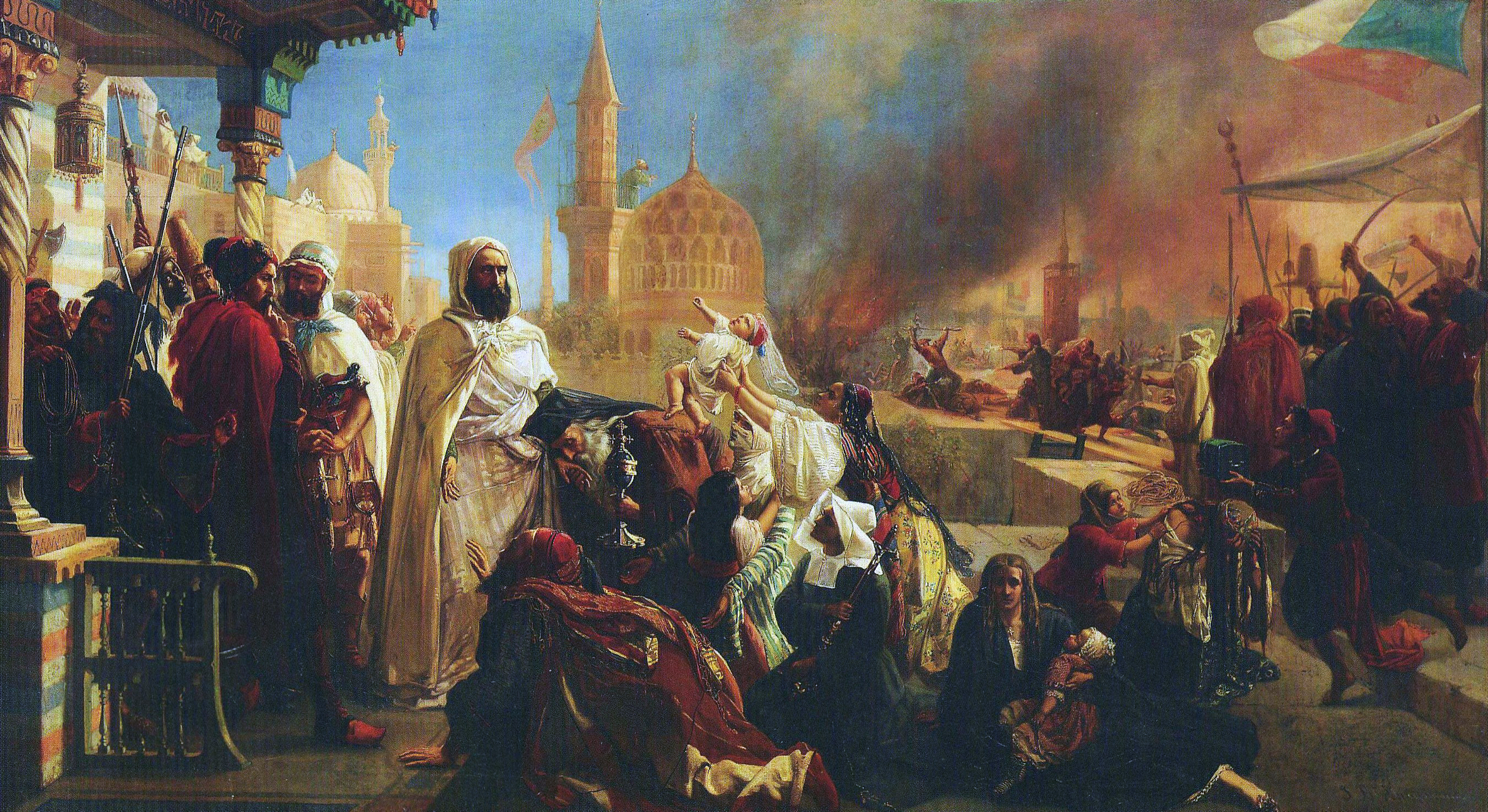
Abdelkader saving Christians during the Druze/Christian strife of 1860. Painting by Jan-Baptist Huysmans. (Public Domain)
.
V. Damascus, 9 July 1860
After a stay at Bursa cut short by an earthquake, the emir settled in 1855 at Damascus — the city of Ibn Arabi, the city of his youthful pilgrimage. There he led the life he had always wanted and history had refused him: dawn to the litanies, the day to teaching, the evening to guests. He commented on Ibn Arabi’s Futuhat at the Umayyad Mosque. His house in the al-Amara quarter was a scholarly court through which passed ulama, consuls, European travellers, pilgrims, refugees.
The British colonel Charles-Henry Churchill, who came in the spring of 1860 to gather from his lips the story of his life, describes him governing without power: an authority purely moral, but immense.[17]
Now Damascus, that summer, was a powder keg. The civil war of Mount Lebanon between Druze and Maronites, fanned by Anglo-French rivalries and by the resentments left by the Ottoman Tanzimat reforms, had left thousands dead in the mountains. The fall of Zahleh, the impunity of the killers, everything announced the contagion. The emir saw the storm coming weeks ahead: he wrote to the notables, warned the authorities, alerted the consuls, requested and obtained arms for his Algerians.
On 9 July 1860 the riot broke out. Tens of thousands of men fell upon the Christian quarters while Governor Ahmed Pasha let it happen; in places, his soldiers joined the looting. The toll of the dead, in Damascus alone, would be counted in thousands — General d’Hautpoul would advance the figure of more than five thousand.[18]
Then came the scene for which the old man’s whole life seems to have prepared him. The emir rode out with his guard of former mujahidin — the same men who, 15 years earlier, had fought Bugeaud’s zouaves — and placed himself between the mob and its prey.
The accounts agree: his son in the Tuhfat al-za’ir, the consular dispatches, Churchill, the survivors. He opened his house, then the houses of all the Algerians in the quarter. He had the thousands of refugees who no longer fit in the courtyards escorted, in protected groups, toward the citadel. He had it cried through the city that any man who brought him a Christian alive would be rewarded — turning against the riot the lure of gain, just as he had once turned against tribal war the bounty on the living prisoner. To the ringleaders who came to demand he surrender his guests, he opposed, the witnesses report, his guard with muskets levelled. The crowd fell back.
How many lives were saved in this way? The question is disputed, and honesty requires saying so. The sources range from “several hundred,” among the most reserved authors, to “close to fifteen thousand” among the most generous; the intermediate estimates speak of several thousand.[19] The true number will likely remain beyond reach. But the fact does not depend on the count: among those saved were the consuls of France and Russia, the religious of the congregations with the children of their orphanages, and families in great number. Take the lowest figure, and the act keeps its full measure.
The shock went round the earth. Napoleon III conferred on him the grand cordon of the Legion of Honour; Pope Pius IX, the Tsar, Greece, Prussia, the Ottoman Empire covered him with distinctions. Tradition holds that Abraham Lincoln sent him a pair of inlaid pistols; the anecdote is plausible and often cited, but I give it for what it is, a tradition. One fact, by contrast, is certain and more eloquent: as early as 1846 an American frontier jurist had given the distant hero’s name to a small town in Iowa, Elkader, which bears it still.[20]
The emir’s reply to the congratulations is worth more than all the decorations. To the bishop of Algiers who thanked him, he wrote that the good he had done the Christians he owed to fidelity to the law of Islam and to respect for the rights of humanity; for all creatures are the family of God, and the most beloved of God are those most useful to His family.[21]
This is the point to be heard, for it governs the whole meaning of the event. No imported humanitarianism, no conversion to the victor’s values: the emir claims his act as an act of Islam, in the name of the hadith of the “family of God” and of the verse he cited without ceasing: “We have sent thee only as a mercy to the worlds” (Qur’an 21:107). Damascus 1860 is not the exception that would redeem Islam in the eyes of the West. It is, for whoever will read it so, the Qadiri and Akbarian tradition carried to its point of application, in the thick of the riot, as a theology made deed.
Let us now hold up the mirror. At Laghouat, a regular, disciplined army, commanded by officers one of whom would end a marshal of France, destroys a civilian population, and the press speaks of a brilliant feat of arms. At Damascus, a mob without leader or law commits a massacre, and it is a defeated theologian, exiled, dispossessed, who reconstitutes single-handed, with a few hundred men, all that the law of nations holds most precious: asylum, the protection of non-combatants, armed neutrality in the service of the weak.
I will draw from it only one sentence, and one alone, because it carries enough to do without repetition: in 1852, what called itself civilisation produced barbarism; in 1860, the man called a barbarian produced civilisation. The rest, the reader has already understood without me.
VI. The Master of the Halts: The Invisible Conquest
To reduce the emir’s last 23 years to a pious twilight would be a final mutilation. They are, on the contrary, the most fertile period, and the least studied.
At Damascus the emir wrote the Kitab al-Mawaqif, the Book of Halts: hundreds of meditations dictated along the “stations” of the spiritual path, ranking among the summits of Akbarian metaphysics — the school of Ibn Arabi, to whom he expressly laid claim: “He is our treasure, from which we draw what we write.”
It was he, the former warlord, who financed and directed the first printed edition of the Futuhat al-Makkiyya (The Meccan Openings), Ibn Arabi’s great summa, from the Konya manuscripts he had collated. The gesture is worth a victory: it gave back to the Muslim world its greatest thinker at the very moment that world was doubting itself. Initiated by Shaykh Muhammad al-Fasi al-Shadhili, the emir knotted together the Qadiri, Shadhili, and Akbarian chains. In him the great rivers of Sufism converge.
He died at Damascus in the night of 25–26 May 1883 and was buried, as he had wished, beside Ibn Arabi at Salihiyya: the disciple laid in the shadow of the master, the loop of the 1826 pilgrimage closed. In 1966, independent Algeria repatriated his remains to the Martyrs’ Square of El-Alia — an act of sovereignty some of his readers would regret, seeing in it the emir torn from his vow and from his master.
VII. Objections and Counter-Readings
A portrait that would claim to be a reference has no right to pass over what contradicts it. Three serious objections stand against the reading I have just conducted; I set them out here in their full force before answering them.
The first is that of “the friend of France.” After 1860, the emir drew a French pension, remained under French surveillance, and declared himself, until his death, a friend of France. Some Algerian nationalists have taken offence at this and refused to grant him that role under the Second Empire. A diplomatic document of the period says as much without ambiguity: “Our former adversary in Algeria had become a loyal friend of France.”[22] Historians — Benjamin Stora, Jacques Frémeaux — go further: they show that the emir’s memory was shaped by France itself, which made of him the image of a “loyal resistant” and a “civilised Muslim,” set against the more intransigent figures of the resistance — a real adversary turned into the showcase of a colonisation anxious to be called civilising.[23] How is one to hold together the resistant of 1847 and the man decorated by Napoleon III?
The second bears on the scale of the rescue. I have given the ranges; a critical reader will observe that they are so wide — from several hundred to fifteen thousand — as to authorise the suspicion of a legend inflated after the fact. And indeed, the event was seized at once by various interests: France found in it the “good Muslim” useful to its Eastern policy, Freemasonry a prestigious candidate, Christian Europe a convenient hero. The Damascus deed was, in part, a political construction.
The third is the deepest. It comes from those for whom the emir, a spiritual man of the umma, belongs to no nation-state, and for whom to make him the ancestor of Algerian nationalism is a misreading — as it is a misreading, in the opposite direction, to make him the smooth icon of a “dialogue of civilisations” by cutting him off from his integral Islam.
I hold these three objections to be partly founded, and that is why I keep them rather than set them aside.
To the first, one will answer that the emir’s fidelity to his word of non-belligerence — sworn in 1852, kept to the end — is not a betrayal but its exact opposite: the constancy of a man who, precisely, did not break his oaths, even toward one who had broken his own. “Friend of France” does not mean accomplice of the conquest; the emir never disowned Laghouat, nor ceased to succour the refugees it cast onto the roads. That his image was instrumentalised by the coloniser says nothing about the man, but everything about the one who instrumentalises him: to recognise the appropriation is to defuse it, not to endorse it. As for the charge of “treason” revived of late — the accusation of having “sold Algeria” by signing the Tafna — Hosni Kitouni has refuted it point by point: the 1837 treaty, far from a capitulation, consecrated the emir’s sovereignty over two-thirds of the country, so much so that Governor Damrémont himself saw in it an agreement that made the adversary “more powerful than a brilliant victory could have made him.”[24]
To the second, one will grant that the number is uncertain and that the legend fed on interests; but one will recall that the material fact — consuls, congregations, families sheltered under his roof — is attested by witnesses who had no motive to serve his glory, beginning with the saved themselves. Take the lowest figure, and the act remains.
To the third, finally, I subscribe almost entirely, and I make it the heart of my reading: the emir is neither the first nationalist nor the religionless humanist that some have tried, by turns, to fabricate. He is an integral Muslim — a jurist and a gnostic — and it is as such, not despite his Islam, that he founded a state and protected Christians. To reduce him to either label is to miss him.
These reservations made, the mirror holds. It holds even better, stripped of what had been added to it that was too good to be true.
VIII. What the Mirror Shows
Let us sum up the portrait, soberly.
Here is a man who founded a modern state without copying Europe, drawing on the public law of his own civilisation, and who proved thereby that political modernity is the property of no one continent. Here is a warlord who codified the protection of the prisoner before Geneva, and who applied his code against an enemy who did not apply it — reciprocity was not the condition of his law, which is the very definition of a moral law. Here is a defeated man who kept a word his victors had betrayed. Here is an exile who, stripped of all power, exercised one July day in 1860 the only sovereignty that cannot be usurped: the sovereignty that protects. Here, finally, is a contemplative whose work stands in the direct lineage of Ibn Arabi.
Facing him, the century that fought him violated the capitulation of Algiers, the Tafna, the word of Lamoricière; it smoke-killed the Dahra, destroyed Laghouat, deported, expropriated, starved — Tocqueville a witness — and called this a civilising mission. The juxtaposition is no retrospective indictment: it was drawn by the contemporaries themselves, by Fromentin writing murdered city, by Tocqueville at the rostrum, by the officers whose letters confess what the bulletins disguise. The trial of colonisation is written, in French, in the coloniser’s own archives. One need only read, and set the dates against the dates.
This is why 4 December 1852 and 9 July 1860 would gain from being taught together, as the two pans of a single scale. To celebrate Damascus without naming Laghouat is to use the protector to make one forget what there was to be protected from. To commemorate Laghouat without meditating on Damascus is to keep the memory of the wound without its compass. For what the emir did at Damascus is exactly what Pélissier did not do at Laghouat; and it is at Damascus, therefore, that Laghouat finds its tribunal — not that of vengeance, but that of comparison.
There remains the lesson for our own time, and I hold it to be double. To the heirs of the emir, it opposes two symmetrical abdications: the one that kills in the name of the God in whose name Abd el-Kader protected, and which 9 July 1860 refutes in advance; and the one that awaits from the former master recognition, validation, even the definition of the self. The emir asked of Europe neither pardon nor certificate. He gave it, twice, a lesson — in law, then in humanity — from within his own tradition, proving that this tradition contained all that was needed to be civilised in the full sense.
To the heirs of the victors, the lesson is simpler, and it is concrete. France still holds the patrimony of the man it honours in words. The standards of the Laghouat resistance and the key to one of its gates are held in France; the sabre attributed to the emir is displayed at the Musée de l’Armée, as are the caftan given by his son and two rhetorical manuscripts of the holy Book seized during the conquest; the inventory submitted by Algiers in 2024 lists more than a hundred objects, manuscripts, and documents scattered from the Musée de l’Armée to the National Library and the château of Chantilly.[25] And in 2026, nothing has been officially returned — to the point that Benjamin Stora, who has long argued for these symbolic restitutions, deplores it publicly: one speaks of repentance, he says in substance, when one has not even managed to return a Qur’an, a sword, a burnous.[26] Whether or not one settles the disputed question of the sabre’s provenance,[27] the political fact remains, and it is of a perfect irony: the emir’s statue is inaugurated at Amboise, and his arms are kept; the protector of Damascus is celebrated, and his key is refused to Laghouat. The “murdered city,” for its part, still has no place, in the textbooks, beside the “capture of the smala.”
One July day in 1860, an old man stood alone between a mob and its victims, and he said, in substance: these are under my protection, for all creatures are the family of God. One may dispute the number of the saved; one cannot dispute the sentence. It alone suffices to make of this portrait something other than the portrait of a man: the portrait of what the century might have been, held upright, one day, in a Damascus alley, by a single Algerian — for the whole world, including those who had defeated him.
Chronological Markers
1808 — Birth at the Guetna of the Oued el-Hammam, near Mascara.
1825–1828 — Pilgrimage: Cairo, Mecca, Baghdad, Damascus.
5 July 1830 — Fall of Algiers.
27 November 1832 — The bay’a at Ghriss: Abd el-Kader proclaimed emir.
1834 — Desmichels Treaty.
1837 — Treaty of Tafna.
16 May 1843 — Capture of the smala at Taguin.
June 1845 — Smoke-killings of the Dahra.
1846 — Founding of Elkader, Iowa.
23 December 1847 — Conditional surrender; the word broken: Toulon, Pau, Amboise.
16 October 1852 — Release announced by Louis-Napoléon at Amboise.
21 November 1852 — Siege of Laghouat begins.
2 December 1852 — Proclamation of the Second Empire (anniversary of the 1851 coup); plebiscite voted by the troops.
4 December 1852 — Decisive assault and destruction of Laghouat, feast of Saint Barbara (Âm el-Khalia).
21 December 1852 — The emir sails from Marseille for the East.
1855 — Settles at Damascus.
9–17 July 1860 — Damascus massacres; the emir protects the Christian population.
1864–1865 — Masonic contacts and rupture.
1869 — Guest of honour at the opening of the Suez Canal.
26 May 1883 — Death at Damascus; burial beside Ibn Arabi.
1966 — Remains transferred to Algiers.
February 2022 — Amboise statue vandalised, then inaugurated.
2024 — Inventory of claimed goods submitted by Algiers to the joint commission.
4 December 2024 — Commemorative plaque, rue de Laghouat, Paris.
2026 — No official restitution of the emir’s goods; arms bought and returned by an association (Stains, March).
[Note on figures and quotations: the ranges for casualties (Laghouat) and for persons protected (Damascus) are given within the span of available sources; narrowing them would require a review of the Vincennes holdings and the consular dispatches. The emir’s quotations — the letter to the bishop of Algiers, phrases reported during the riot — are widely attested but deserve to be collated against the critical editions (Chodkiewicz for the spiritual writings). The anecdote of Lincoln’s pistols is reported by tradition and given as such.]
*
Click the share button below to email/forward this article. Follow us on Instagram and X and subscribe to our Telegram Channel. Feel free to repost Global Research articles with proper attribution.
Sources and References
Witnesses and primary sources. Eugène Fromentin, Un été dans le Sahara, Paris, 1857 (the witness who reached Laghouat in June 1853; the “murdered city”). Charles-Henry Churchill, The Life of Abdel Kader, Ex-Sultan of the Arabs of Algeria, London, Chapman & Hall, 1867. Alexandre Bellemare, Abd-el-Kader, sa vie politique et militaire, Paris, Hachette, 1863. Léon Roches, Trente-deux ans à travers l’islam, Paris, Firmin-Didot, 1884–1885. Mgr Antoine-Adolphe Dupuch, Abd-el-Kader au château d’Amboise, Bordeaux, 1849. Emir Abd el-Kader, Letter to the French (*Dhikra al-‘aqil wa tanbih al-ghafil), Amboise, 1855; Kitab al-Mawaqif* (The Book of Halts); letter to the bishop of Algiers, 1860. Muhammad ibn Abd el-Kader, Tuhfat al-za’ir fi tarikh al-Jaza’ir wa-l-amir Abd al-Qadir. Alexis de Tocqueville, Travail sur l’Algérie and parliamentary interventions, 1846–1847. Reports of General Pélissier and officers’ correspondence on the taking of Laghouat, Service historique de la Défense (Vincennes).
Studies. Charles-André Julien, Histoire de l’Algérie contemporaine, t. I, PUF, 1964. Charles-Robert Ageron, Histoire de l’Algérie contemporaine, PUF. Bruno Étienne, Abdelkader, isthme des isthmes, Hachette, 1994. Ahmed Bouyerdene, Abd el-Kader, l’harmonie des contraires, Seuil, 2008 (English trans.: Emir Abd el-Kader: Hero and Saint of Islam, World Wisdom, 2012). Michel Chodkiewicz, Émir Abd el-Kader, Écrits spirituels, Seuil, 1982 (English: The Spiritual Writings of Amir ’Abd al-Kader, SUNY Press, 1995). Mustapha Chérif, L’Émir Abdelkader, apôtre de la fraternité, Odile Jacob, 2016. John W. Kiser, Commander of the Faithful: The Life and Times of Emir Abd el-Kader, Monkfish, 2008. Mohammed Chérif Sahli, Abdelkader, le chevalier de la foi, Algiers. Hosni Kitouni, Le désordre colonial. L’Algérie à l’épreuve de la colonisation de peuplement, Algiers, Casbah, 2018; Histoire, mémoire et colonisation, Algiers, Chihab, 2024. Benjamin Stora, Les Questions mémorielles portant sur la colonisation et la guerre d’Algérie (report, 2021). Didier Monciaud, “Laghouat 1852,” Cahiers d’histoire, no. 156, 2023. Lazhari Labter, Laghouat, la ville assassinée, Algiers, 2019.
Notes
[1] On the code for the treatment of captives issued by the emir, see Bruno Étienne, Abdelkader, isthme des isthmes, Hachette, 1994, and Ahmed Bouyerdene, Abd el-Kader, l’harmonie des contraires, Seuil, 2008; his friendship with Bishop Dupuch is documented in A.-A. Dupuch, Abd-el-Kader au château d’Amboise, Bordeaux, 1849.
[2] On the smoke-killings of the Dahra (Ouled Riah, June 1845) and Saint-Arnaud’s repetition of the act, see Saint-Arnaud, Lettres, and the discussion in Jacques Frémeaux, La Conquête de l’Algérie.
[3] Alexis de Tocqueville, Travail sur l’Algérie (1841), in Œuvres complètes; the phrasing recurs in his parliamentary reports and interventions of 1846–1847. English readers may consult Tocqueville on Empire and Slavery, ed. Jennifer Pitts (2001).
[4] Separately verifiable facts: the siege began on 21 November 1852; the decisive assault was delivered on 4 December (Aimable Pélissier, “Expédition de Laghouat,” Revue de l’Orient et de l’Algérie, 1853; Le Moniteur, 14 December 1852); the Second Empire was proclaimed on 2 December 1852, with the southern column’s troops voting the plebiscite; and 4 December is the feast of Saint Barbara, patron of the artillery (a general calendar fact). The phrase attributed to Pélissier’s dispatch (“fittingly celebrated Saint Barbara’s day”) is reported by later writers; I have found no direct citation to the original text, and give it as tradition — distinct from the verified calendar facts, and without implying proven intent on the field commander’s part.
[5] Achour Cheurfi, Dictionnaire des localités algériennes, Algiers, Casbah, 2011, pp. 707–713 (art. “Laghouat”), gives the higher range; Charles-André Julien, Histoire de l’Algérie contemporaine, t. I, PUF, 1964, pp. 390–391, a lower population. A recent academic synthesis (HAL, 2025) estimates 2,300–3,000 dead out of some 4,500 inhabitants.
[6] Aimable Pélissier, “Expédition de Laghouat,” Revue de l’Orient et de l’Algérie, 1853, pp. 64–68; official account reproduced in Le Moniteur universel of 14 December 1852. Reports of the southern column: Service historique de la Défense, Vincennes, series H (Algeria).
[7] “More than 2,500”: the wording of the explanatory statement of the Paris Council deliberation (2024) and of the Laghouat–France Committee.
[8] The figure of 3,627 belongs to Algerian scholarly and commemorative tradition; see the survey by Didier Monciaud, “Laghouat 1852,” Cahiers d’histoire, no. 156, 2023, pp. 159–164.
[9] The figure of 3,786 is advanced by recent Algerian presentations claiming archival grounding; to be handled with caution, absent a verifiable reference to date.
[10] Text of the plaque on the rue de Laghouat (Paris, 4 December 2024): a massacre “decimating two-thirds of the town’s population” and “amounting to a war crime.”
[11] Eugène Fromentin, Un été dans le Sahara, Paris, 1857, chapter “El-Aghouat.” See also Lazhari Labter, Laghouat, la ville assassinée, ou le point de vue de Fromentin, Algiers, 2019.
[12] General François-Charles du Barail, Mes souvenirs, t. II: 1851–1864, Paris, Plon, 1897–1898 — an admission the more telling for coming from an officer who took part in the operation.
[13] The use of “shells charged with chlorine” is maintained on the Algerian side (notably by Prof. Mostéfa Khiati) but is not, to date, corroborated by an identified French archival source; I mention it as an allegation to be investigated, not an established fact.
[14] Hosni Kitouni, Le désordre colonial. L’Algérie à l’épreuve de la colonisation de peuplement, Algiers, Casbah, 2018; Histoire, mémoire et colonisation, Algiers, Chihab, 2024. Kitouni (research associate, University of Exeter) defines settler colonialism as a process of population replacement, structural rather than episodic, and warns against an “exceptionalist” reading of the violence that masks its systemic character.
[15] See the explanatory statement of the Paris Council deliberation (2024).
[16] Key and standards held in France (Musée de l’Armée, Les Invalides; Musée de l’Empéri, Salon-de-Provence, depending on the object); restitution demanded since 2020–2022.
[17] Charles-Henry Churchill, The Life of Abdel Kader, London, Chapman & Hall, 1867 — a biography gathered from the emir’s own lips at Damascus in 1859–1860.
[18] Figure given by General d’Hautpoul (“more than five thousand” killed at Damascus); see the accounts of 1860–1861.
[19] The low estimates (“several hundred”) appear among cautious authors; the high ones (“close to fifteen thousand”) in Mustapha Chérif, L’Émir Abdelkader, apôtre de la fraternité, Odile Jacob, 2016. Accounts of 1860 often retain roughly 5,000 survivors out of some 20,000 persons concerned. The gap turns on what is counted: those directly under his roof, or those saved by his intervention in the broad sense.
[20] The town of Elkader (Clayton County, Iowa) was named in 1846 by the jurist Timothy Davis; it still bears the name.
[21] Letter from the emir to Bishop Pavy of Algiers (1860), widely cited; for collation see Michel Chodkiewicz (ed.), Émir Abd el-Kader, Écrits spirituels, Seuil, 1982 (English: The Spiritual Writings of Amir ’Abd al-Kader, SUNY Press, 1995).
[22] Archives diplomatiques, Amyot, 1877, p. 384; on the reticent nationalist reading, see Jean-Charles Jauffret, La Guerre d’Algérie par les documents, vol. 2, SHAT, 1998, p. 174.
[23] See Benjamin Stora’s work on the memory of colonisation (including the report submitted to the French presidency, January 2021), and Jacques Frémeaux. Stora also initiated the Amboise statue (2022) and co-chairs the joint Algerian–French commission of historians established in 2022.
[24] On the “traitor” polemic (statements by N. Aït Hamouda, 2021) and its refutation, see Hosni Kitouni, interview in Liberté, 2021: the Treaty of Tafna (1837) consecrated Algerian sovereignty over two-thirds of the territory; Governor Damrémont himself judged that it made the emir “more powerful than a brilliant victory.”
[25] Inventory presented by the Algerian side to the joint commission (May 2024): more than a hundred objects, manuscripts, and documents of the nineteenth century held at the Musée de l’Armée, the Bibliothèque nationale, and the château of Chantilly (fonds of the Duke of Aumale).
[26] On the refusal by the French authorities (the need for a law derogating from the inalienability of public collections; J.-L. Martinez report, 2021) and B. Stora’s disappointment (“Nothing has been returned. Absolutely nothing,” remarks of 2025), see the specialist press, 2020–2026. In March 2026 only a Franco-Algerian association, having acquired arms at public sale, announced their restitution — without the involvement of the public authorities.
[27] The sabre (often called a “sword”) is said to have been handed to the Duke of Aumale at the surrender of 23 December 1847, then given to Lamoricière, before entering the Musée de l’Armée by acquisition; the caftan (often called a “burnous”) was given in 1897 by the emir’s son, El Hachemi. The Martinez report (2021) concludes to a “legal” acquisition by gift; the Algerian side contests this reading for the items seized during the conquest (manuscripts, Laghouat trophies).
Featured image: Emir Abdelkader painted by Tissier whilst he was imprisoned at the Château d’Amboise in 1852. (Public Domain)
Global Research is a reader-funded media. We do not accept any funding from corporations or governments. Help us stay afloat. Click the image below to make a one-time or recurring donation.









.png)





.jpg)



 English (US) ·
  French (CA) ·