3 weeks ago
12
3 weeks ago
12
PROTECT YOUR DNA WITH QUANTUM TECHNOLOGY
Orgo-Life the new way to the future Advertising by Adpathway
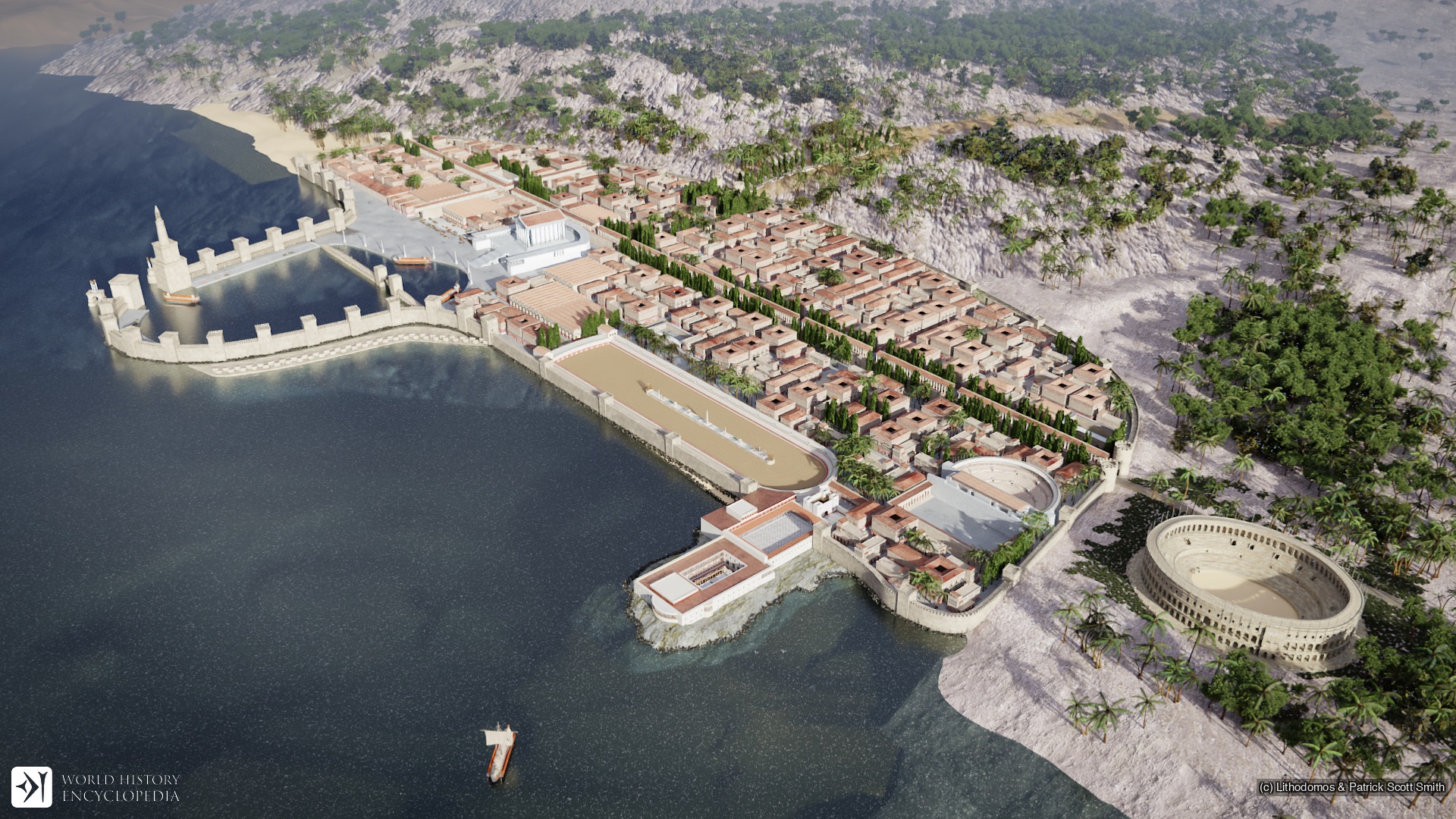
Caesarea Maritima was a bustling trading hub of the Eastern Mediterranean. Built on earlier ruins, the new metropolis was commissioned by Herod the Great (reign 37-4 BCE), and it became one of the most important trade centers of the day due to its colossal harbor. Herod's harbor was a fortress at sea which both facilitated trade in the Roman Empire and served a military purpose. Besides the harbor, the city had a temple, palaces, an amphitheater, a theater, paved streets, and waterworks.
This gallery features digital reconstructions created as a collaboration of Lithodomos and Patrick Scott Smith, based on archaeological reports and comparative analysis of known Roman construction techniques, Josephus' eyewitness descriptions, and Herodian fortification work at Jerusalem and Masada.
Caesarea Maritima Digital Reconstruction

One of the most remarkable builds of the ancient world, the metropolis of Caesarea Maritima was literally built from the ground up. In the latter years of the 1st century BCE, as a port city, it served Rome’s purpose in extending its military and commercial presence in the Eastern Mediterranean. As Rome’s client king and point man in the East, Herod the Great accomplished this feat by constructing a whole city, complete with a temple, palaces, amphitheater, theater, paved streets, waterworks, and, fundamental to the city’s purpose, Herod's harbor.
As a favorite location for the stationing of troops by the Roman emperor Vespasian, and as a base of operations, military action out of Caesarea came when the Great Jewish Revolt of 66 CE was crushed with thousands of Jewish lives lost by Roman soldiers garrisoned at Caesarea. After this, Vespasian elevated the city to the status of a Roman colony. Then, when the Bar-Kochba Revolt (132-135 CE) ended with the destruction of Jerusalem, the provincial governor of Judea was raised to senatorial rank, and it was then that Judea’s name was changed to Syria-Palaestina, and Caesarea became the official capital of the Roman province. Finally, with added aqueducts fed by new water sources, the population of Caesarea, spilling past the original Herodian wall, during the Byzantine period, after the 4th century, is thought to have exceeded 100,000 residents.
Using archaeological reports by Ehud Netzer, Barbara Burrell, Kenneth Holum, Robert Bull, and others, along with Flavius Josephus' eyewitness descriptions, the image you see is part of the collaborative work of Lithodomos and Patrick Scott Smith.
World History Encyclopedia is a non-profit organization publishing free history content that has been carefully researched and reviewed. If you liked this content, please consider donating at www.worldhistory.org/donate/. To remove this message from printouts, you can become a supporting member at www.worldhistory.org/membership/. Thank you for supporting our work!







.png)




.jpg)


 English (US) ·
  French (CA) ·