

Elsa Ruiz delivered a personal appeal to city council members Tuesday night as they considered a controversial vote to terminate an extended contract with interim independent police monitor Aeiramique Glass.
“First and foremost, I would like you to vote for Miss Glass,” said Ruiz, the mother of Corey Ruiz, who was shot and killed by a Madison police officer nearly three months ago. “She has been doing a superb job in her position,” added Ruiz, calling Glass “someone I need desperately in my corner.”
But, as dawn broke, the council voted 14-6 to terminate Glass’ extended contract as interim independent monitor. Voting no were Alds. Ellen Zhang, Carmella Glenn, Barbara Harrington-McKinney, Julia Matthews, Davy Mayer and Devine Nzegwu.
After the vote, the dozens who remained in the council chambers shouted “shame” at the alders who had voted to end the contract.
As the council wrapped up, alders and city staff hustled to clear the room to allow for setup for municipal court. Uniformed police officers intervened as some protestors confronted city alders.
The resolution to remove Glass, who became the city’s interim police monitor in December 2025, was introduced from the floor Oct. 6 by Ald. Will Ochowicz. The resolution reverses the extension of Glass’ appointment that the council approved June 9. Under that extension, Glass would have worked through March 2027, or departed earlier if the position were filled.
It also places the office of the independent monitor under the supervision of Karen Kapusta-Pofahl, chief of staff for the Common Council, and engages experts from the National Association for Civilian Oversight of Law Enforcement for their help in finding a permanent monitor.
Those opposed to the resolution argued that it violates the 2020 ordinance that created the independent monitor position. The ordinance states that the monitor reports directly to the Police Civilian Oversight Board, and that “the monitor shall act as directed by the board.”
It also states, “No city employee or official shall attempt to use their political or administrative position to unduly influence or undermine the independence of the monitor.”
Going into the meeting, there were eight co-sponsors of Ochowicz’s resolution: Council President Sabrina Madison, Alds. Yannette Figueroa Cole, Tag Evers, Regina Vidaver, Derek Field, Joann Pritchett, Badri Lankella and Sean O’Brien. Some explained their reasoning ahead of time.
“Trust is low between the Common Council, the PCOB, and the public,” Ochowicz wrote in an Oct. 15 blog post. “I hope that people understand that what I am doing is what I think is best for the city. What is going on right now is clearly not working, and we need to do better.”
Vidaver wrote that Glass failed to follow work rules — including neglecting to submit paperwork for contractors or adhering to telework and family leave policies — and exhibited a “lack of discernment and objectivity.”
“This has been by far the most challenging decision I have had to make as alder,” wrote Ald. Noah Lieberman in a blog post. Ald. Dina Nina Martinez-Rutherford, in explaining how she had changed her mind “no less than 50 times,” wrote that Glass “exhibited behavior that gives me pause and causes me to question her judgment as a leader who is employed by the city.”
Public comment dominated eight of the meeting’s 12 hours, as those crammed into council chambers frequently interrupted, heckled and insulted the city staff, alders, and those who spoke in favor of firing Glass. In total, the resolution drew 177 people registered in support, 318 against, and three registered neither for nor against, according to city staff. It also drew 109 pages of written comment ahead of the meeting.
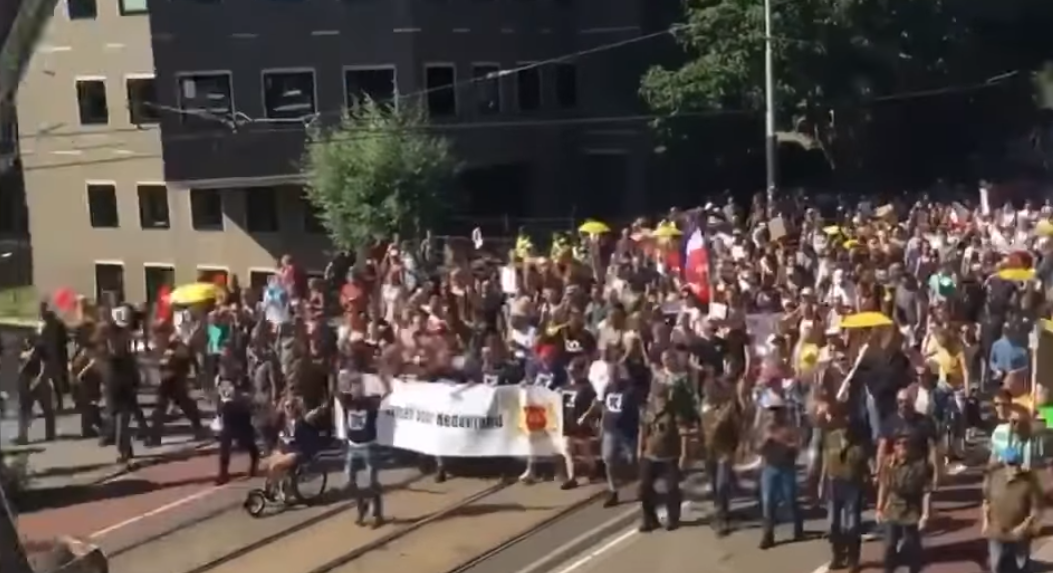
A protest led by the UW-Madison chapter of Students for a Democratic Society converged on the City-County Building at the start of the meeting, as a police drone monitored overhead. So many people showed up that the staff opened an overflow room one floor above. On the ground floor, half a dozen uniformed officers tuned in to the proceedings from a reception desk, ready to be called into council chambers if need be.
The firing of the independent monitor, the overwhelming number of speakers said, symbolized many things. It was “evil,” “procedural corruption,” “retribution and retaliation,” “frankly ridiculous,” an attempt to “sweep police murder under the carpet,” support of “a racist system,” a “slap in the face,” and “an urgent rush to push a Black woman out of her job.”
Crowds drowned out the few speakers who defended the firing of the monitor, including conservative blogger David Blaska and police advocate Bonnie Roe.
A few speakers backed the termination on process grounds. “No matter how pure her intentions,” said Edward Montasaros, one of Glass’s core responsibilities was to recruit a permanent hire, and he pointed to the little that had been done.
Greg Gelumbiak, the office’s data analyst, spoke at the speed of an auctioneer during public comment, declaring he was in his eighth day of a satyagraha, a hunger strike in an “appeal to moral principles.”
“If this resolution is passed, I will continue my fast,” Gelumbiak said, arguing that the allegations against the police monitor were distorted and lacked context. “Monitor Glass is being subject to a political lyching.”
Former alders who helped establish the groundwork for the police civilian oversight committee, and the role of the monitor, urged their successors to support the independence of the monitor position.
“I’m just so furious with this council,” said Brenda Konkel, who served as alder from 2001-2009. “If you can’t respect community voices, can you at least read my email, and think about legislative intent?”
Konkel called on alders to remember that the civilian oversight board and independent monitor were designed to be independent of the city council and the mayor. “Honor that intent,” she added.
Former longtime Ald. Marsha Rummel, calling herself the “ghost of Common Councils past,” described “the hundreds of hours” previous alders had invested in creating the monitor and oversight board.
“We gave you a gift,” she said, conceding that there are still “some things to figure out.” She cautioned: “I don’t think you have the authority to terminate the appointment.”
Rummel represented the Williamson Street area when Tony Robinson was killed in 2015 by police officer Matt Kenny. Kenny was not charged with any crime, and remains employed by the Madison Police Department. In 2017, the city of Madison settled a $3.35 million civil rights lawsuit with Robinson’s family.
Robinson’s grandmother, Sharon Irwin, has continued to seek justice. In 2023, assisted by a team of attorneys, Irwin sought to use a little-known state law to compel a judge to issue a criminal complaint if a district attorney refuses to prosecute. The effort failed.
Hours before Tuesday’s meeting, Glass announced she had hired attorney Damon Etawlyah to represent Irwin before the Police and Fire Commission in her grandson’s case. It’s the first time the monitor’s office has appointed an attorney to represent a complainant.
Speaking in front of the council, Irwin paced back and forth, admonishing alders for ignoring her pleas for action and calling them “colonizers.”
“And you guys call yourselves moral? You’re not even close to moral,” she said. “For 11 years, you ignored me.”
On Monday, the civilian oversight committee announced it had conducted a performance review of Glass and found she had “performed at a high level across every category.”
“Board members identified significant strengths in her leadership, communication, commitment to independent oversight, community engagement, and dedication to advancing the mission of civilian police oversight,” the board said in a news release. The review was not statutorily required for an interim monitor.
“The evaluation also identified opportunities for continued growth, including rebuilding relationships with key stakeholders, expanding data-driven oversight efforts, strengthening public communication strategies, and continuing efforts to secure the resources necessary for the office to fully conduct its mission. Board members emphasized that many of these challenges arise within a complex environment involving multiple governmental agencies and institutional barriers.”
The review follows an Oct. 2 “employment review” prepared by City Attorney Michael Haas. The document states it aims to “respond to inquiries from the public and alders” by outlining the interim monitor’s duties and responsibilities set forth in the job announcement and appointment letter, employment law, and more. After public testimony, and over the course of some three hours, alders posed questions to city staff, including Haas, police Chief John Patterson, and Glass.
The discussion reflected the lack of clarity over how the monitor’s office differs from a traditional city agency and what that means in terms of requirements to follow city human resource rules and contracting procedures, among other things.
Glass outlined her difficulties: “It’s not about not wanting policy to adhere to and how we function. It’s about who it flows through,” she said.
“There is currently no pathway that does not lead back to the mayor or to the Common Council.”
[Editor's note: A previous version of this story incorrectly said the council would take up the rest of its agenda Oct. 22. That motion failed; alders instead voted to adopt the remainder of the agenda.]










.png)





.jpg)


 English (US) ·
 French (CA) ·