

.png) 1 month ago
30
1 month ago
30
PROTECT YOUR DNA WITH QUANTUM TECHNOLOGY
Orgo-Life the new way to the future Advertising by AdpathwayAlpine ski resorts in New South Wales and Victoria saw climate records shattered at the weekend with maximum temperatures up to 12C above average.
Ski areas of Mount Hotham and Falls Creek set July records for their hottest daytime and night-time temperatures and Thredbo also set a new hottest July day, according to the Bureau of Meteorology.
The records come after a challenging start for Australia’s ski season with dry and warm temperatures seeing only sporadic falls of natural snow in many alpine areas, leaving resorts to rely mostly on snow-making technology.
The El Niño now in place in the tropical Pacific and the bureau’s long-range forecast both pointed to generally drier and warmer conditions for alpine regions this winter – a “bad combination” for snow.
Climate scientists have long warned that global heating will create difficult conditions for Australia’s ski resorts.
Angus Hines, a senior forecaster at the bureau, said a slow-moving high pressure system – characterised by clear skies and descending dry air – had been a key to the spiking temperatures.
He said this had also caused a “temperature inversion” where it was cooler closer to sea level than it was at higher altitudes.
“These temperatures were a substantial departure from the norm and even from previous bursts of heat for July,” he said.
“This highlights the likely issues we will have with ski seasons into the future with a warming climate.”
He said warmer than usual temperatures would remain in ski areas until about Wednesday and there was a chance of a snow flurry at the weekend, before temperatures were expected to climb again early next week.
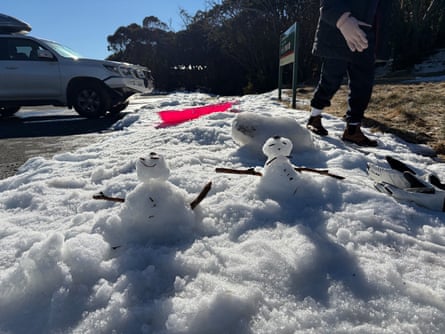
At Mount Hotham in Victoria’s alpine country, where the official temperature record goes back 36 years, the previous hottest July day was 8.7C in 1994.
But that record has been broken three times this month. The mercury peaked at 12C on Sunday in a month when the average daily maximum temperature is usually zero.
At Falls Creek, the highest July temperature had been 9.8C recorded in 1992. But this was eclipsed with 11.5C recorded on Saturday and then 13C on Sunday. The average daily maximum for Falls Creek in July is 1.2C.
New daily temperature records in alpine regions this weekend were also set in Thredbo (14C), Cabramurra (14.3C) and Mount William (15.2C).
Record warm night-time temperatures were set in Mount Buller (5.7C), Mount Baw Baw (12C), Mount William (9.4C), Mount Hotham (4.6C) and Falls Creek (also 4.6C).
after newsletter promotion
Dr Andrew Watkins, a climate scientist at the Climate Council, skied at Mount Hotham on Friday when temperatures were already threatening the previous 1994 record.
“It was incredibly warm up there,” he said.
“You do not expect to see temperature records that are more than 30 years old being broken by two or three degrees. It is quite phenomenal.
“I don’t think any climatologist is surprised by events like this any more. It is shocking in its own way.”
Laura Gray, from Bright in Victoria, skied Mount Hotham and Falls Creek on the weekend and said she saw people skiing in T-shirts and without gloves.
“It did feel pretty bizarre and I had to keep reminding myself that it was still mid-July and not the spring,” she said.
“In the morning it was lovely to ski but once the sun got high enough on the slopes it turned slushy very quickly.”
She said the ski season, which officially started in early June around the King’s birthday long weekend, had been “pretty grim” so far.
“It is not unusual not to ski on opening weekend but it’s been pretty dire – just pretty dry and warm. Without snow-making, we absolutely would not have been skiing at all.
“When we heard there was going to be an El Niño, that put us on edge but I don’t think anyone could have expected these July temperatures.”
The Guardian has approached Snow Resorts Australia for comment.














.png)






.jpg)



 English (US) ·
  French (CA) ·