

 3 hours ago
7
PROTECT YOUR DNA WITH QUANTUM TECHNOLOGY
Orgo-Life the new way to the future Advertising by AdpathwayScientists at the Department of Energy's Oak Ridge National Laboratory have discovered that applying a small amount of pressure can dramatically alter the magnetic properties of a promising new class of materials called altermagnets. Using neutron experiments, the researchers uncovered how a simple mechanical squeeze can change the way these materials behave, offering a potential new approach to controlling magnetism.
The results, reported in two consecutive studies published in Physical Review X and Advanced Materials, show that mechanical strain can influence both magnetic structures and the movement of electrons. This ability could provide a straightforward way to control materials being investigated for advanced electronic technologies.
Why Altermagnets Matter for Future Electronics
One particularly promising application involves spintronics, short for spin electronics. Unlike conventional electronics, which processes and stores information using the electrical charge of electrons, spintronics also takes advantage of a property known as electron spin.
If scientists can identify and develop suitable materials, including altermagnets, this approach could lead to major advances in technologies ranging from wireless communication to quantum computing.
"By controlling the magnetic domains, we can directly influence the transport behavior, and that opens the door to exploring these materials for spintronic technologies," said Pengcheng Dai of Rice University, a former neutron scientist at ORNL.
A Simple Squeeze Reveals Surprising Magnetic Changes
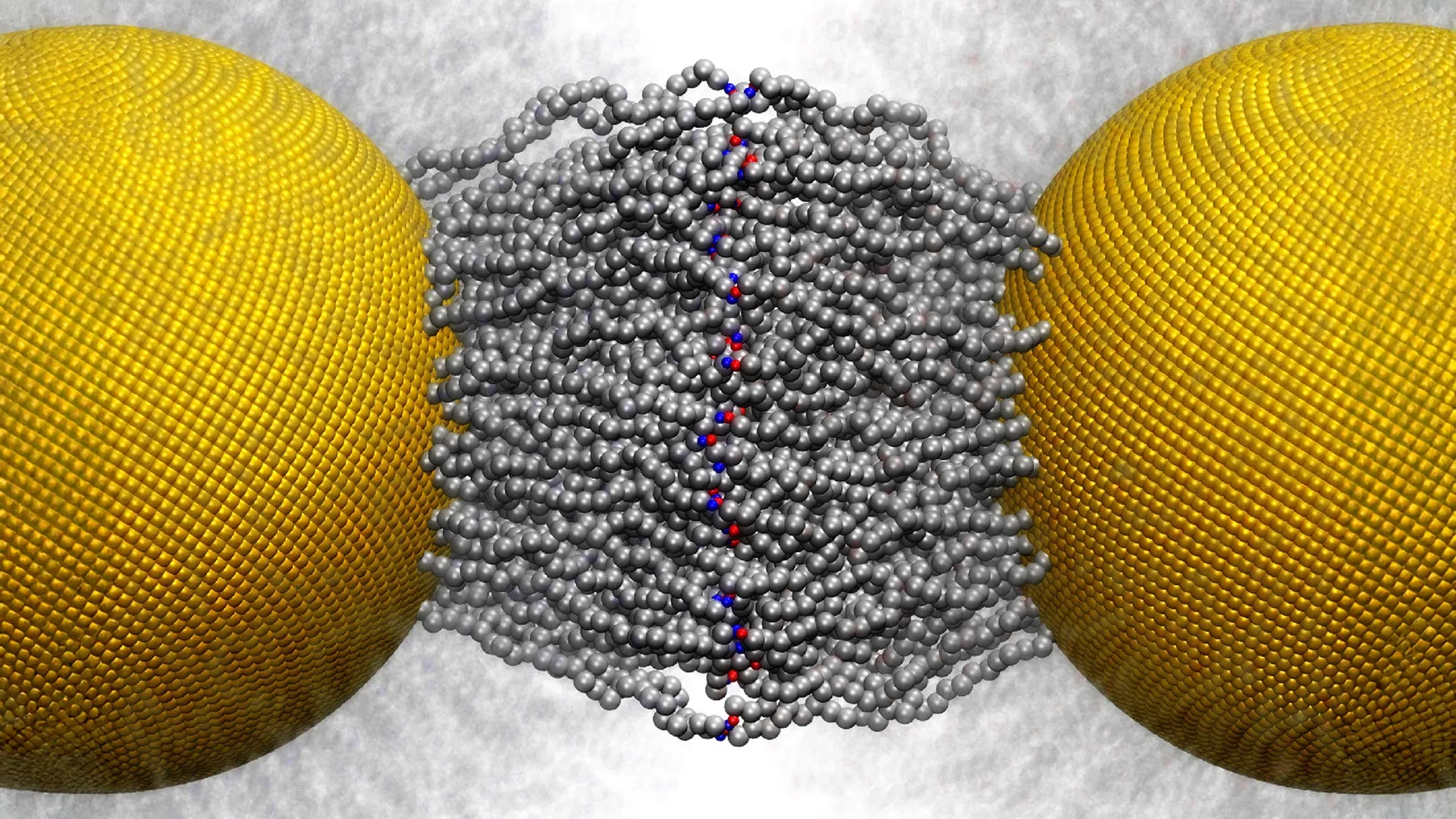
To investigate how pressure affects these materials, the ORNL team placed tiny crystals of manganese telluride and iron sulfide between a pair of titanium plates and gently compressed them.
Using neutron diffraction at ORNL's Spallation Neutron Source, the scientists examined what happened to the magnetic structures inside the crystals. They found that the applied pressure changed the relative populations of magnetic domains, which are regions within a material that have particular magnetic arrangements. The strain also altered an electrical phenomenon called the anomalous Hall effect, providing evidence that the mechanical squeeze influenced the materials' electrical behavior.
"What's exciting is that one creative experimental idea -- a small mechanical squeeze between two plates -- can reveal entirely new magnetic behavior and push the field forward, and neutron scattering plays such a critical role, revealing the underlying change in magnetism," said Feng Ye, an ORNL neutron scientist and co-author on both linked publications.
The findings highlight how a relatively simple experiment can uncover new ways to manipulate magnetic materials, potentially helping researchers develop the building blocks for future spintronic devices.
ORNL's Spallation Neutron Source is a DOE Office of Science user facility.















.png)






.jpg)



 English (US) ·
 French (CA) ·