

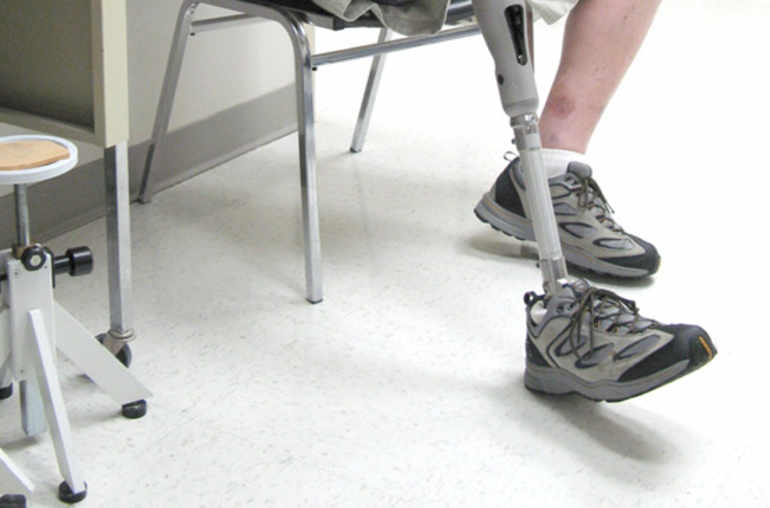
Gene has been homeless in Madison since 2013. Because of his recent hip surgery, walking brings debilitating pain. “That’s why I sit here,” says Gene, who is perched on a bench at a Madison Metro bus shelter on an early August day. He lost his cane this week, he adds. “Being disabled puts me at a little bit of a disadvantage, because I can’t go out and seek the things that I need,” he says.
He’s a veteran, and receives about $500 a month in Social Security. He’s hoping that when he turns 65 soon, his payments will increase. While he’s had jobs, he doesn’t want to work only to “live in a room — I did that for a while, and I don’t like it.”
Gene sometimes stayed at the temporary men’s shelter on Zeier Road, which shut down Sept. 1, after being replaced by the new permanent men’s shelter at 1904 Bartillon Drive. He pulls a creased letter from his pocket. It explains he’s among the first 250 men to get into the new shelter, but the clock on his stay had already started ticking.
He already receives services from Porchlight, which managed the Zeier Road shelter and is now managing operations at Bartillon Drive. So Gene will need to start working with a case manager to develop a permanent housing plan before September is over, or risk losing his new bed.
Gene’s worried about the people who are on the waitlist. “Where are they supposed to go to sleep? On State Street? Winter’s coming up again very soon, and I’m worried.”
The new “purpose-built” shelter is a significant shift in how the city approaches its unhoused population. For 35 years, the basements of three downtown churches — Grace Episcopal Church, St. John’s Lutheran Church and First United Methodist Church — served as the primary shelter space for men who were limited to 90 stays a year, except during extreme weather. They were drop-in shelters, meaning no advanced reservations were needed.
Then COVID hit, and “everything changed,” Karla Thennes, executive director of Porchlight, tells Isthmus on Aug. 10, during an open house at the new shelter. People were “queued in line, inches apart, sleeping in mats on the floor.” The city and county moved men through a series of temporary shelters, eventually settling on the packed temporary men’s shelter on Zeier Road.
The new shelter opened after years of planning. The new facility gleamed in the sunshine during the recent open house; ample windows make the place feel airy.
There’s an intake area and large cafeteria on the first floor, along with conference rooms where residents can meet with case managers, and a nurse’s station/medical isolation area. On the second floor, 250 blue beds are spread out across several rooms, along with electrical outlets and lockers at every bed, and bathrooms with showers and a laundry room.
Communities that have built similar “purpose-built” shelters warned local planners that a larger-capacity shelter would present more complex safety and security challenges; 250 beds is already “on the higher end” of being manageable, according to informational posters across the shelter. Adding more beds would have also bumped costs and required a third floor.
The shelter cost $27 million to build, with $13.5 million from the city, $10.5 million from Dane County, and $3 million from the federal government. Eventually, the goal is to operate 24 hours a day; that will cost an estimated $4.4 million a year. To start, the shelter will be open from 5 p.m. to 8 a.m.
Jim O’Keefe, Madison’s director of community development, says that safety was one of the biggest concerns cited in a survey of people who had used the city’s shelters — and of people who needed shelter but chose not to use it.
“What you see here is a response to that,” he says, pointing to security cameras, clear lines of sight, and smaller sleeping areas that provide privacy and less noise and chaos.
Older men and those who have medical issues were prioritized to have a first shot at the shelter. Length of time without housing and in shelters are also taken into account. The shelter operates from a waitlist sourced from day shelter or street team referrals; it does not accept drop-ins, or phone calls.
While there is no cap on the number of days one can stay at Bartillon, the “purpose-built” shelter does work to return people to stable housing. Guests will have the expectation to proactively look for housing; they also must use their bed every night to keep it. Past 90 days, if clients haven’t secured housing, they must work with a case worker to develop a housing plan.
“We have to turn our attention a little bit away from getting more people into shelter, and toward getting more people out of shelter,” adds O’Keefe, who said that the people who use this facility will “have some responsibility to take part in that.”
All-around, it’s a new endeavor. “Everyone is going to have to be really patient, and realize that this is going to be a learning process,” says Justice Castañeda, executive director of Common Wealth Development, a nonprofit that helps people with affordable housing.
Castañeda worries about how Madison will respond if things don’t go exactly as planned. He predicts some of this experiment could be “rocky” and urges members of the public to refrain from knee-jerk criticism. Instead, he suggests people step up and ask, “What is my role?”
Dane County outpaces every other county in Wisconsin in its rate of homelessness: 13.4 people experience homelessness for every 10,000 residents, according to a report released in August by the Wisconsin Policy Forum. As of January, there were 880 people in Dane County reported as homeless, according to the report; the county’s homeless count has grown by 40% over the past decade.
Each case is different and complex.
“Everybody’s got mental health issues,” along with addictions, Gene says. They’re “dealing with family problems, and then just trying to get through the next day.” Gene doesn’t talk with his three sisters, and his parents are dead. He’s come to care, and worry, about “all my street friends that I have. That takes up a lot of my energy, so maybe I don’t have enough energy to get better for myself.”
“I could probably do more for myself,” he reflects. “I think if I could just have the right direction, have the right ambition, or whatever.”
When he gets tired, Gene will hop on the bus and sit at another stop; he also likes to lie down in a park, go to the library, or head to the Beacon, the city’s day shelter on East Washington Avenue. “Nighttime is the hard part, because that’s when you get harassed the most.” That’s when there aren’t many places to go: “You can’t camp nowhere. You’re not even supposed to sit on a bench.”

![Something on a NASA photo from Mars [Cosmic Ray]](data:image/png;base64,iVBORw0KGgoAAAANSUhEUgAAAAIAAAACCAYAAABytg0kAAAAFElEQVQYV2N8+vTpfwYGBgZGGAMAUNMHXwvOkQUAAAAASUVORK5CYII=)








.png)





.jpg)



 English (US) ·
  French (CA) ·