

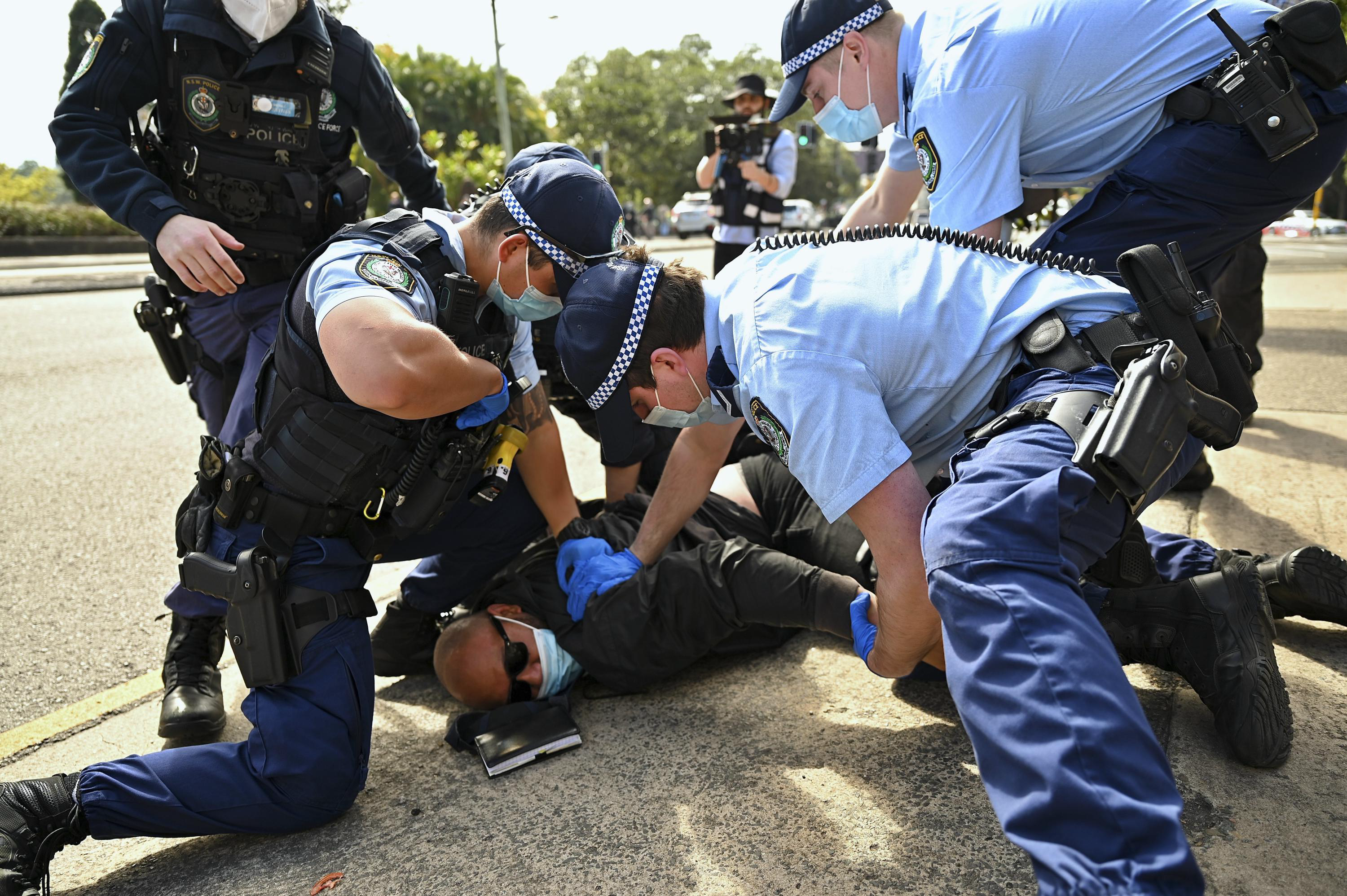
Protesters have renamed South Baldwin Street “Corey Street” by spray painting the original sign near the intersection of Williamson and Baldwin, where a community hub has formed after a Madison police officer shot and killed Corey Ruiz on July 22.
Look in any direction, and the grief is visible: there are messages written in all colors of pens and Sharpies, and spray paint on the ground. Condemnations of the “murderous MPD” are embroidered and painted on quilts. The Crystal Corner has changed out its marquee to read “Corey Ruiz.”
Messages that Ruiz should still be alive are written on the podium of a raised Black fist from George Floyd Square in Minneapolis, and on handmade cards at the growing altar of flowers and candles at the spot where Ruiz was killed.
“This corner is no longer just an intersection. It has become sacred,” said Lature Carter, aunt of Tony Robinson, who was shot and killed by Madison police officer Matt Kenny in 2015 a block and a half away. Carter spoke Sunday at an event organized by Freedom Inc. centering mothers whose children have been killed or harmed by state violence.
“This ground now carries Tony. It carries Corey…. It carries every child whose life ended before their family was ready to say goodbye. And I refuse to believe that they are only remembered for how they died. They laughed. They loved. They had favorite songs. People waited for them to come home. People still love them enough that their name's catching our throats,” she said.
Carter said mothers carry an impossible weight: “I don't think we ask enough of what this does to a mother's heart. To wake up every morning, carrying an absence that never gets lighter. To hear your child's name on the news instead of the next room. To know the world debates their worth while you're just trying to survive another day. No mother should have to live like that.”
At a press conference July 24, Ruiz’s family spoke publicly about the shooting for the first time. His 13-year-old daughter described how her heart broke on hearing the news, and her mother described the reality that their daughter will walk past the spot where her father was killed.
Ruiz’s family was joined by Ben Crump, a civil rights attorney who’s represented the families of George Floyd and Breonna Taylor.
In the press conference, Crump called for justice and charges against the officer who shot Ruiz. He also pressed for a specific form of accountability: body cameras. Madison Police Chief John Patterson has already requested funding for cameras in next year’s budget, as part of a three-year-plan to roll them out. The mayor has in recent days also committed to funding cameras.
Crump’s visit could also be a sign that he is preparing a civil suit against the city. The city paid $2.3 million to the family of Paulie Heenan after Madison police shot and killed Heenan in 2012. A few years later the city paid $3.35 million to the family of Tony Robinson after police shot and killed him in 2015, both within a block or so of where Ruiz was shot and killed. (Another civil case, in the 2024 police custody death of Richard Lee Johnson, is expected to be filed by the end of next year.)
Five days after the shooting some at the intersection are starting to refer to the intersection as CRAZE — the Corey Ruiz Autonomous Zone Encampment.
Volunteers staff tents at checkpoints along four entrances behind layers of barricades: a makeshift spikestrip made of nails, vehicles, collections of furniture and wood scraps (on a piece of plywood, as part of the barricade, is spray-painted: “Firefighters are hotter and have friends.”)
Protestors had been using neighborhood garbage cans, but those were no longer being used as of Tuesday; over the weekend, garbage was picked up by the city. For a few days, the city also provided salt trucks as barricades. There's been a port-a-potty installed. Ald. Davy Mayer says he’s been having a “dialogue with protest organizers to facilitate driveway access to residents and municipal services.”
The CRAZE has also been the base of organizing, with multiple groups coordinating overlapping protests, including a vigil for Ruiz on Thursday, a march to police headquarters on Friday, and a march to State Street on Saturday, where protesters staged a sit-in.
Protesters are all calling for accountability and justice, but their specific proposals for achieving those goals vary, and sometimes overlap. Demands for city officials include: releasing the name of the officer, arresting the officer, putting the officers involved on unpaid leave, providing full cooperation with the city’s independent police monitor, giving the Police Civilian Oversight Board power to discipline officers, rejecting an ordinance to rein in the independent monitor, enacting more recommendations issued in 2019 after a review of police policies and procedures, and defunding of the police.
Achieving these goals would entail changes at all levels of government — the state Legislature, Dane County (specifically the Dane County District Attorney’s Office), the city council. But pressure for change could already be working. On Monday, four alders withdrew their names from proposed amendments related to the independent monitor.
The amendments would have clarified that the independent monitor is subject to city rules and must utilize the city attorney in some instances. One amendment would also have directed the department to adopt a memo of understanding with the police department for sharing data. Instead, the conversation over operational issues will move to restorative justice facilitators recommended by the National Association for Civilian Oversight of Law Enforcement, according to an update from council president Sabrina Madison. NACOLE presented to the council on these questions just last week, one day before Ruiz was killed.
Ruiz’s killing remains under investigation by the Department of Justice’s Division of Criminal Investigation. Patterson, at an at-times chaotic and emotional press conference last Thursday, told protesters and the media that by design he has no access to information from that outside investigation, but pledged to be as transparent as possible. He made one other commitment.
"We're not going to wait for a final report from DCI to begin the work of examining our policies, our training and our response," Patterson said. "The review has to start now, and it can't wait. There is accountability. If this investigation finds that policy, training, judgment failed yesterday, I will say it publicly and we'll fix it."
At that same press conference, city council president Sabrina Madison fielded questions about council-level reforms, including controversial amendments concerning the independent monitor which as of Monday, have been rescinded by alders.
But she opened her remarks from personal experience, saying Ruiz could have been her brother, who like Ruiz, is homeless and often rides a bike. Madison said after seeing the videos, her first thought about the officer walking away was, “Why isn’t he walking away in cuffs? While we know there will be investigations; [Ruiz’s] death is final. My thoughts are with his family who nurtured him, who poured into him.”








.png)



.jpg)

 English (US) ·
  French (CA) ·